Environmental intelligence platform - built for apparel and footwear brands, and their suppliers.
The Open Source
LCA Database for Footwear & Apparel
Over 4800 impact scores across 300+ LCI datasets – including assembly, spinning, dyeing, weaving, and knitting.
The Open Source
LCA Database for Footwear & Apparel
Over 4800 impact scores across 300+ LCI datasets – including assembly, spinning, dyeing, weaving, and knitting.
Fully Disaggregated Dataset
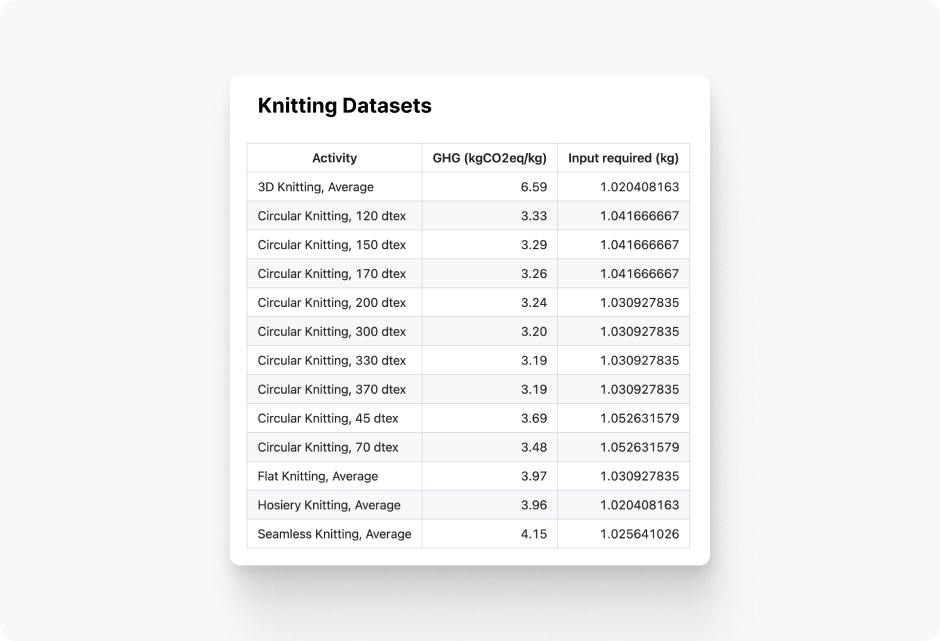
Carbonfact's database disaggregates to the unit process level, differentiating by substrate, fiber group, dye type, process type, and technology. Every parameter is visible, auditable, and replaceable with primary supplier data, so the emission factor reflects what is actually happening in your supply chain, not a category average.
Frequently Asked Questions
What's in the first release?
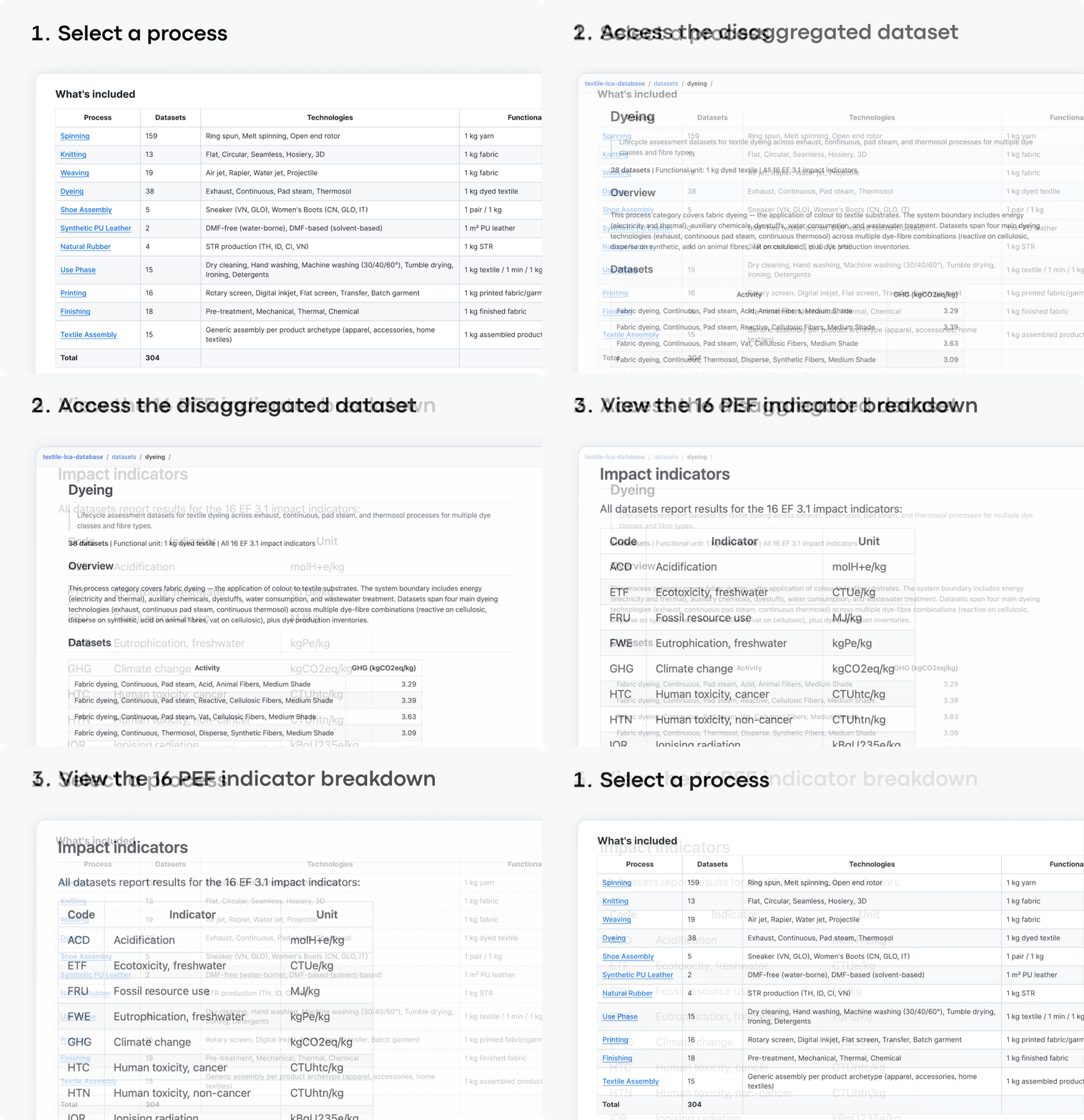
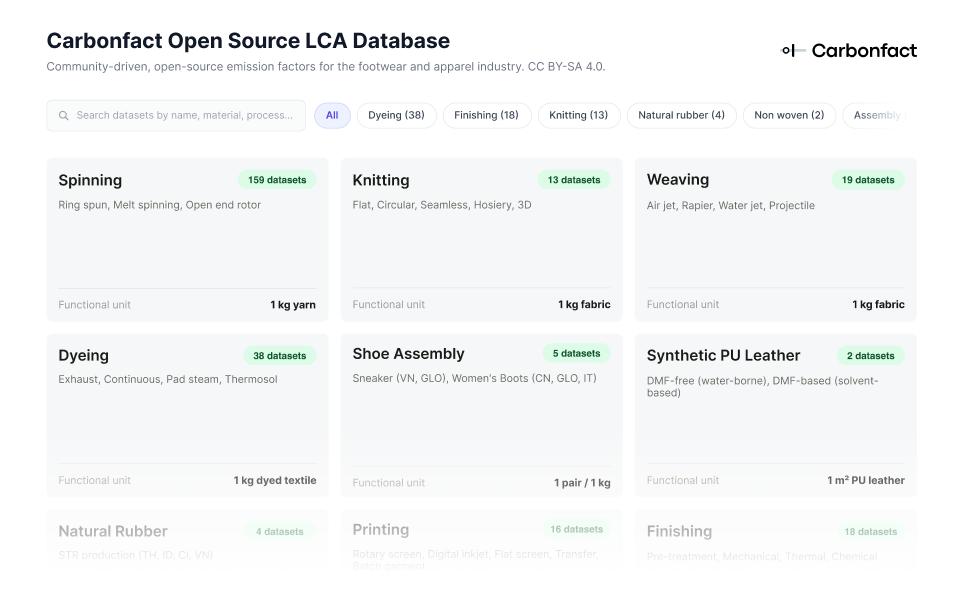
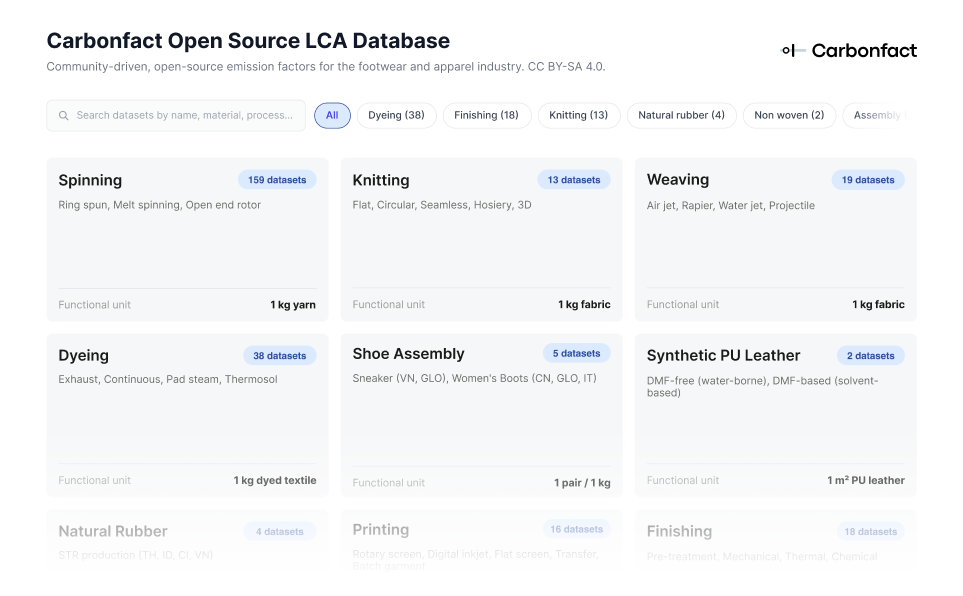
This first release contains 300+ LCI datasets across spinning (159), dyeing (38), weaving (19), finishing (18), printing (16), textile assembly (15), the textile use phase (15), knitting (13), shoe assembly (5), natural rubber (4), and synthetic PU leather (2). Every dataset includes emission factors across all 16 PEFCR environmental indicators, and full methodological documentation.
What does "disaggregated" actually mean here?
Most public LCA databases bundle different process technologies into a single value – one number for all dyeing, regardless of substrate, fiber, dye, or technology. Disaggregation breaks that apart. Every parameter behind every emission factor is exposed: fiber type, dye, process technology, energy and water inputs, chemicals. Practitioners can audit each value, swap in primary supplier data, and update the dataset as supply chains evolve. Two brands dyeing the same fabric on different routes will get different results.
What's the license?
Released under Creative Commons Attribution-ShareAlike 4.0 (CC BY-SA 4.0). Use it, adapt it, integrate it into your own background database, provided you credit Carbonfact and share derivatives under the same license. Suitable for commercial and academic use.
What's coming next?
Subsequent releases will add non-woven fabric formation, viscose, bovine leather, and dyeing and printing chemicals. Carbonfact is in discussion with leading LCA background databases about integration, and is participating in the PEFCR technical secretariat sub-group working on the next generation of EU methodology.
How often will the database be updated?
Updates land as better data becomes available rather than on a fixed cadence. The system supports automated recalculation, so improvements roll out quickly. Expect a higher cadence early on as practitioner feedback comes in.
Does it cover regional variations?
The first release uses a global energy mix. Regional assembly datasets, covering key production regions including Bangladesh, Turkey, Portugal, and Southeast Asia, are planned for a future release.
How was the data built?
Built in-house by Carbonfact's science team. Background data draws on Ecoinvent for energy mixes. Process-specific energy consumption for dyeing, knitting, and similar processes is informed by Apparel Impact Institute facility benchmarks, combined with primary data collected through Carbonfact for Suppliers and peer-reviewed literature. Every dataset is validated against real production processes, with methodology notes that make assumptions and sources visible.
What format does the data come in?
Process inventories are available as .csv files. Each dataset includes emission factors across all 16 PEFCR environmental indicators. EcoSpold support for OpenLCA and SimaPro is being explored for a future release as well as compatability with Brightway.