

Environmental intelligence platform - built for apparel and footwear brands, and their suppliers.
Built for apparel and footwear
Data work, automated.
Spend less time on admin with Carbonfact’s smart data engine.

dtex: 147
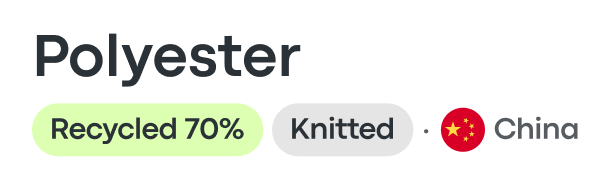
Variant: White

Thermofixing finishing
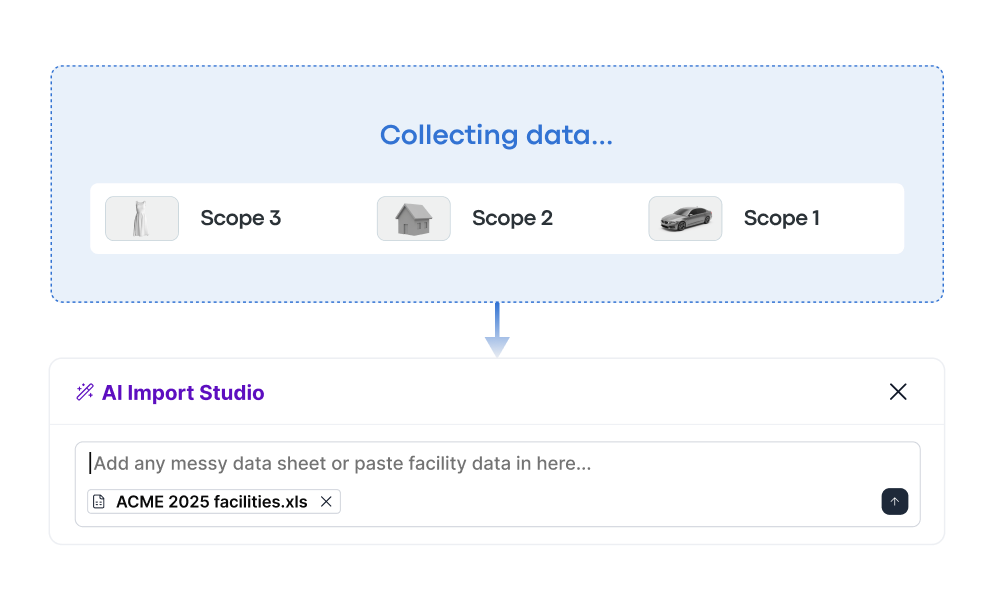
Import All Your Data With Ease
Don’t get stuck filling templates, Carbonfact does the work for you.
Corporate data
Drop any file and let our engine clean, map, and validate your data.
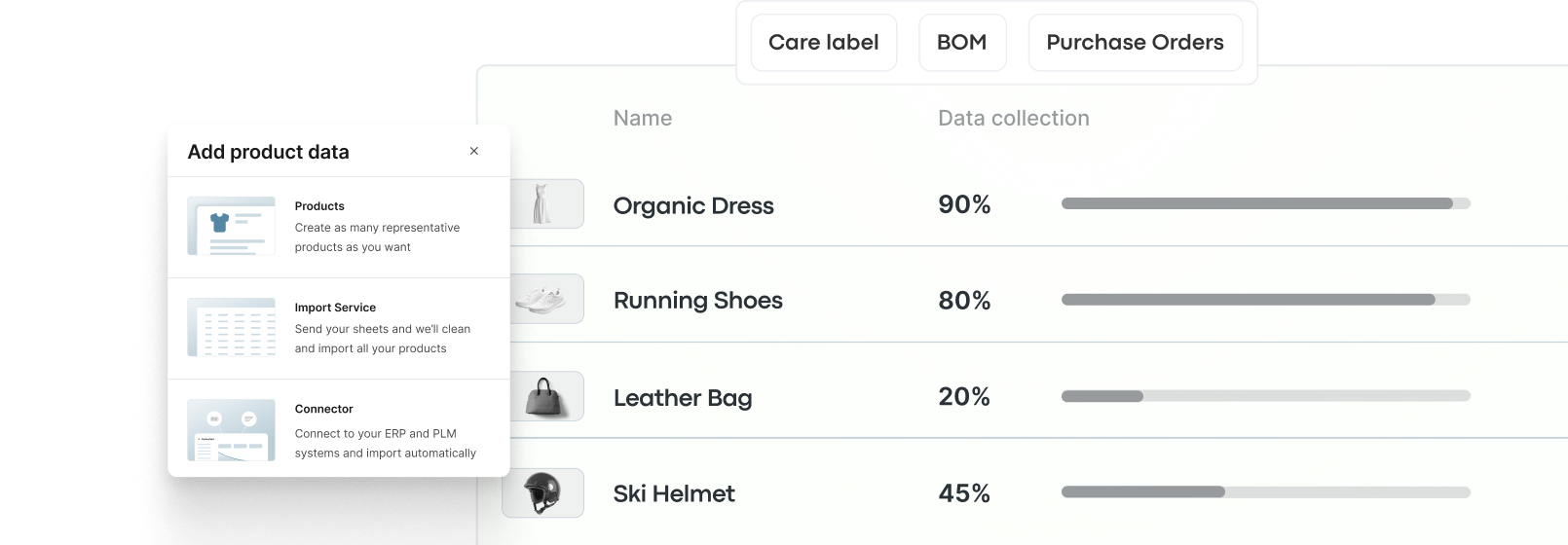
Product data
Add representative products or let us import all of your products.
Integrations
Carbonfact connects to all tools, saving hours on manual processes.
From Messy Files to Usable Data
Drop your files; our smart data engine and data expert handle the cleanup.
Normalization and mapping
We normalize weights, spellings, materials, and map everything to the Carbonfact taxonomy — automatically.
![Image [aa-initial]-4](https://26616759.fs1.hubspotusercontent-eu1.net/hubfs/26616759/Image%20%5Baa-initial%5D-4.png)
Anormality detection
Errors are flagged instantly. Link materials, fix categories, or create rules without going back to your spreadsheets.
![Image [aa-initial]-Jan-05-2026-12-19-29-6357-PM](https://26616759.fs1.hubspotusercontent-eu1.net/hubfs/26616759/Image%20%5Baa-initial%5D-Jan-05-2026-12-19-29-6357-PM.png)
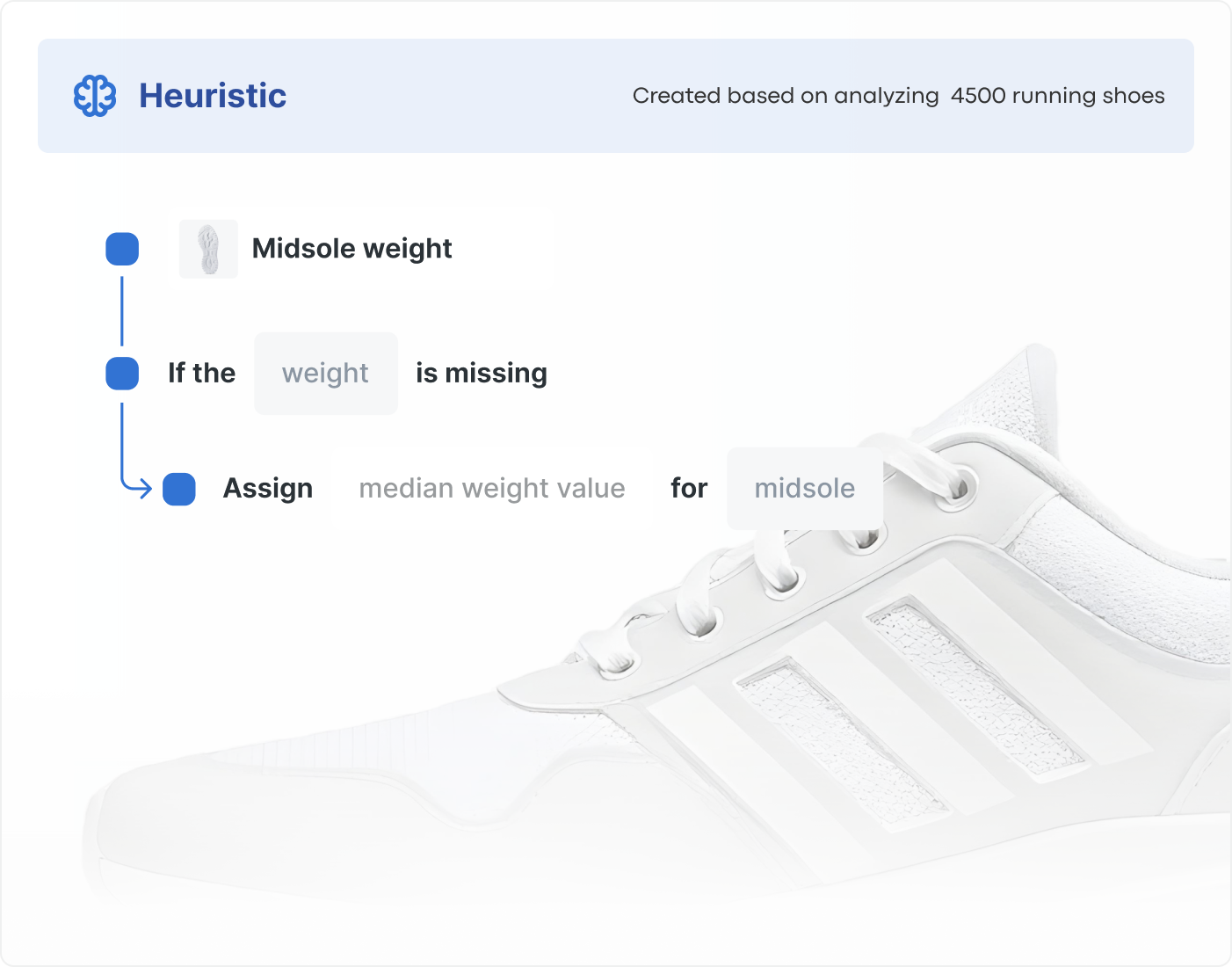
Heuristics
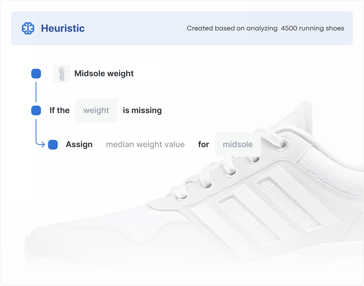
We use the patterns in our dataset of more than 50m LCAs to build smart heuristics that reliably fill gaps when data is missing. By analyzing thousands of similar products, we establish data-backed expectations for weights, materials, and product parameters – and cross-check your data against them. This lets us fill gaps and verify accuracy without relying on manual supplier checks.
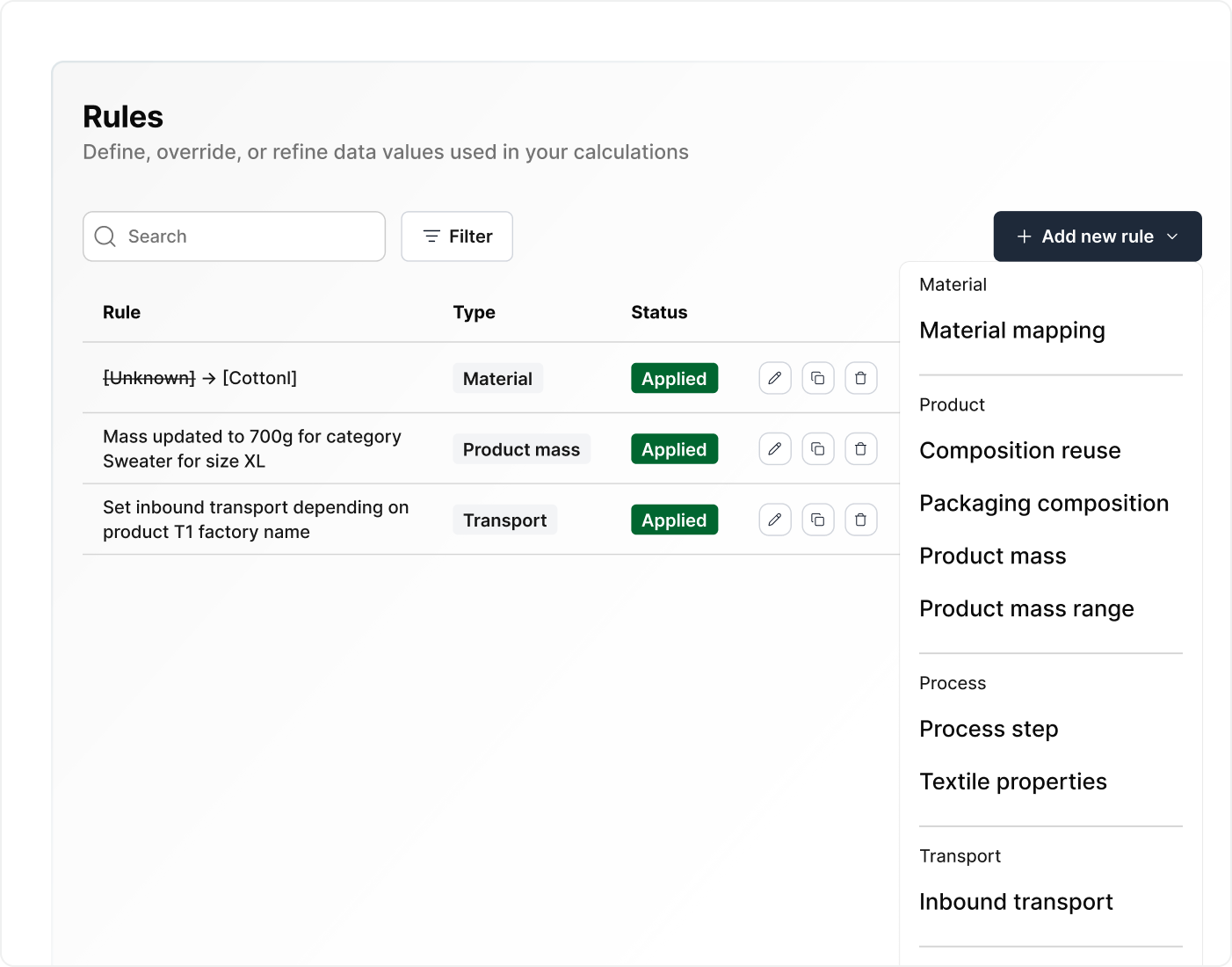
Rules
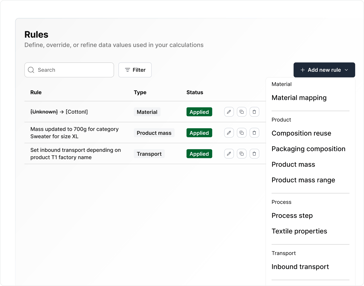
Your PLM doesn’t hold all your data. With Carbonfact, you can capture that undocumented knowledge and turn it into automated rules that clean and enrich your data, from renaming materials to correcting transport modes or recording a specific supplier’s process step.
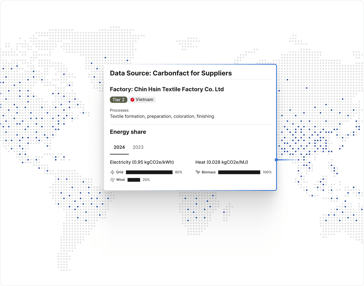
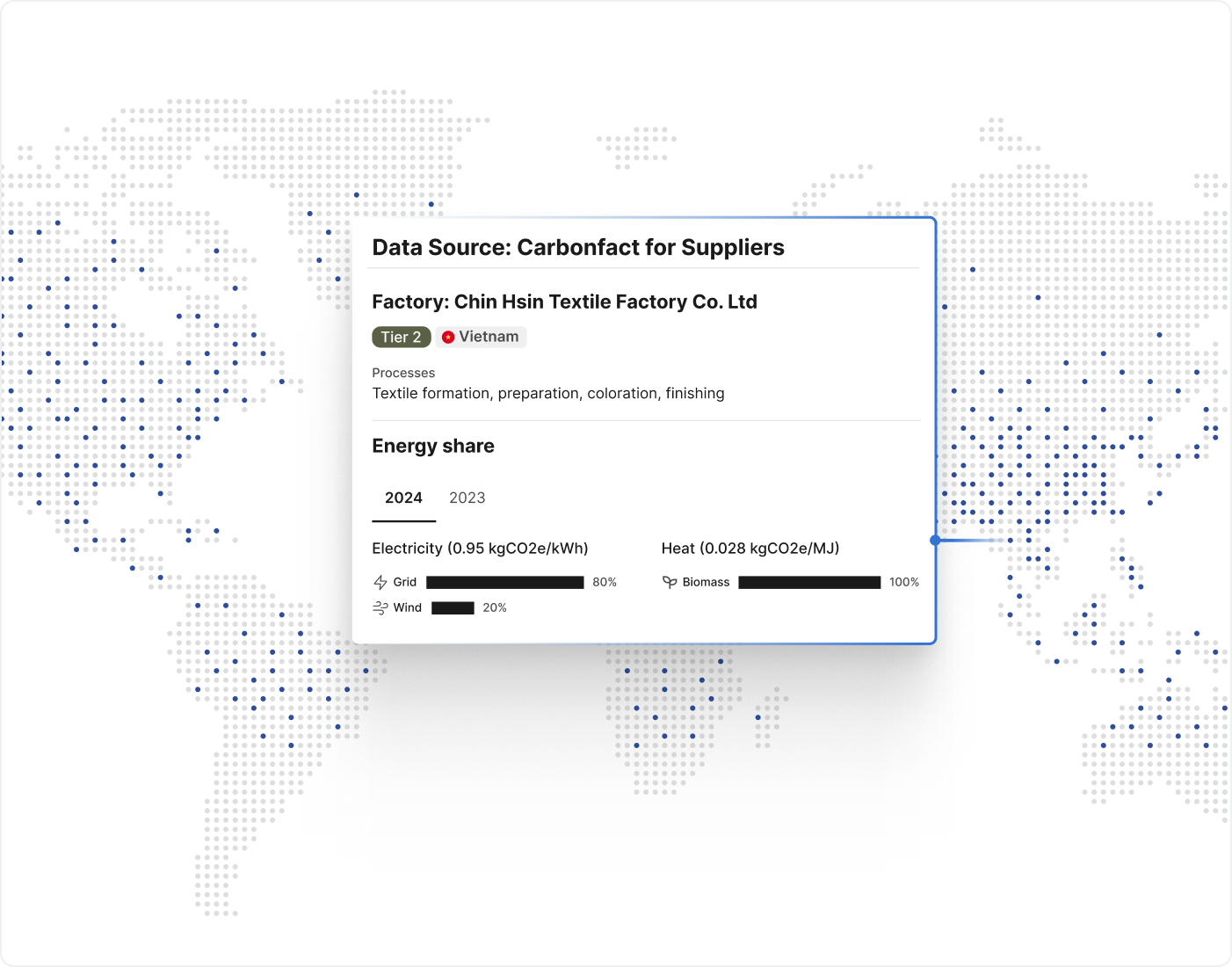
Data Exchange Network
Suppliers share primary data straight into Carbonfact, no chasing, no follow-ups. And you don’t collect the same data twice: tap into verified emissions data from 7000+ factories and 50+ material and process factors, shared across brands and Carbonfact.
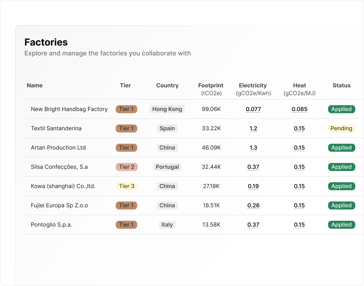
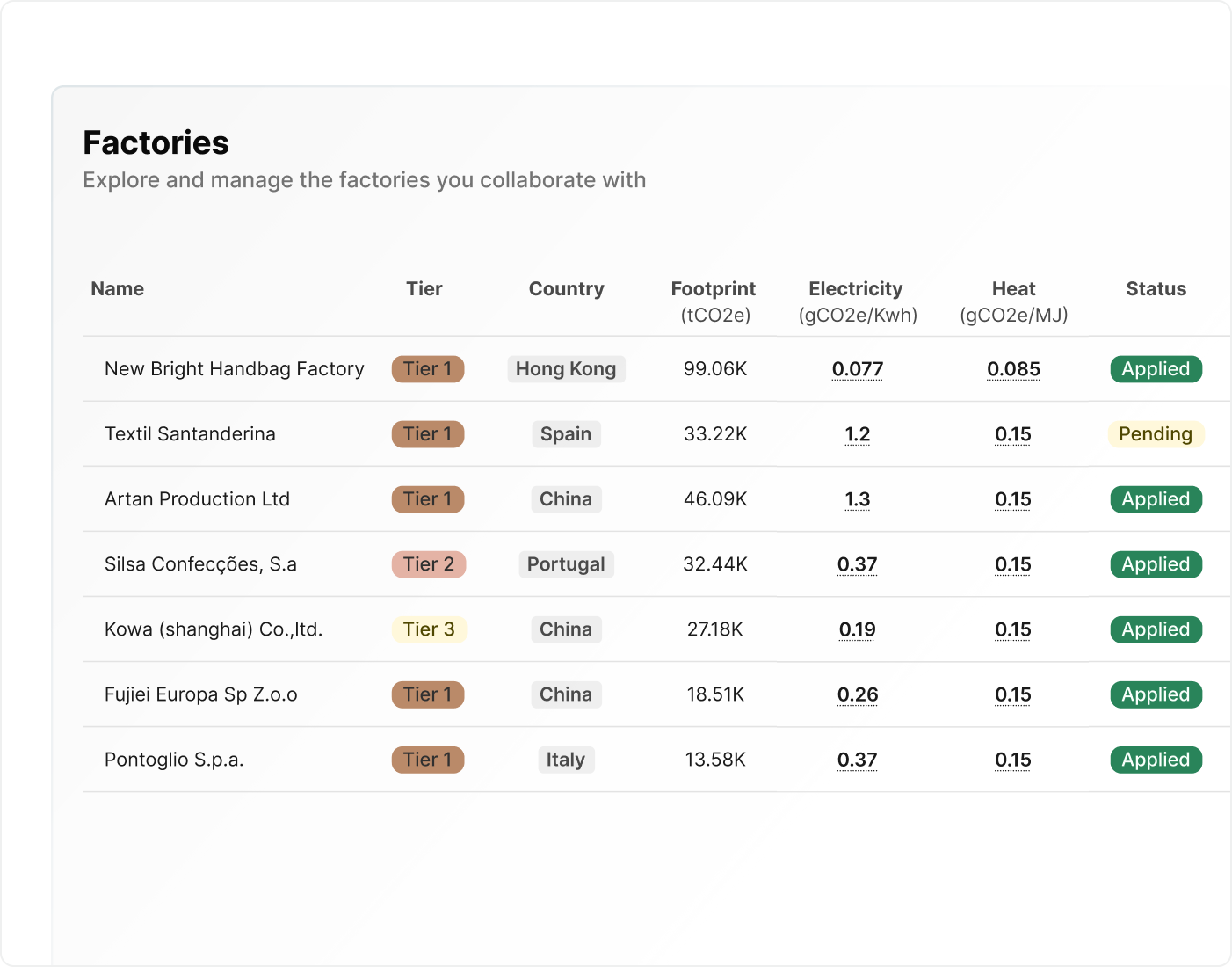
Factories
Carbonfact consolidates all factory-level information - energy mixes, processes, certificates, and more. When factories update their data, those updates flow directly into your LCAs, keeping everything accurate without manual effort.
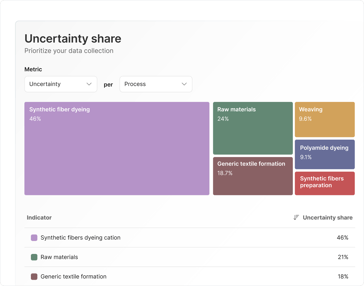
Data prioritization
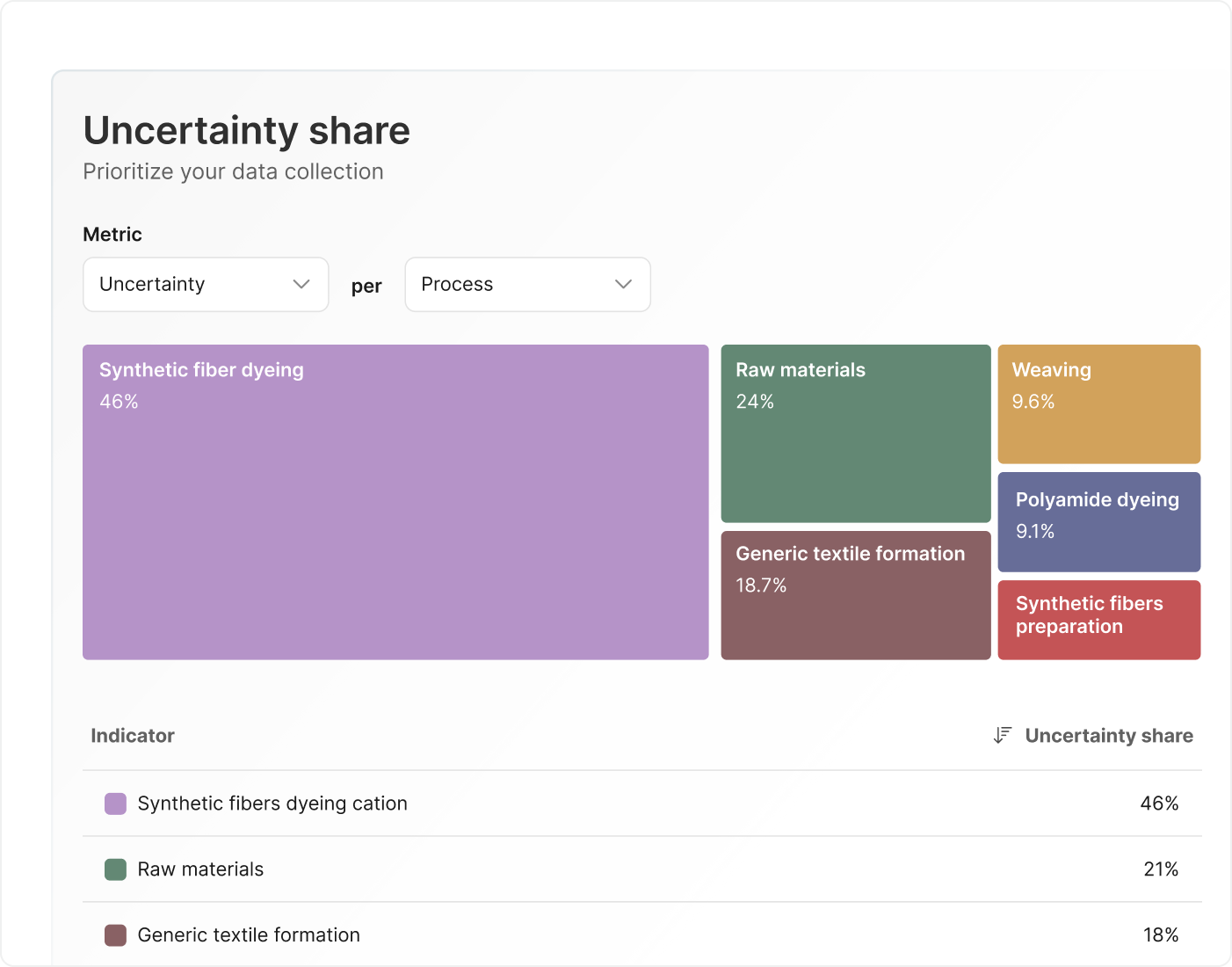
Carbonfact helps you focus your data collection where it matters most. Each process and product comes with an uncertainty range that shows how wide its potential environmental impact could be. A high uncertainty share means the result relies heavily on estimates rather than primary data, highlighting exactly where better data collection will have the biggest impact on improving your footprint accuracy.
The Most Comprehensive Industry-Specific Emission Factor Database
Through our work with 200+ apparel and footwear brands and their suppliers, we’ve built a proprietary, fashion-specific dataset, complemented by best-in-class secondary data sources.

150,000+
Fashion-specific emission factors

50+
patented materials & processes

7000+
factories, shared between brands & suppliers

200+
Textile-specific processes covered

7,500+
Bespoke emission factors created for clients

650+
Material categories across 144 countries

Carbonfact proprietary database
BEIS
DERA
EPA
BASElmpact
Ecobalyse
EF 3.1
GLEC Framework datasets
DESNZ
Exiobase
IPCC
IEA
Ecoinvent
Agribalyse
Security and Compliance
Built to meet the highest standards — so you’re always audit-ready.
GHG protocol
Carbon Accounting aligned with the leading standard.

EU PEFCR
Meets EU standards for product-level disclosure.

SOC 2 certified
Enterprise data security, availability & confidentiality.

ISO 14040-44
Methodology independently reviewed by PwC.
A Platform to Evolve With
From carbon accounting to compliance to decarbonization — all in one place
Carbon Accounting
Switch from consultants to fully transparent, fashion-specific carbon accounting.
Decarbonization
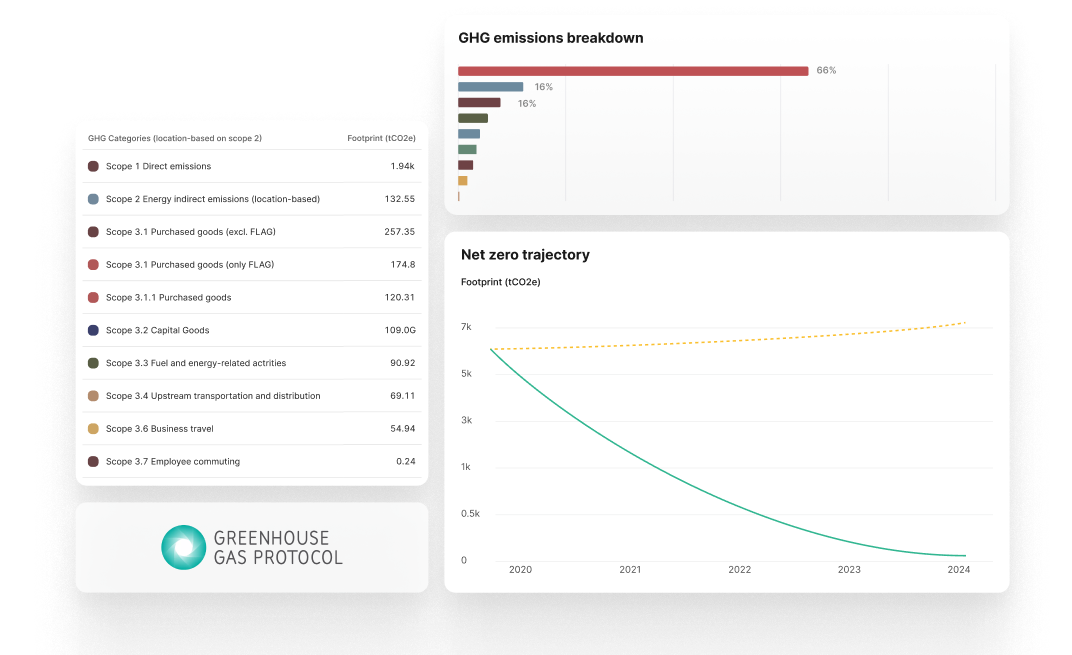
Model product and company-wide reduction scenarios using your real data.
Reporting
Simplify compliance with automated, audit-ready reports.
Product LCAs
LCAs across your full catalogue – powered by primary data.
Data Management
Connect your systems – we’ll clean, map, and enrich your data.
What Our Customers Say

Carbonfact gives me precise carbon measurements that reflect my products - not generic industry averages. They provide bespoke emission factors that reflect the unique materials, suppliers, and processes we actually use, making it easy to simulate changes and see the impact of our sourcing decisions."
Lisa Schmidt
Sustainability Manager at SNOCKS


"With Carbonfact, we finally found a partner that ideally complements our new carbon strategy. The ability to break down carbon data down to product level finally gives us insight into the biggest levers for carbon reduction along the entire product life cycle. With the modelling function of possible scenarios, we hope to integrate carbon reduction measures into product development. This will be an important step towards achieving our carbon targets."
Philipp Schumacher
Corporate Social Responsibility Manager at Fondof


“With the help of Carbonfact's production scenario simulator, we were able to assess the environmental impact of our supply chain and make an informed decision to move part of our manufacturing from China to Vietnam. This change has resulted in a 12% reduction in the carbon footprint of our upcoming January 2024 spring collection. “
Nicolas Gand
VP Production at Adore Me


“We have quite a lot of partners that want to distinguish themselves and they have their own bespoke LCAs and then Carbonfact is doing a great job connecting with them directly. Then Carbonfact’s team sits down and works through the LCAs and matches them to the methodology Carbonfact is using in order to integrate data into the platform.”
Julia Kirschner
ARMEDANGELS


“With Carbonfact we can go deeper and do full product LCAs on all of our products. Thanks to being able to measure things early on, it allows us to simulate how a new product is going to have a different impact compared to the current version. For example, one of the new products that we are looking into is expected to decrease its carbon footprint by a fourth just by designing it differently.”
Jessica Genta
Strategy & Sustainability at La Sportiva


We have moved from spend-based carbon accounting into Carbonfact to prioritise primary data and get more accurate calculations. The main reason for us to choose Carbonfact is that we now not only get our company's total carbon footprint but also break it down for each of our products. Thanks to Carbonfact’s focus on the apparel industry we get life cycle assessments with industry-specific data for all our products in an easy way. Which helps us make the right decisions and reach our goal of reducing our emissions by 50% before 2030.”
Malin Bosaeus
Global Sustainability Manager at Happy Socks


“Shoes can consist of up to 1500 components, made from different materials and of different weights. In the beginning, we asked our developers to cut shoes and weigh every single piece but if you want to measure the carbon footprint of your whole portfolio, such a manual approach is not scalable. Carbonfact has helped us a lot in deriving rules on how to overcome data gaps by creating accurate assumptions.”
Philipp Engels
Product Sustainability Lead at On


“The Explorer is, for sure, my favorite feature. I love the ability to look at our product line on a material basis or at the subcategory level. That's so dynamic that we're able to kind of leverage it in different ways depending on the projects that we're working on or the teams that we're engaging with.”
Emily Foster
Director of Planet & People Impact at Burton


“What's really special about Carbonfact is the way that it can work alongside the brands to help identify where there are gaps in our product impact data. But also helping us bridge towards improving that data. So it's much more of a partner to solve the challenges we have, whilst also recognizing that we can, in the interim, fill those gaps where we need to in a way that can scale. That really helped, particularly working in a brand like VF where we've got so many different brands with so many different systems who are all at different points of maturity.”
Julian Ling
VFC Outdoor

Environmental Sustainability Software
