



Environmental intelligence platform - built for apparel and footwear brands, and their suppliers.


On January 30, 2026, the Greenhouse Gas Protocol will publish its first Land Sector and Removals (LSR) Standard, establishing the definitive global rules for how companies must account for land-based emissions and removals – including those from cotton, wool, leather, forestry, and other agriculture-linked commodities. An accompanying LSR Guidance document with calculation methods and examples will follow in Q2 2026.
FYI: Throughout this article, you’ll see us reference both the Greenhouse Gas Protocol (GHG Protocol) and the Science Based Targets initiative (SBTi). These two bodies work closely together to ensure alignment in the accounting and target-setting for FLAG emissions. FLAG emissions, as defined by the SBTi, represent a subset of GHG Scope 3 emissions, focusing specifically on land-based emissions sources. For more on the GHG Protocol, read our Carbon Accounting for Fashion Guide.
FLAG emissions in a fashion and apparel company's Scope 3 category, specifically from Purchased Goods & Services, largely originate from the production of natural fibers like cotton, leather, and wool. In fact, for some apparel brands, wool alone can account for up to 50% of their total carbon emissions. That’s why accurately measuring and setting reduction targets from land-based CO2 emissions is essential for fashion brands to lower their climate impact.
The Science Based Targets initiative's (SBTi) FLAG guidance is a new framework that requires companies to measure and set precise reduction targets for their FLAG-related emissions in addition to their energy/industry SBT. For apparel and footwear brands, following this guidance can provide greater visibility into your emissions down to the farm level. In addition to reducing land-based emissions, following the SBTi FLAG guidance enables companies to identify opportunities to restore important carbon sinks such as forests, oceans, and peatlands.

SBTi is a corporate climate action organization that helps companies set emissions-reduction targets grounded in climate science, driving climate action towards the goals of the Paris Agreement. The organization has developed a series of standards, tools, and guidance mechanisms, but until recently, their work only covered energy and industry-related GHG emissions. Enter FLAG, expanding the scope from energy-and-industry only.
There are five key requirements of the SBTi FLAG Guidance:
Set Near-Term FLAG Science-Based Targets: Establish 5-10 year emission reduction targets aligned with the goal of limiting global warming to 1.5°C.
Account for Removals in Near-Term Targets: Include biogenic CO2 removals, such as restoring natural ecosystems, improving forest management, implementing silvopasture, and enhancing soil carbon sequestration
Set Long-Term FLAG Science-Based Targets: For companies significantly involved in land and agriculture, long-term targets must reduce emissions by at least 72% by 2050, following the SBTi Net-Zero Standard.
Zero Deforestation by 2025: Companies must commit to zero deforestation by 2025, in line with the Accountability Framework initiative (AFi).
Set Science-Based Targets for Fossil Emissions: In addition to FLAG targets, companies must also establish energy/science-based targets for fossil fuel-related emissions.
The new FLAG guidance enlarges the scope of their work, enabling fashion and textile brands to include FLAG emissions. As you’ll soon see it’s extremely comprehensive, and at times complex. It demands a lot of data – especially from suppliers – but we’ll take it piece by piece and delve into how your brand can utilize this guidance.
There are three critical emissions-related categories covered under the FLAG guidance that will define how data is collected and later reported upon.
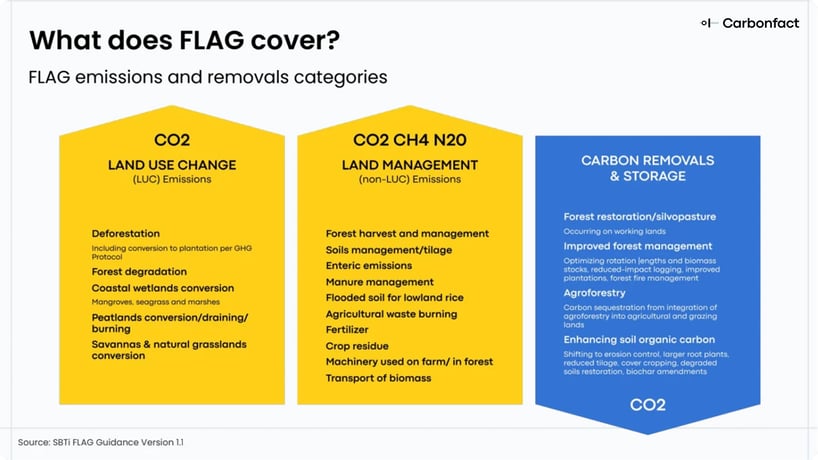
These include:
Land Use Change (LUC) related emissions: encompasses the greenhouse gases emitted when natural landscapes are altered for agricultural purposes.
Example: CO2eq emitted by converting 1 m² of forest (high carbon absorption) to 1 m² of cotton field (low carbon absorption)
This category highlights the environmental impact of transforming natural ecosystems – whether that’s deforestation, forest degradation, or wetland conversion – into agricultural land. The amount of time that has passed since the land was transformed for agricultural purposes will impact the emissions count, which will be discounted linearly over 20 years.
Land Management (LM) related emissions: addresses the greenhouse gases generated from ongoing agricultural practices and land management during the raw material stage. This includes emissions from activities such as burning agricultural waste, using fertilizers to grow cotton, using farm machinery, and managing manure.
Example: direct N2O (Nitrogen dioxide) emissions from soil due to fertilizer application or methane (CH4) emissions from sheep farming
Tip: fossil-based emissions from machinery (e.g., tractors) and energy emissions embedded in fertilizer are not technically "land-based emissions." However, you can choose to include them in your FLAG emissions accounting. Alternatively, they may be included in an energy/industry target, but pay attention not to double-count them across FLAG and energy/industry targets.
Carbon removal and storage: focuses on capturing and storing CO2 through sustainable land management practices. This includes activities such as soil carbon capture on farm and pasture, agroforestry, and conservation reserves. In the FLAG targets, removals must be reported separately from emissions, and they can’t be used to offset against the energy/industry-related targets. Fashion companies can also not use purchased carbon credits to meet their near-term FLAG or energy/industry targets. The removal must occur on land owned or operated by a supplier or within the fashion brand’s supply chain.
SBTi reporting is not currently mandatory from a regulatory standpoint. However, it does serve as a strong framework for reducing carbon emissions. Companies submitting new SBTi targets or doing their rebaselining must already submit FLAG SBTs today, using the GHG Protocol FLAG draft guidelines.
If your business has already set SBTs, then you will be required to set a FLAG SBT if 20% or more of your Scope 1, 2, and 3 emissions are derived from FLAG sources. In other words, a large percentage of apparel and footwear brands.
The SBTi recommends that companies with FLAG-related emissions that fall below the 20% threshold nonetheless set a FLAG target. If a company chooses not to set a FLAG target, FLAG-related emissions still must be included in the overall energy/industry (non-FLAG) target boundary.
Small and medium enterprises (SMEs) are exempt if they meet two or more of the following criteria:
Many apparel and footwear brands will find that 20% of their emissions are derived from land-based uses. If you use naturally sourced materials such as wool, viscose, rayon, cotton, or leather, there’s a good chance your company falls in this category.
Below are some anonymous examples from our customers using wool:
In order to assess your own percentage, you’ll first need detailed insights into your value chain. If you’re already measuring your environmental impact for legislation such as the Corporate Sustainability Reporting Directive, you will already be collecting much of this data. If not, utilizing a sustainability platform to measure product emissions – such as Carbonfact – will provide deep insights into your textile supply chain.
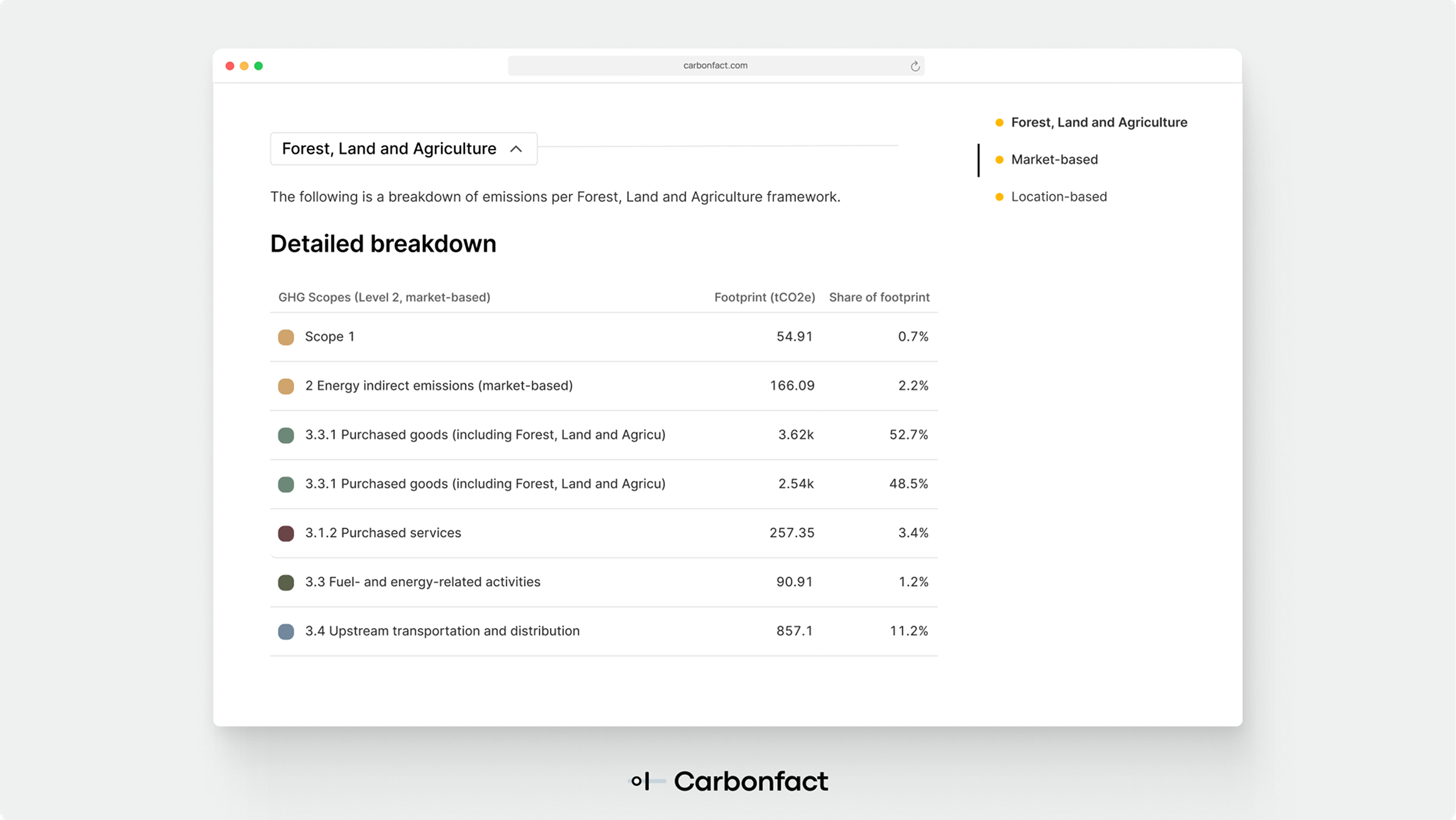
Carbonfact's SBTi FLAG tool: Instantly know if you are above the 20% threshold and need to submit the target
Without the use of Carbonfact, your approach would likely be:
GHG Protocol Land Sector and Removals (LSR) Standard will be published on January 30, 2026, with accompanying Guidance released in Q2 2026. Until then, companies must continue using the draft LSR Guidance for FLAG accounting and target-setting.
Under the current SBTi FLAG guidance, brands with existing validated science-based targets are required to submit a FLAG target within six months of the final publication of the GHG Protocol Land Sector and Removals (LSR) Guidance.
However, in 2025, SBTi published an Urgent Revision of SBTi FLAG Guidance v1.1 proposal that would change how FLAG target timing is applied. If adopted, the revision would remove the fixed six-month deadline and instead link FLAG target submission to a company’s SBTi target lifecycle:
New or updated SBT submissions: Companies meeting the FLAG criteria must include a FLAG target at the time of submission.
Existing validated SBTs (without FLAG): FLAG targets must be added no later than the mandatory five-year SBTi review.
Below the 20% threshold: FLAG targets are recommended but not mandatory.
Regardless of target-setting requirements, all companies must include FLAG-related emissions in their GHG inventories since the introduction of SBTi FLAG in 2023.
No-Deforestation Commitment: Companies setting FLAG targets must make a public no-deforestation commitment covering their primary deforestation-linked commodities, with a target date no later than December 31, 2025.
Note: SBTi has published a proposed revision to the FLAG Guidance that would update how the no-deforestation deadline is applied. Under the proposal, companies setting a FLAG target for the first time would have up to two years after FLAG target validation to eliminate deforestation, with an absolute deadline of December 31, 2030. This revision has not yet been formally adopted.
Calculate your FLAG inventory: Before setting FLAG targets, you should first calculate your corporate FLAG GHG inventory according to the GHG FLAG guidelines. As mentioned above, you need to account for FLAG and industry/energy-related emissions separately.
Rebaseline: To incorporate FLAG into your established science-based targets, you will need to rebaseline and recalculate your existing emissions. Find our guidance on rebaselining for apparel and footwear brands here.
Separate Land-Based GHG Emissions: Distinguish between energy and industrial emissions versus land-based emissions.
Set a New Baseline: Select a baseline year where accurate and detailed FLAG data is accessible.
Evaluate Your Current Target: Confirm that your existing target aligns with FLAG requirements, which are 95% for Scope 1 and Scope 2 emissions, and 67% for Scope 3 emissions.
Establish a New Target: One that is compliant with the FLAG guidelines.
Example of a FLAG target:
Near-term target: Reduce Scope 1 and 3 FLAG GHG emissions by 33% over 7 years starting at your base year. No deforestation across our deforestation-linked commodities, with a target date of 2025.
Long-term target: Reduce Scope 1 and 3 FLAG GHG emissions by 72% from the base year to 2050
For fashion brands setting FLAG targets, it’s important to adhere to the data-quality guidelines from the GHG Protocol's Land Sector and Removals Guidance.
To calculate land use change (LUC) emissions, textile companies should use the most accurate and representative data available – whether from their own operations, suppliers or established emission factors. For FLAG scope 3 emissions, companies should collect high-quality data from suppliers and value chain partners. If emission factors are used, they should be representative of the commodity and region, and any uncertainty associated with default data should be disclosed.
Companies should use granular, representative data for FLAG-related emissions, disaggregating emissions by commodity and region, and separating land use change emissions from land management emissions. CO2 and non-CO2 emissions from land management should also be reported separately.
Land removals should rely on primary data to be included in a FLAG target.
Carbonfact is built to collect and make sense of large datasets and to give your company practical, auditable climate reporting tools. FLAG guidance is data-intensive — and meeting it requires deep supplier data, careful LCA work, and robust reporting. Here’s how Carbonfact helps brands implement FLAG-aligned measurement and reporting.
1. Source & consolidate the right data.
Calculating a FLAG inventory starts with granular inputs. For example, when assessing deforestation we look at project location, duration, vegetation type, and the final land use after conversion — all of which feed into a land-use change CO₂ metric. Carbonfact helps you consolidate purchase-order and supplier data and fill missing values so you can produce representative FLAG estimates.
2. Extract FLAG-relevant LCA emissions.
FLAG calculations rely heavily on product-level LCA. For a wool sweater, for instance, you must extract agricultural emissions (fertiliser use, manure) and related upstream inputs (fertiliser production). Carbonfact links product bill-of-materials with emission factors and LCA outputs so the FLAG portion can be isolated at the product level.
Watch this short demo by our Head of Science:
3. FLAG reporting aligned with GHG Protocol.
You can report FLAG emissions separately according to the GHG Protocol guidance referenced by SBTi. Carbonfact’s output is structured to support FLAG-specific disclosures and SBTi submissions, ensuring your reporting aligns with current guidance.
4. Track FLAG emissions over time.
Carbonfact’s Trends view includes FLAG emissions tracking, letting you monitor whether FLAG emissions are increasing or decreasing and assess progress against reduction targets and no-deforestation commitments.


Environmental intelligence platform - built for apparel and footwear brands, and their suppliers.