

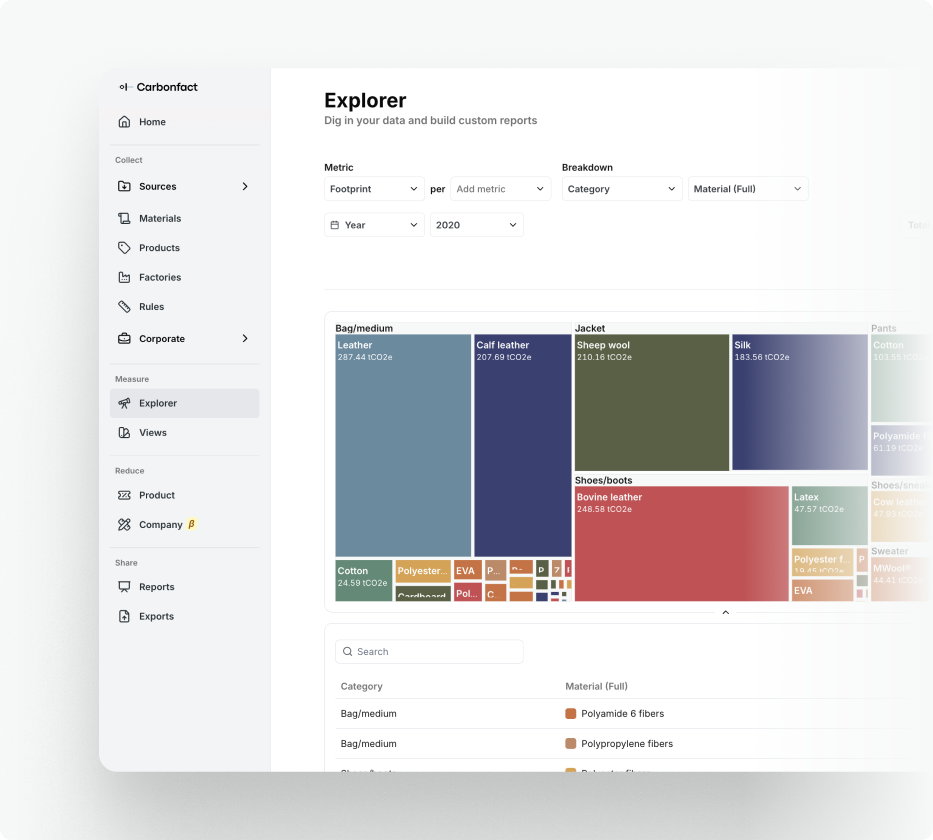

Environmental intelligence platform - built for apparel and footwear brands, and their suppliers.
Copilot: Your AI Data Analyst, on Demand
Copilot turns your environmental data into intelligence: answers, graphs, and the methodology behind every number.
CHOSEN by 300+ BRANDS and SUPPLIERS
Answers in Seconds, Not Weeks
What took a week of consultant work now takes one prompt.
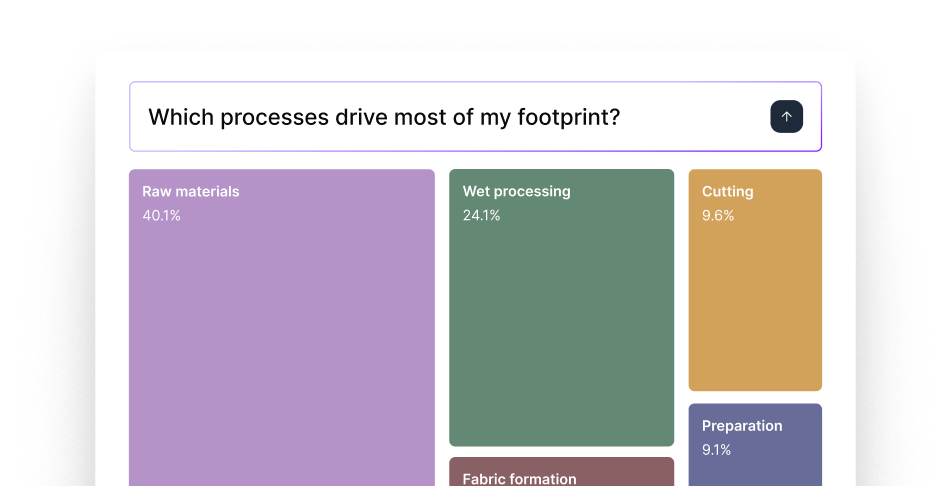
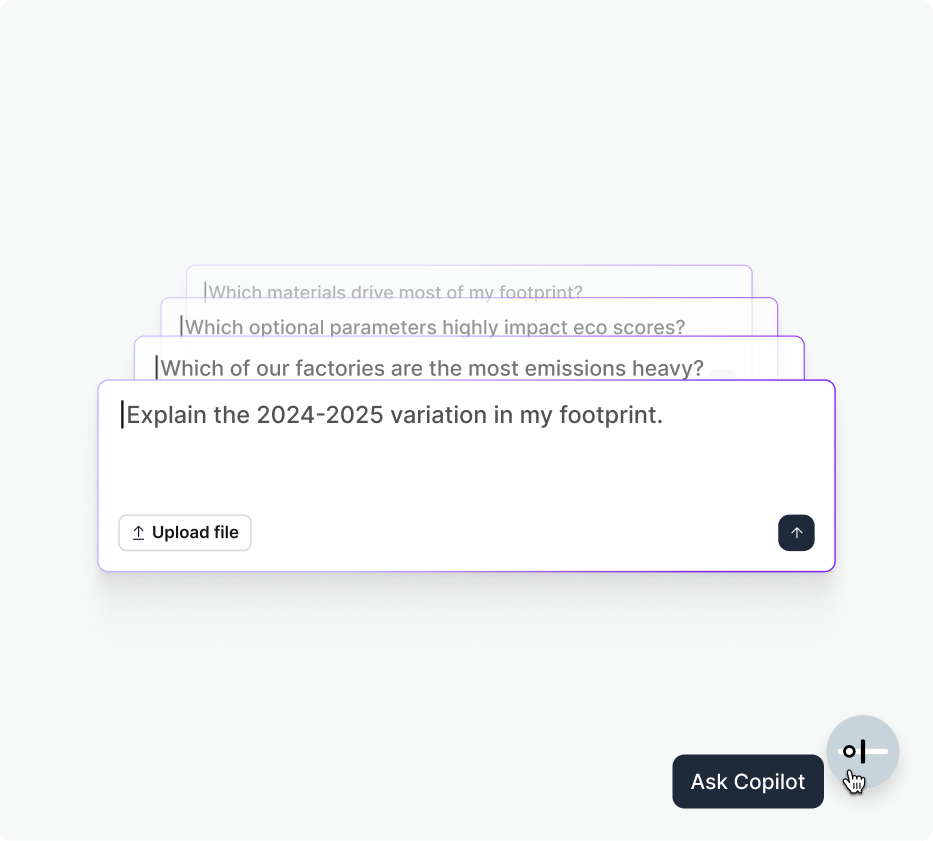
Ask your data anything
Type a question about your footprint and get the answer back, with a ready-made dashboards built alongside it.
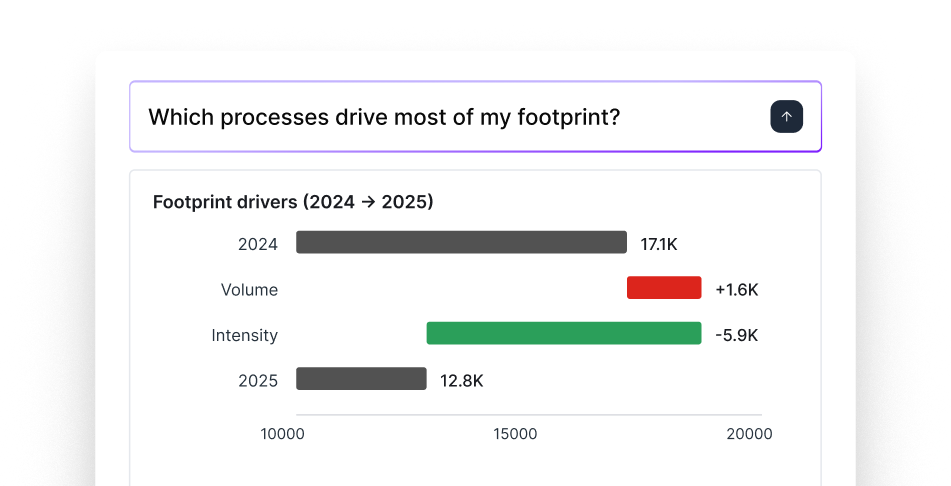
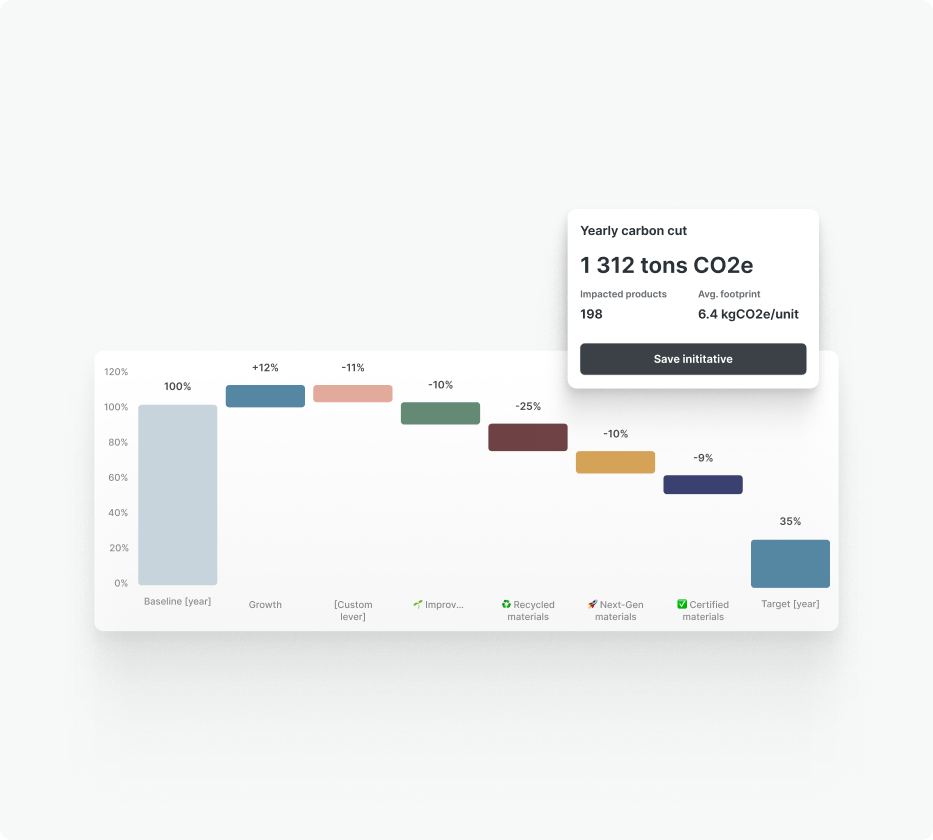
Decomposition analysis, without the analyst
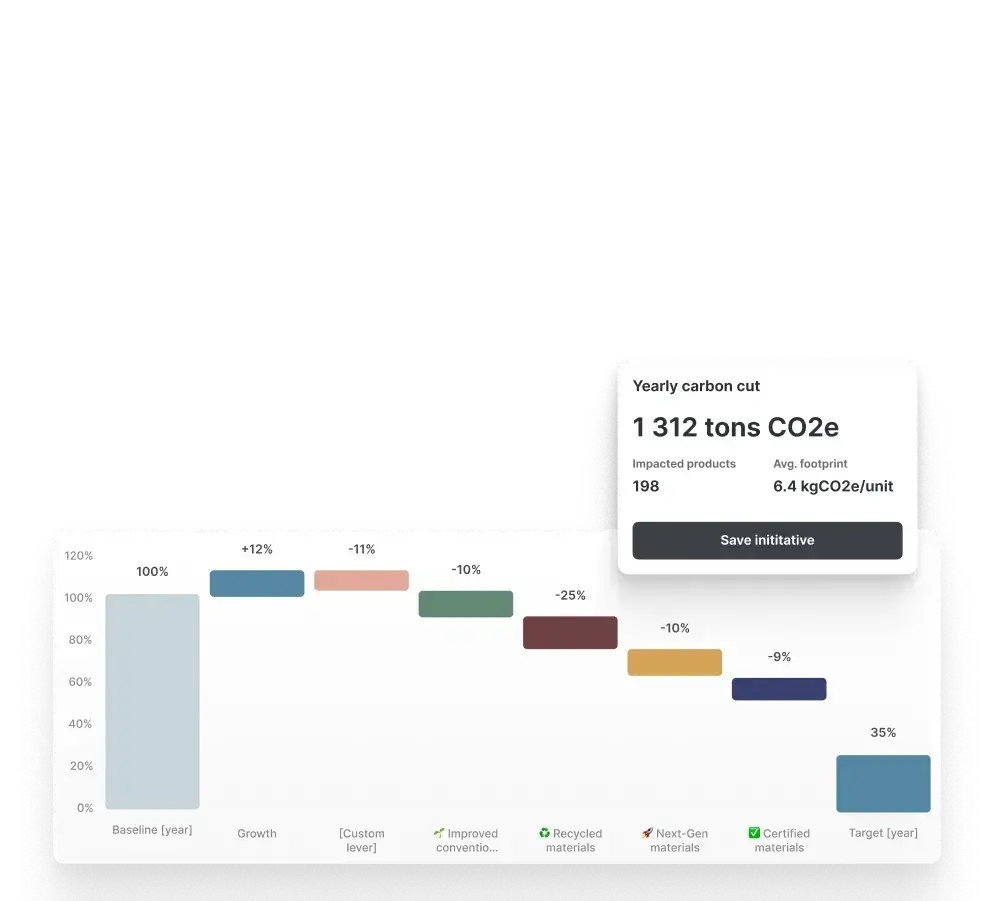
Break any number into a full waterfall chart that separates volume drivers from intensity drivers, in seconds rather than days.
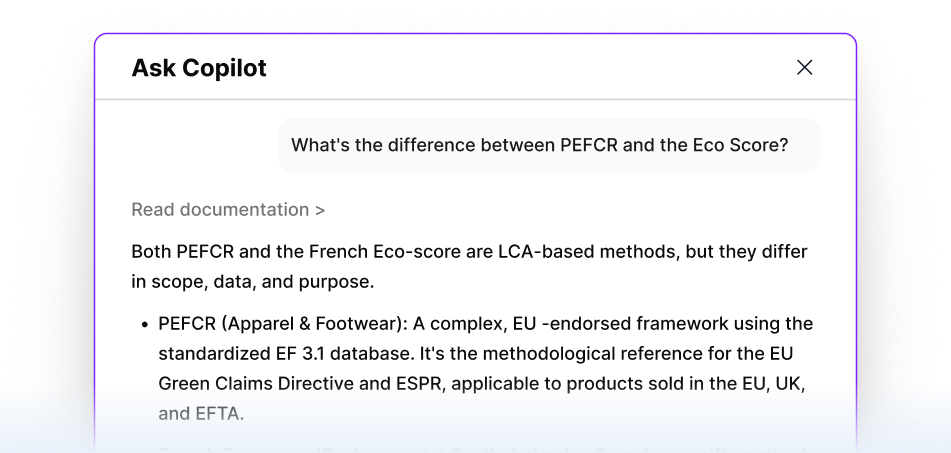
Simplify complex methodology
Get easy-to-understand explanations of the methodology and regulations behind each number.
Compliance on demand
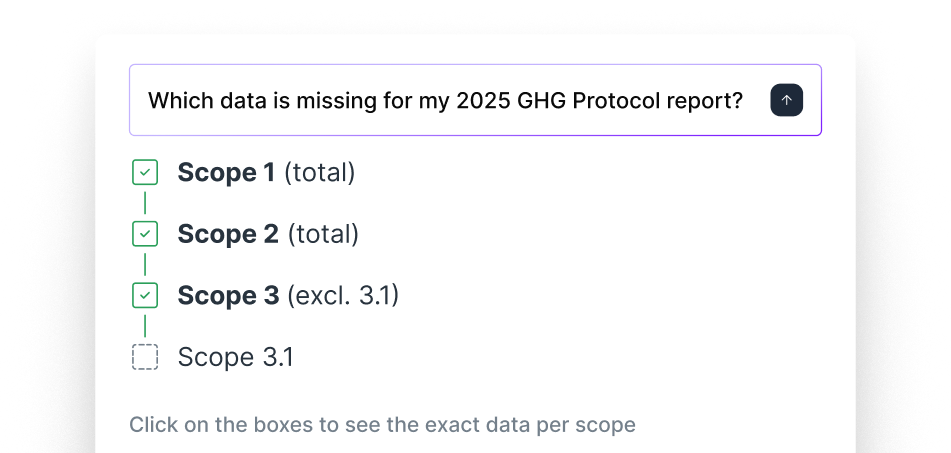
See exactly which data is missing for your next reports, and prioritize what to collect first.
Security and Compliance
Audit-ready numbers you can trust and communicate.

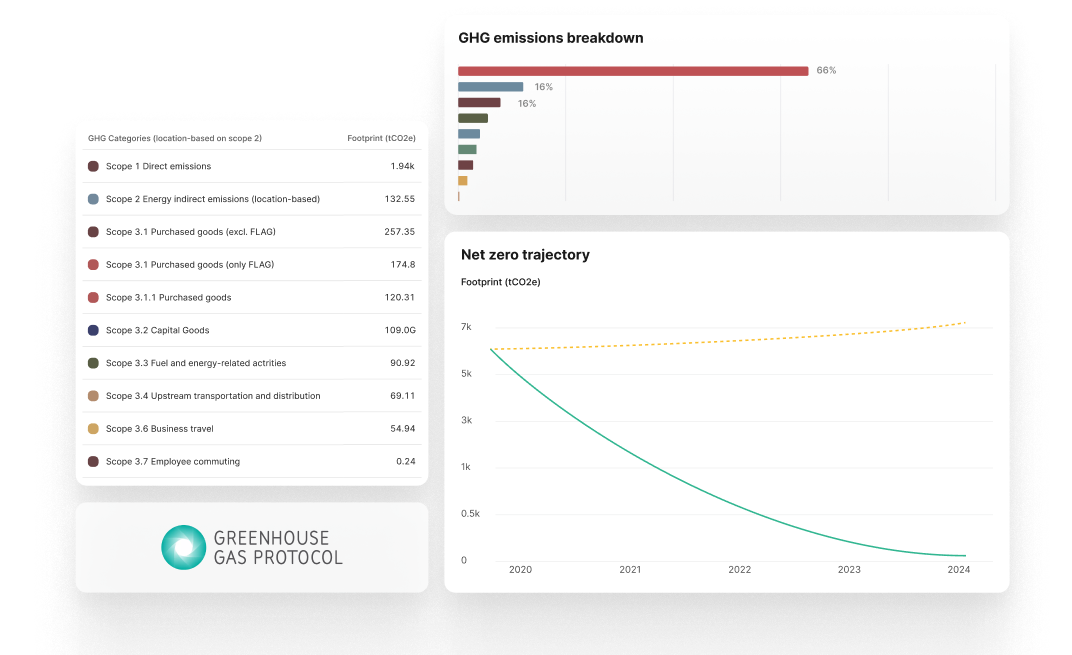
GHG protocol
Carbon Accounting aligned with the leading standard.

EU PEFCR
Meets EU standards for product-level disclosure.

SOC 2 certified
Enterprise data security, availability & confidentiality.

ISO 14040-44
Methodology independently reviewed by PwC.
Turn your raw data into environmental intelligence
Copilot makes complex climate expertise actionable, enabling every brand to move beyond reporting to reduce its impact.
The questions you couldn't afford to ask before
How does this season compare to last? Which suppliers improved the most this year? Did the switch to recycled polyester actually pay off? Most of these questions never get asked, because the answer used to cost a week of analyst or consultant time. Copilot drops that to the time it takes to type up one sentence.
From data to decarbonization
Once you understand where your emissions come from, the next question is what to do about them. Copilot points to where reductions are possible - which suppliers to engage, which materials to swap, which factories to prioritize. Form the foundations of a decarbonization plan in a few prompts, not a quarter's worth of consulting work.
Your data, easier to use
Type your question in plain language. Copilot answers from your live account and builds a tailored dashboard alongside - one you can save, share, and come back to as a reference later.
What Our Customers Say
From first footprint to net zero - hear it from the teams doing the work.
"With our Carbonfact platform, our creation teams are better equipped to replace virgin fossil-based materials and energy-intensive processes with sustainable alternatives that still fulfill our high-performance requirements."
Product Sustainability Lead at On
"For our brand, accurate and scalable carbon accounting -especially for Scope 3.1 - is critical. We started with consultants but that approach became too limited. Partnering with Carbonfact allowed us to move faster and improve data accuracy, the platform automatically fills in missing values using insights from working with hundreds of fashion brands."

Division Head Sustainability & Corporate Responsibility at Marc O'Polo
"Carbonfact gives me precise carbon measurements that reflect my products — not generic industry averages. They provide bespoke emission factors that reflect the unique materials, suppliers, and processes we actually use."
Sustainability Manager at Snocks
"We have moved from spend-based carbon accounting into Carbonfact to prioritise primary data and get more accurate calculations. The main reason for us to choose Carbonfact is that we now not only get our company's total carbon footprint but also break it down for each of our products — helping us reach our goal of reducing emissions by 50% before 2030."
Global Sustainability Manager
at HappySocks
A Platform to Evolve With
From carbon accounting to compliance to decarbonization — all in one place
Carbon Accounting
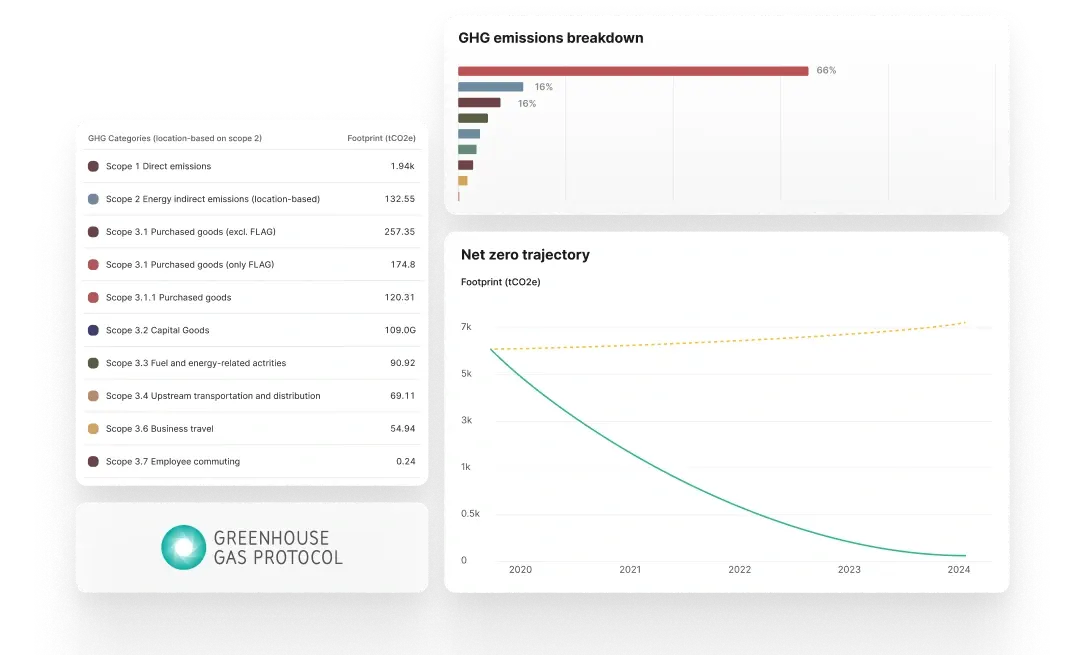
Switch from consultants to fully transparent, fashion-specific carbon accounting.
Decarbonization
Model product and company-wide reduction scenarios using your real data.
Reporting
Simplify compliance with automated, audit-ready reports.
Product LCAs
LCAs across your full catalogue – powered by primary data.
Data Management
Connect your systems – we’ll clean, map, and enrich your data.
A Platform to Evolve With
From carbon accounting to compliance to decarbonization — all in one place
Carbon Accounting
Switch from consultants to fully transparent, fashion-specific carbon accounting.
Decarbonization
Model product and company-wide reduction scenarios using your real data.
Reporting
Simplify compliance with automated, audit-ready reports.
Product LCAs
LCAs across your full catalogue – powered by primary data.
Data Management
Connect your systems – we’ll clean, map, and enrich your data.
Frequently Asked Questions
What is carbon accounting in the apparel and footwear industry?
Carbon accounting measures greenhouse gas emissions across every stage of a product's lifecycle — from raw material sourcing to production, transportation, and disposal. For fashion brands, it provides insights into which parts of the supply chain are most carbon-intensive, enabling targeted sustainability efforts.
Why should I switch from a Carbon Accounting consultant to a fashion-specific Carbon Accounting software?
- Fashion-specific carbon footprint platforms like Carbonfact automate data collection, fill data gaps, and generate audit-ready reports—saving you significant time versus consultants.
- You gain full control and transparency, with real-time results, granular fashion-specific accuracy, and detailed Scope 3 insights.
- Easily scale from basic carbon accounting to product LCAs and regulatory reports (CSRD, SBTi, DPP) as your needs grow—no switching platforms needed.
- Lower costs, seamless integrations, and ongoing expert support help you decarbonize efficiently and future-proof your compliance and sustainability work.
How does Carbonfact measure Scope 3.1?
We offer two ways to calculate your Scope 3.1 (Purchased Goods and Services), depending on your data maturity, and needs for granularity. Many fashion brands start with 1) and move later to 2).
1) Representative Products Method (Activity-Based)
- Brands add representative products to model their product mix. Each product includes material composition, weight, and process data.
- Carbonfact extrapolates Scope 3.1 emissions from these entries, using verified emission factors and enrichment rules.
- This approach is GHG Protocol-compliant, and offers a more accurate, activity-based footprint.
2) Product LCA Method (Granular)
- Brands provide SKU-level product data, either via manual upload or system integration (e.g. PLM).
- Carbonfact runs automated LCAs using its proprietary database (50M+ datapoints, verified T1–T5 sources).
- These LCAs are then aggregated to calculate precise Scope 3.1 emissions across the full catalog.
- This method allows for Eco-score, CSRD, and DPP readiness, and is best for brands with more advanced data setups.
Can Carbonfact measure Scope 1, 2, and 3 emissions separately?
Yes, Carbonfact's corporate emissions platform allows full calculation of Scopes 1, 2, and 3. The platform enables activity-based measurement for Scopes 1 and 2, and for several Scope 3 categories including Purchased Goods (3.1, usually 80% of a fashion brand's emissions), Upstream Transportation and Distribution (3.4), Use of Sold Products (3.11), and End of Life Treatment of Sold Products (3.12). For other Scope 3 categories, the platform can use spend-based measurements.
Do I get support when I am performing my Carbon Accounting for the first time with you?
Yes, absolutely — when you perform your Carbon Accounting for the first time with Carbonfact, you get hands-on, expert support every step of the way.
Here’s what’s included:
- Dedicated Onboarding & Customer Success: You’ll be matched with a Customer Success Manager who guides you through setup, data collection, and reporting — at your own pace.
- Access to Science & Data Experts: Carbonfact’s Climate and Data Science teams are available to support questions around methodology, emission factors, and GHG Protocol compliance.
- Carbonfact Collective: You’ll join a network of sustainability leaders (like GANNI, On, and others) to exchange learnings and best practices through workshops and events.
- Guided Tools: We provide smart templates, automatic data cleaning, and enrichment tools to make first-time carbon accounting easier and less manual than working with a consultant.
⸻
In short: you’re not left alone with a platform — you get a full team to help you succeed.
How does your Carbon Accounting platform enable streamlined / automated data collection?
Carbonfact can build customized connectors for each brand or supplier to automate data collection from their systems. Our Carbon Accounting platform can retrieve information from any ERP (e.g., SAP, Oracle, Microsoft Dynamics), PLM (e.g., Centric, Lectra, PTC), traceability solution, or structured files (.csv, .xls). The process typically begins with static exports, then moves to live connections, and requires minimal effort from the client.
What types of data sources can the platform integrate with?
Carbonfact can integrate with various data sources, including ERPs, PLMs, traceability solutions, data warehouses (e.g., Snowflake, BigQuery), and structured files (.csv, .xls). The platform is flexible and can adapt to different data formats and systems, as long as the format is consistent and machine-readable.
Can the Carbon Management platform handle large volumes of data?
Yes, the platform can handle tens of thousands of product references and millions of purchase orders annually. It has been successfully deployed for apparel and footwear brand and suppliers with billions in revenue.
How does Carbonfact handle data gaps when primary data or information from its current database is not available?
We use several major databases including EF 3.1, Ecoinvent (currently version 3.11), and Base Empreinte. We also use our proprietary database of heuristics (primary data points such as Dtex or component weights) coming from the hundred of fashion brands and suppliers we work with to fill in data gaps with more accuracy than generic industry averages.
How does the Carbonfact platform ensure transparency and auditability of calculations?
Carbonfact uses Version Control to track all calculations and methodological changes. The platform's engine and procedures are audited annually by PwC to ensure compliance with ISO 14040, PEFCR Apparel and Footwear, and GHG Protocol standards.
What tools does the platform offer for modeling emission reduction scenarios?
Carbonfact provides two main modeling tools for textile, and footwear brands:
- Product Impact Simulator: Allows simulating new products before production, testing material origins and supplier changes, and modifying individual components with real-time impact calculations
- Company CO2 Modeling Tool: Enables testing scenarios like increasing renewable electricity usage across supplier networks and modeling material transitions across entire product lines.
How does the platform help identify decarbonization hotspots?
Using Carbonfact's Explorer tool, fashion and footwear brands can break down emissions by component and process step level, view environmental impacts through charts and trend analysis, and identify specific areas for improvement in the supply chain.
What reporting frameworks does the carbon footprint platform support?
The platform generates reports compliant with the GHG Protocol, which is accepted by major frameworks and reporting standards. Carbonfact progressively releases new reporting frameworks based on customer priorities (e.g., CSRD, TCFD, CDP) and supports compliance with regulations such as the AGEC law.
Can the platform generate reports that are audit ready, or drastically decrease the time to get them there?
Yes, by default Carbonfact can generate automated environmental reports for GHG, CSRD and CFMB. Other requestable reports include CDP, PFM, TCFD and B Corporation certification. Please note that some reports, such as the CSRD report, will still require manual input due to the nature of the report itself.