


Environmental data platform - built for apparel and footwear brands, and their suppliers.


![[Guide] SBTi: How Fashion Brands and Suppliers Can Set Climate Targets](https://www.carbonfact.com/hs-fs/hubfs/Imagery%20template%20%288%29.png?width=743&height=432&name=Imagery%20template%20%288%29.png)
The Science-Based Targets initiative (SBTi) is currently the leading and most recognized climate target-setting protocol for the fashion industry. Increasingly, companies are using the SBTi as their north star for carbon reduction goals.
For many apparel and footwear brands, committing to SBTi isn’t just a choice – it’s an expectation. Investors increasingly demand 1.5°C-aligned targets, suppliers are asked by global brands to validate their commitments, and industry groups such as Cascale and the European Outdoor Group have made SBTi a requirement for membership.
But the momentum isn’t only driven by compliance. Many companies in our industry are setting targets because climate responsibility is part of their DNA, and SBTi provides a tangible, science-based framework to transform ambition into data-backed decarbonization pathways.
Yet while the motivation is clear, the path is rarely simple. Every fashion brand struggles with the same core questions – which target type should we choose, when to re-baseline, what is in the SBTi submission portal, etc.
In this article, we’ll unpack what textile brands need to know before, during, and after committing to SBTi. Are you new to SBTi terminology? Find core terms in the SBTi glossary here.
Let’s dive in!
The Science Based Targets initiative itself is an independent, non-profit partnership between CDP, the UN Global Compact, WRI, and WWF. Its framework has become the global standard for validating that company climate targets are in line with the 1.5°C pathway of the Paris Agreement.

Once a fashion brand decides to align with the Science Based Targets initiative, the first step is to register through the SBTi Validation Portal. The registration collects information such as company size, structure, and business activities to determine the appropriate validation route.
The target-setting process consists of four main stages:
Commit to setting targets: Companies can submit a commitment letter through the SBTi portal, signaling their intention to set a science-based target. After committing, they have up to 24 months (max) to develop and submit their targets for validation.
Set a baseline and develop targets: Using the SBTi Target Setting Tool, companies define their baseline year, target year, and reduction pathway.
Submit targets for validation: The developed targets are submitted through the SBTi Services Portal. The review process usually takes between 30 and 60 working days, resulting in a validation report and decision letter.
Communicate and disclose targets: Once validated, the company must publicly disclose its approved targets on the SBTi website within six months.
.png?width=1644&height=940&name=Blog%20image%20(7).png)
Carbon accounting is the process of tracking and measuring the greenhouse gases (GHGs) emitted by a fashion company. It is the first step in setting SBTi targets. Without an accurate baseline, it is impossible to define meaningful reduction goals or implement effective mitigation strategies.
SBTi requires apparel and footwear companies to build a GHG inventory that is compliant with the GHG Protocol Corporate Standard. This inventory must include:
Scope 1 (direct emissions): emissions from sources owned or controlled by the company (e.g., fuel burned in facilities or vehicles).
Scope 2 (indirect energy emissions): emissions from purchased electricity, steam, heating, or cooling.
Scope 3 (value chain emissions): all other indirect emissions that occur upstream and downstream, such as raw material production, transportation, product use, and end-of-life.
SBTi requires that targets cover Scopes 1, 2, and 3 within a fashion brand’s chosen boundary. The boundary defines which operations and emissions are included in the inventory. For Scopes 1 and 2, at least 95% of emissions must be included. For Scope 3, targets must cover at least 67% of total Scope 3 emissions.
Choosing a platform for Carbon Accounting? Read this guide about Carbon Accounting for apparel and footwear brands.
.png?width=1552&height=880&name=box%20(48).png)
A baseline year is the starting point against which a fashion company measures its greenhouse gas (GHG) reductions. It represents the company’s emissions in a chosen reference year. It could either be a fiscal or calendar year. By comparing future emissions to this baseline, companies can track whether they are reducing their footprint in line with SBTi requirements.
It is recommended to choose a baseline year as recent as possible (e.g., 2023 or 2024) to reflect accurate data and current operations. It is recommended that the baseline year be no more than two years before the target submission date (cannot be earlier than 2015). Using older years (such as 2019) often relies on more generic emission factors, which can underestimate the footprint, weaken the credibility of the target, and lead to target rejection.
Another recommendation is to select the same base year for all the targets that you will set on scopes 1, 2, and 3 to ensure consistency in reporting.
Future emission pathways are profile scenarios of how much greenhouse gas the world will emit over time and at what pace the reduction will happen.
If global CO2 emissions keep rising, we are heading toward very high warming scenarios of 3–5°C by the end of the century. To limit warming to well below 2°C, emissions need to decline sharply, reaching net zero around 2070. To stay within the 1.5°C limit, the most ambitious goal and aligned with the Paris Agreement, emissions must fall even faster –reaching net zero by 2050.
These emission profiles will directly determine the global temperature rise. For example, at 1.5°C, around 14% of species face a high risk of extinction – but at 3°C, that risk doubles to nearly 30%.
Every fraction of a degree matters. Limiting warming closer to 1.5°C drastically reduces human suffering and ecological damage. SBTi targets are designed to align companies with these global pathways.
Brands set two types of science-based targets, defined by their timeline.
Near-term targets cover the next 5 to 10 years and ensure immediate action. They are not stand-alone goals – they are milestones along a single trajectory toward net-zero. Once one near-term target expires, the next is set on the same path.
Scope 1 & 2: must align with the 1.5°C pathway – there is no lower-ambition option.
For Scope 3, companies choose between two ambition levels:
1.5°C pathway – the encouraged level and industry standard.
Well-below 2°C pathway (WB2C) – a lower-ambition alternative.
The exact reduction rate depends on the company's base year, scope mix, and ambition level.
Long-term targets define how far emissions must be cut before applying carbon removals to neutralise residual emissions and reach net-zero. They must be 1.5°C aligned across all scopes. The required reduction varies by scope:
Scope 1: −90% by 2050
Scope 2: −100% by 2040
Scope 3 (1.5°C): −90% by 2050
The well-below 2°C pathway is not eligible at the long-term level – brands on a WB2C near-term Scope 3 target must transition to 1.5°C if they later set a long-term net-zero target.
NOTE: Under the SBTi framework, every textile brand has to set a near-term SBT. Long-term net-zero is optional, but highly recommended, and is becoming an industry standard.
In 2024, 30% of SBT-committed footwear and apparel companies have set net-zero targets.
In April 2026, SBTi published Corporate Net-Zero Standard v1.3.1, a revision to the Absolute Contraction Approach used to set near-term targets. The net-zero ambition by 2050 is unchanged. What changed is how the annual reduction rate is calculated.
The original Absolute Contraction Approach was designed in the early 2020s, when most brands set near-term targets with 2030 as the target year and base years before 2020. It worked like this: each year, a company had to cut a fixed amount equal to 4.2% of its base-year emissions. So if base-year emissions were 100 tonnes, the company removes 4.2 tonnes every year – the same fixed cut, year after year. Over the decade from 2020 to 2030, that adds up to −42% in total.
The challenge came with later base years. SBTi kept the −42% by 2030 end-point fixed, regardless of when a company started – meaning a company with a 2025 base year still had to deliver a −42% cut, but in only 5 years instead of 10. The required annual rate climbed sharply, and a company starting in 2026 had to cut more than 10% of its base-year emissions every year – a pace that was not technically feasible:
Late starters were penalised with disproportionately steep curves, and required rates differed between companies based only on when they happened to set targets.
The principle is the same:
What changes is how the annual reduction rate is computed for these near-term targets.
The yearly reduction rate for near-term targets is now calculated based on the time remaining between the Base Year (BY) and the Net-Zero Year (2050 for Scope 1 & 3; 2040 for Scope 2), spreading out emissions reductions over a longer time period compared to previous standard.
One important addition: to compensate for the slower near-term reduction rate, the new method assumes that Scope 2 emissions reach net-zero by 2040, in line with global power-sector decarbonization pathways. This is why Scope 2 reduction rates are higher than Scope 1 rates under the new approach.
Brands affected by this methodology change include:
For most brands and retailers, Scope 1 and 2 emissions are relatively small compared to Scope 3. For material suppliers and manufacturers, they can be much larger. Still, all companies must set targets for Scopes 1 and 2.
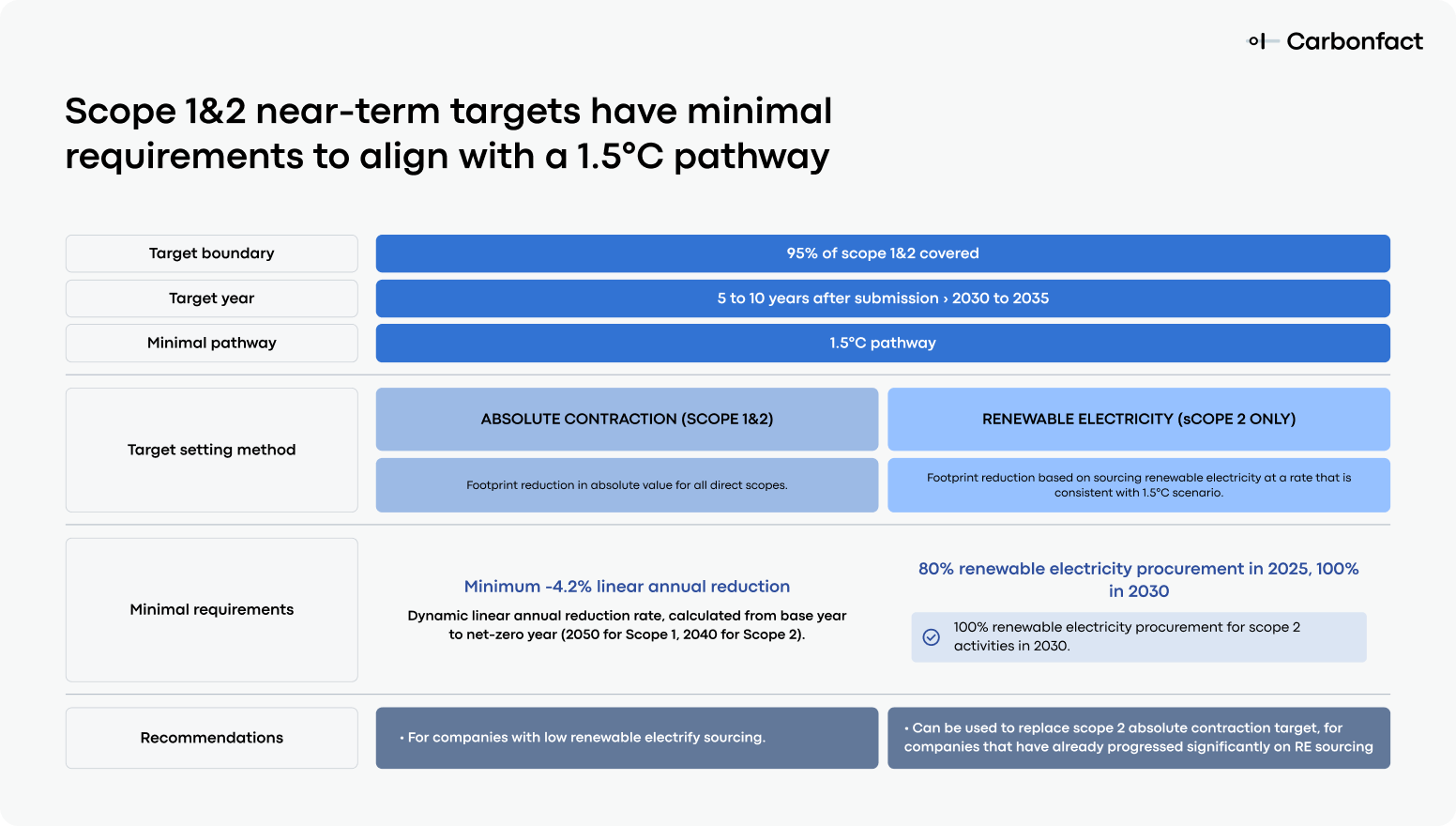
Here are the target requirements for Scope 1 and 2:
Boundary: The boundary defines how much of the total emissions must be included. For Scopes 1 and 2, 95% of all mandatory emissions from the GHG Protocol guidance should be included.
Ambition: Must align with the 1.5°C pathway. Scope 1 and 2 are set as a combined target with a dynamic annual reduction rate, calculated from the company's base year to net-zero (2050 for Scope 1, 2040 for Scope 2). A minimum floor of −4.2%/year applies. The exact rate depends on the company's Scope 1: Scope 2 mix – companies with more Scope 2 emissions face a steeper rate.
All GHGs: Must cover all seven greenhouse gases in the GHG Protocol.
Bioenergy: Emissions from burning biomass or biofuels must always be reported. If a company claims these are “CO₂ neutral,” it must provide justification (e.g., proof that the biomass is sustainably sourced and regrows to reabsorb the CO₂).
Scope 1 and 2 targets are set differently:
This is the preferred and most common approach. Under this method, a company must reduce its total emissions each year by a fixed percentage – known as the Linear Annual Reduction (LAR) – regardless of business growth or decline. If your company’s overall footprint increases (for example, due to higher sales or production volumes), you will need to make larger annual reductions to stay on track with the science-based rate.
Target requirements:
Instead of absolute reductions, a company can commit to sourcing renewable electricity in line with 1.5°C. The renewable electricity target option is only for Scope 2 and can be combined with absolute contraction for Scope 1.
The target requires companies to source at least 80% renewable electricity by 2025 and 100% by 2030.
Examples (validated under previous methodology, targets remain valid):
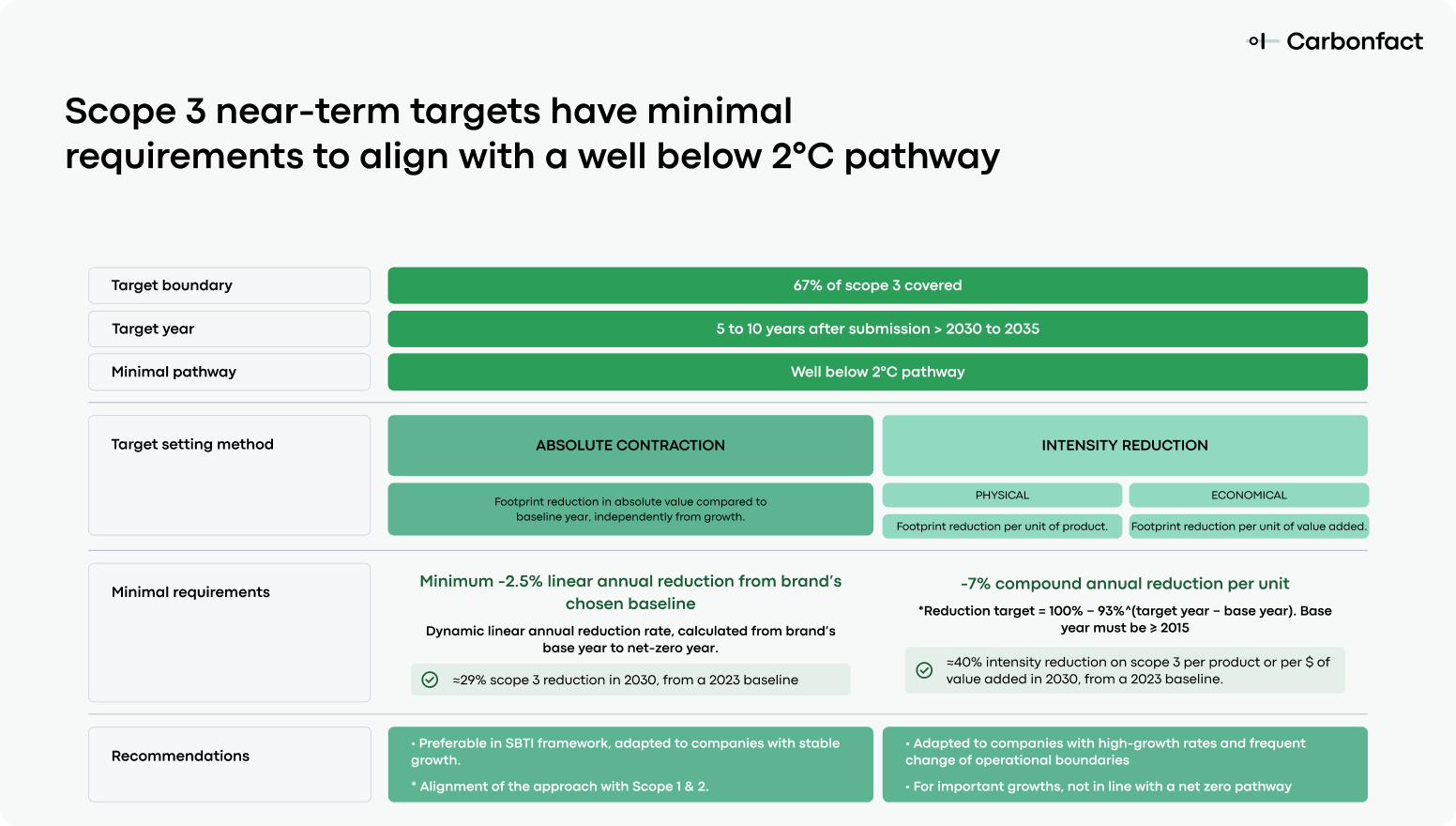
According to the SBTi framework, if Scope 3 emissions account for 40% or more of a company’s total footprint (Scopes 1+2+3), then a Scope 3 target is required. For fashion brands, Scope 3 often represents 90–95% of emissions, mainly from purchased goods and services.
Here are the target requirements:
Boundary: Cover at least 67% of total scope 3 emissions – this rule ensures companies address the major drivers of their footprint (like purchased goods and transport) while allowing flexibility to exclude smaller categories.
Ambition: Targets must align with at least a well-below 2°C (–2.5%/year) pathway, with 1.5°C (–4.2%/year) strongly encouraged and now the industry standard.
Scope 3 targets can be set using one or a combination of the following methods: absolute contraction, physical intensity, economic intensity, or supplier engagement.
No matter which target-setting method you choose for Scope 3 (absolute contraction, intensity, or supplier engagement), the target must cover GHG categories (such as purchased goods, transport, product use, etc.) that represent at least 67% of total Scope 3 emissions. So, hypothetically, if your total Scope 3 footprint is 1,000 tCO₂e, your target must include Scope 3 GHG categories that cover at least 670 tCO₂e (67%). If you then commit to cut those emissions by 50%, your reduction target is 335 tCO₂e.
Apparel and footwear brands can combine different Scope 3 target-setting methods, as long as each method applies to a clearly defined category and together they cover at least 67 % of total Scope 3 emissions. For example, a brand might use absolute contraction for purchased goods and services and a supplier engagement target for upstream transportation or finished goods suppliers.
Absolute contraction - Reduce total emissions by a fixed percentage each year (regardless of business growth).
The annual reduction rate is now dynamic, calculated from the brand's base year to the relevant net-zero year, with a minimum floor depending on the pathway chosen:
1.5°C pathway (encouraged, industry standard): rate calculated to reach −90% by 2050 compared to baseline year. Minimum floor: −4.2%/year.
Well-below 2°C pathway (WB2C): rate calculated to reach −75% by 2050 compared to baseline year. Minimum floor: −2.5%/year.
The previous fixed anchor of "−42% by 2030 vs. 2020" (for 1.5°C) or "−25% by 2030 vs. 2020" (for WB2C) no longer applies. Targets are now anchored to the company's own base year and the relevant net-zero year, so the absolute reduction by 2030 (or any other target year) depends on when the company started.
Past progress is also factored in: reductions made between the original base year and the most recent year are credited toward the new target.
Physical intensity - reduce emissions per physical unit (e.g., per T-shirt, per pair of shoes).
Requirement: At least –7% compound reduction per year from brand's baseline (no earlier than 2015).
Example: Princess Polly commits to reducing scope 3 GHG emissions 52% per unit sold by 2030 from a 2020 base year. The target boundary includes land-related emissions and removals from bioenergy feedstocks.
Growth disclosure: Physical intensity target should also result to absolute reductions, so if production grows, intensity cuts must be steep enough to offset that growth.
Economic intensity - reduce emissions per unit of value added (like per € of gross profit).
Requirement: Emissions per unit of economic value (e.g., tCO₂e per € of gross profit or per € of value added) must fall by at least –7% per year, compounded from brand's baseline.
Example: TOTEME AB & commits to reduce scope 3 GHG emissions 51.6% per million SEK value added within the same timeframe.
Note: 1) We consider this method as less robust – economic indicators fluctuate, and are not strongly tied to physical emissions. 2) Two companies with the same emissions per product could look very different when measured “per € of value added”. E.g. Luxury B2C brand selling a handbag for €2,000 generate very high value added per product. B2B supplier spinning yarn for €2/kg generate much lower value added per product. 3) If you decrease the price of the product in the future (meaning a decrease in the added value overall), then you might miss the target even if you decarbonize.
When you submit an intensity target (physical or economic), you must also give SBTi your expected production/output growth for the target period. This ensures that the intensity reduction will also lead to an absolute decrease in total emissions, not just lower emissions per unit.
Supplier engagement - Decathlon and Zalando are among the brands that want to ensure a set % of suppliers (by spend or emissions) adopt their own SBTs within 5 years. You can set this target with your top suppliers in terms of production volumes, and combine it with an absolute contraction or intensity target, to reach a minimum coverage of 67% of scope 3 emissions.
Boundary: Must apply to a relevant Scope 3 category (e.g., purchased goods & services, logistics).
Coverage: Must cover ≥67% (two-thirds) of scope 3 emissions when combined with other scope 3 targets.
Metric: Coverage can be based on emissions or spend, but if spend is used, you must prove it represents ≥67% of emissions. (A fashion brand spends €100 million per year on purchased goods & services. To meet the requirement, it must ensure that suppliers representing at least €67 million of that spend adopt validated SBTs.)
Timeframe: Selected suppliers must set their own SBTs within 5 years of your target approval.
Ambition: Supplier targets must be aligned with SBTi-approved pathways (1.5°C or well-below 2°C).
In the Apparel & Footwear Sector Guidance, SBTi recognizes secondhand, repair, and rental models as examples of circular business models. It notes that these models must still be included in Scope 3 accounting and intensity targets, since they are part of the company’s product or service portfolio.
For example:
Secondhand products: If resold items are part of the catalog, they count as product units in physical intensity targets. Since they have little or no new material impact, they can lower the emissions per unit sold. For companies that measure growth by total revenue, secondhand sales can help increase revenue without increasing emissions, since the income comes from reselling existing products rather than manufacturing new ones.
Repair services: Spare parts are treated as separate purchased products, each carrying its own emissions (e.g., if a brand offers a resoling service for shoes, only the new sole is included in the footprint – not the entire shoe).
Rental and subscription models: These must be included in the Scope 3 inventory, typically under downstream leased assets. While they can reduce the need for new production, the methodology for quantifying their emission impact is still being developed and not yet standardized under SBTi.
The use of offsets is not counted as an emission reduction toward the progress of companies’ science-based targets. The SBTi requires that companies set targets based on emission reductions through direct action within their own operations or their value chains. Offsets are considered to be an option only for companies wanting to finance additional emission reductions beyond their science-based targets.
It is generally recommended that only the parent company submit targets. However, subsidiaries may set their own targets if they choose to. When both a parent company and its subsidiaries have targets, they must clearly disclose whether the parent company’s target includes or excludes the subsidiary’s emissions to avoid double-counting.
Example: Both Arc'teryx and its parent company, Amer Sports Corporation, have validated SBTi targets.
SBTi Services’ online Validation Portal is where companies register, commit, and submit their science-based targets for review and approval. Brands submit targets through the SBTi Target Validation Portal, providing:
After submission, SBTi’s Technical Team reviews the data for consistency with the official criteria.

Preparing an SBTi submission can take hours of manual work – finding the right data, answering detailed methodology questions, and compiling documentation. With Carbonfact, everything you need is already centralized, calculated, and ready to submit in one platform.
Platform: by consolidating all data, models and targets, Carbonfact automatically generates an editable submission report for SBTi.
Service: our team helps you finalize the SBTi submission materials and supports you hands-on through the submission process.
Regular SBTi target submission requires companies to first sign a Commitment Letter and then submit their carbon accounting results from the baseline year and science-based targets within 16 months. The submission must include Scope 1, 2 & 3 emissions and targets.
There is a streamlined track for SMEs to set their targets. Only Scope 1 2 emissions and targets need to be submitted for near-term goals. However, SMEs must commit to measuring and reduce their scope 3 emissions by publicly disclosing the target (e.g., via CPD).
Regular SBTi submission costs significantly more than SME submission: $14,500 vs. $2,000. Companies are eligible to use the SME route if they:
And three or more are true:
Here are some examples:
Snocks GmbH (SME): commits to reducing scope 1 and scope 2 GHG emissions 42% by 2030 from a 2022 base year, and to measure and reduce its scope 3 emissions. Snocks GmbH commits to reaching net-zero by 2045. As part of this, Snocks GmbH commits to reducing scope 1+2+3 emissions 90% by 2045 from a 2022 base year.
A.P.C. (Atelier de Production et de Création): commits to reducing scope 1 and scope 2 GHG emissions by 42% by 2030 from a 2022 base year, and to measure and reduce its scope 3 emissions.
Everlane: commits to reducing scope 1 and scope 2 GHG emissions by 46% by 2030 from a 2019 base year, and to measure and reduce its scope 3 emissions. Everlane commits to reaching net-zero by 2050. As part of this, Everlane commits to reducing scope 1+2+3 emissions 90% by 2050 from a 2019 base year.
Yes. Within 6 months of submission, you must publicly disclose the target you set. After that, every year you need to publish both your GHG footprint and your progress toward the targets. If targets are recalculated or updated, those changes should also be explained transparently.
Where to disclose: There are no specific requirements regarding where the inventory should be disclosed, as long as it is public. Recommendations include annual reports, sustainability reports, the company’s website, and/or CDP’s annual questionnaire.
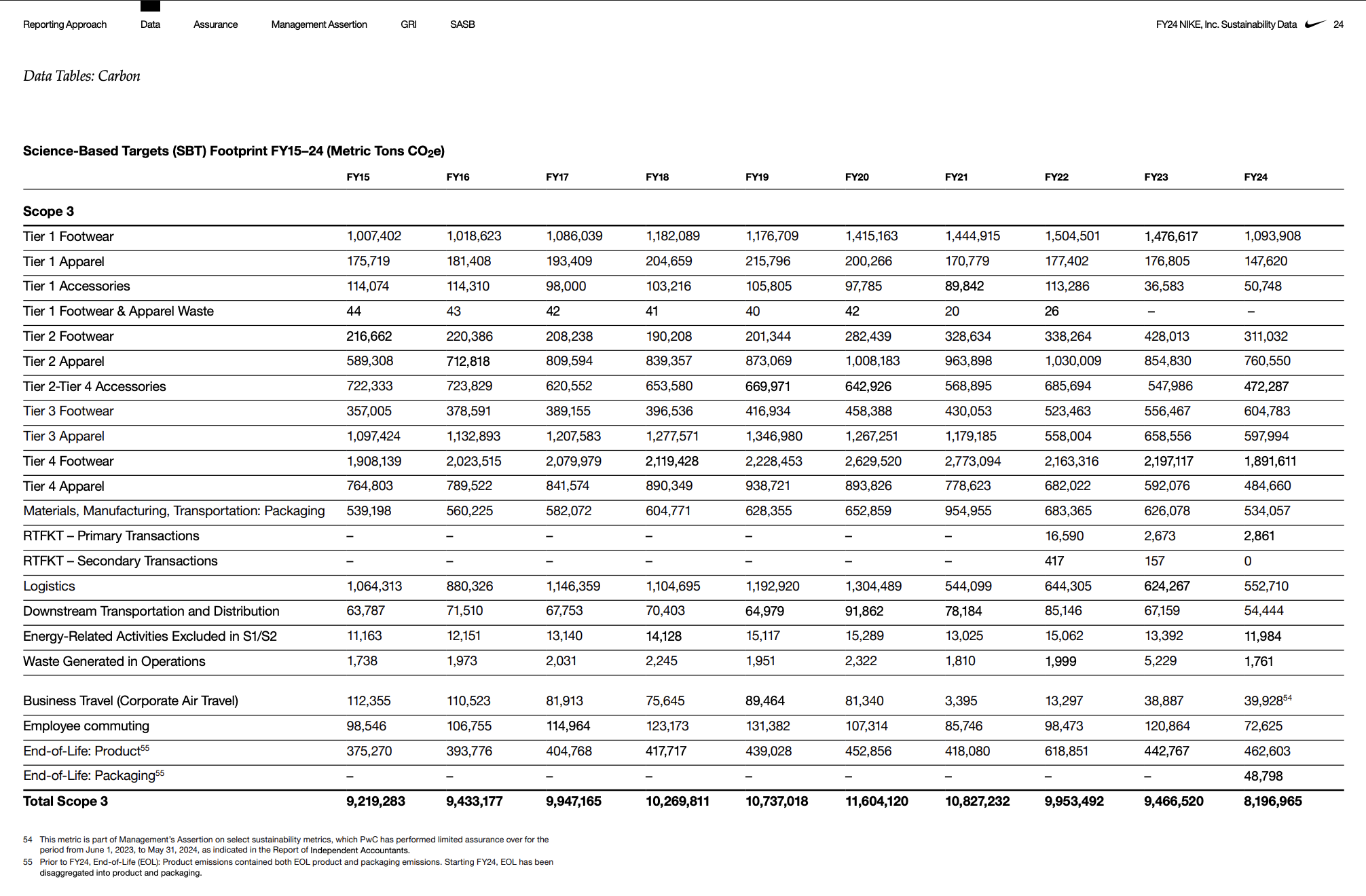
Example from Nike’s FY24 Impact Report
Once targets are in place, maintaining their relevance over time is essential. According to SBTi guidelines, re-baselining becomes necessary when significant organizational or operational changes occur that could affect the validity and consistency of existing targets. Companies should re-baseline when:
The SBTi recommends recalculating targets if there is a 5% or greater change in an organization's total base year emissions or in the emissions covered within a target boundary.
Curious to see how leading brands are communicating the change of baseline emissions in their impact reports? Read our article on rebaselining for apparel and footwear here.
All SBTi targets must be reviewed at least every 5 years to stay aligned with the latest climate science and SBTi criteria.
Additionally, a company must recalculate its target if one of the following triggers arises:
Scope 3 emissions become 40 percent or more of aggregated scopes 1, 2, and 3 emissions
There are major structural changes (mergers, acquisitions, divestitures, big outsourcing/insourcing).
The base-year inventory or key data/projections change significantly (e.g., discovery of large errors or switching methodologies).
Emissions previously excluded (5% allowance) become significant.
Any other change makes the target inconsistent with the latest climate science or SBTi criteria.
If recalculation is needed (e.g., due to structural changes or new data), targets might also be revalidated and resubmitted under the most recent SBTi criteria, if the ambition level no longer matches minimum requirements.
Once a fashion company publicly commits to set science-based targets – by joining the SBTi through the Commitment Letter – the commitment is considered public and permanent.
However, there are a few specific situations where SBTi will remove or update a company’s status on its website:
>Otherwise, companies cannot voluntarily withdraw or delete their SBTi commitment once published.
SBTi guidance for the Apparel & Footwear Version 2.0 is in public consultation and will be used only to set targets from 2027 and onwards. Target setting in 2025 and 2026 will be using the current version 1.3. Targets with version 1.3 set before 2027 will remain valid until their target year. The main changes are summarized in the table below:
.png?width=1552&height=880&name=box%20(52).png)
SBTi’s Forest, Land and Agriculture (FLAG) guidance is a new framework that requires companies to measure and set precise reduction targets for their FLAG-related emissions in addition to their energy/industry SBTs.
In apparel and footwear companies, FLAG emissions originate largely from Scope 3, specifically Purchased Goods Services, stemming from the production of natural fibers like cotton, leather, and wool. If your business has already set SBTs, then you will be required to set a FLAG SBT if 20% or more of your Scope 1, 2, and 3 emissions are derived from FLAG sources. In other words, a large percentage of apparel and footwear brands.
Learn all about SBTi FLAG for apparel and footwear in our blog here.
There are no direct penalties from the SBTi if a company falls short of its reduction pathway. However, missing targets carries significant risks: companies can be flagged as “off track,” which may damage credibility with investors, customers, and NGOs, and result in lower ESG ratings.
Targets must also be reviewed every five years, so persistent gaps may require resubmitting updated targets under the latest SBTi criteria. In practice, failing to stay on track undermines trust and momentum – making it harder to secure supplier engagement (“Why would we invest our time to find emissions data if you’re not sticking to your target”), investment, and internal buy-in for future climate action.
At Carbonfact, we see firsthand how apparel and footwear companies approach the Science Based Targets initiative (SBTi). Across our customer base, more than 30% are already on their SBTi journey – whether they’re setting baselines, defining reduction pathways, or submitting targets for validation.
Scope 1 & 2 reduction strategies can be relatively straightforward, such as switching to 100% renewable electricity. But 90–95% of emissions for apparel and footwear brands sit in Scope 3 – which is complex, requiring both granular data and expert guidance. This is where Carbonfact supports companies from two sides:
Software – our platform centralizes product-level data across all suppliers and materials, enabling brands to:
Build complete Scope 1, 2, and 3 inventories in line with GHG Protocol.
Track emissions at the level of product, material, supplier, factory, or geography.
Model scenarios (e.g., material switches, supplier changes, renewable energy adoption) to test reduction levers.
Monitor progress against SBTi targets and generate compliant reporting inputs.
Services – our SBTi experts provide hands-on support to:
Guide you through baseline definition and target-setting.
Validate your chosen reduction pathway and co-create a roadmap.
Co-create the SBTi submission report.
Support responses to SBTi’s follow-up questions during validation.
Provide ongoing advice to keep targets on track and aligned with business growth.
Absolute contraction – One of the approved methods for setting science-based targets. It requires reducing total greenhouse gas emissions by a fixed annual rate, regardless of business growth. This method is required for Scope 1 and 2 targets and can also be used for Scope 3.
Baseline emissions – A baseline year is the starting point against which a company measures its greenhouse gas (GHG) reductions. It represents the company’s emissions in a chosen reference year. It should represent typical business activity and use the most recent, complete, and reliable data.
FLAG target – A target for Forestry, Land Use and Agriculture emissions, required for materials like cotton, wool, and leather.
GHG emissions – greenhouse gases (such as carbon dioxide, methane, and nitrous oxide) released into the atmosphere from activities like manufacturing, energy use, and transportation. These gases trap heat and are measured in tonnes of CO₂ equivalent (tCO₂e) to show their combined impact on global warming.
Intensity target – One of the approved methods for setting Scope 3 science-based targets. Cutting emissions per unit of product (physical) or per € of value added (economic). Even though performance is measured per unit, the overall result must still show a real decrease in total (absolute) emissions over time.
Long-term net-zero target – A deep-reduction goal (~90% by 2050 or earlier) required to reach corporate net zero.
Near-term target – A 5-10 year target (2030–2035) that drives immediate emission reductions.
Offsets – Carbon credits used to compensate for emissions outside a company’s reduction boundary. Offsets do not count toward science-based targets – they are only used after achieving deep reductions to neutralize residual emissions.
Re-baselining – The process of updating the baseline year emissions data and targets when major structural or data changes occur, ensuring consistency with the latest SBTi criteria.
Residual emissions – The small share of unavoidable emissions left after all feasible reductions, which must be neutralized through permanent removals.
Scope 1 emissions – Direct emissions from owned or controlled sources such as factories or vehicles.
Scope 2 emissions – Indirect emissions from purchased electricity, heating, or cooling.
Scope 3 emissions – All other indirect emissions in the value chain – from raw materials to transport, use, and end-of-life.
Supplier engagement target – A Scope 3 target setting method requiring suppliers covering at least 67% of emissions (by spend or emissions) to set their own SBTs within 5 years.
Target boundary – Defines which operations, subsidiaries, and emission sources are included within the company’s science-based target. Must align with the company’s GHG inventory boundary.



Environmental data platform - built for apparel and footwear brands, and their suppliers.