
![[Guide] SBTi: How Fashion Brands and Suppliers Can Set Climate Targets](https://www.carbonfact.com/hs-fs/hubfs/Imagery.webp?width=412&height=244&name=Imagery.webp)

Environmental intelligence platform - built for apparel and footwear brands, and their suppliers.


Status: ✅ Approved EU law
Adopted in 2024, the Empowering Consumers for the Green Transition Directive – EmpCo – is the EU's answer to vague environmental claims and unverified sustainability labels in consumer-facing marketing.
EmpCo amends the Unfair Commercial Practices Directive (UCPD), the EU's main legal framework for business-to-consumer marketing, adding a specific, targeted layer of rules, including binding prohibitions on sustainability labels without independent certification and product-level claims based on carbon offsetting.
EU Member States must transpose new EmpCo rules into national law by March 2026. The updated rules apply from September 2026. Let’s break down these new requirements for apparel and footwear brands!
Curious to learn more about textile sustainability laws affecting apparel and footwear brands? Read our overview of the EU textile strategy and regulations here.
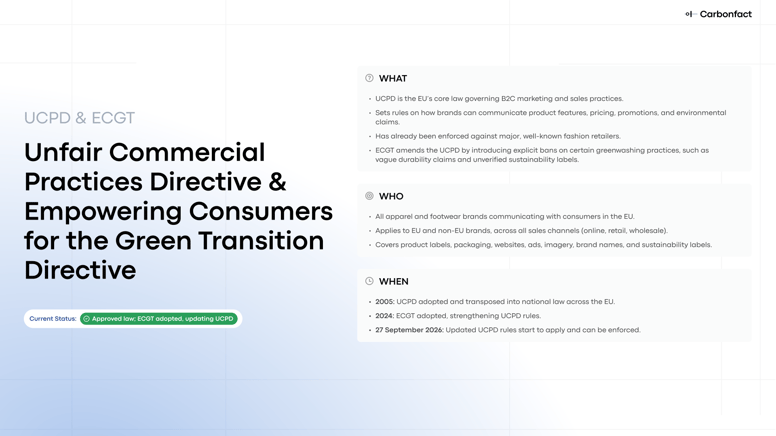
Adopted in 2005, the Unfair Commercial Practices Directive (UCPD) is the EU’s main legal framework for business-to-consumer marketing. For apparel and footwear brands operating in the EU, it sets the basic rules for how claims about environmental performance, pricing, promotions, and product features can be communicated to consumers.
In the fashion industry, several companies have already come under regulatory scrutiny for breaching UCPD provisions. For example, the Dutch Authority for Consumers and Markets flagged H&M and Decathlon for using sustainability-related terms like “Conscious” and “Ecodesign” without clear definitions or supporting evidence. In response, both brands were required to revise their labeling and marketing practices.
The Empowering Consumers for the Green Transition Directive (EmpCo), adopted in 2024, amends and strengthens the UCPD by adding clear rules, specifically for environmental claims and sustainability labels. Rather than replacing the UCPD, the EmpCo updates it by explicitly listing certain practices that are no longer allowed.
Under EmpCo, an environmental claim is any message – textual, visual, or symbolic – that states or implies that a product, product category, brand, or company has a positive or zero impact on the environment, is less damaging than alternatives, or has improved its environmental impact over time. This includes wording, imagery, colors, symbols, product names, and labels used in commercial communications.
The directive applies only to business-to-consumer communications. Corporate sustainability reports are typically not in scope. However, if an apparel or footwear brand uses information from its sustainability report in consumer-facing advertising or marketing, that communication falls under the directive and must comply with all applicable rules.
This chapter outlines the key rules apparel and footwear brands should be aware of. Curious to deep dive into the most common EmpCo questions asked by brands? In May 2026 European Commission released a Q&A on the directive – find it here.
Under EmpCo, an environmental claim is considered generic – and therefore prohibited – when the supporting detail is not clearly stated in the same place as the claim: the same packaging, ad, or webpage. Terms such as "eco-friendly," "green," "sustainable," "ecological," "biodegradable," or "biobased" are prohibited when used without further explanation.
A claim becomes specific and compliant when its specification travels with it. "100% of energy used in production comes from renewable sources" is specific. "Green production" is not.
Allowed: "Made with 95% GOTS-certified organic cotton." (specification stated on the same label).
Not allowed: "Sustainably made" (no supporting detail in the same place).
It is prohibited to claim that a product as a whole is sustainable, recycled, or biodegradable if only one component meets the claim.
Allowed: “This T-shirt's stitching is made from recycled polyester.”
Not allowed: “Recycled T-shirt” (if only the label or thread is recycled).
Highlighting one positive environmental feature while ignoring other significant negative impacts is considered misleading. This includes selective disclosure of benefits while hiding the broader footprint.
Allowed: “Contains recycled polyester; however, production still uses virgin fossil-based dyes.”
Not allowed: “Eco jacket” (if high-impact materials or processes are involved and not disclosed).
Sustainability labels, logos, or visual badges must be based on a valid certification scheme or established by a public authority. A self-created logo with no independent compliance monitoring does not qualify.
For a certification scheme to be valid, it must meet all of the following:
Certification is based on independent third-party verification
The scheme's requirements and terms are publicly available
Compliance is monitored by a competent, independent third party in line with international, EU, or national standards
The scheme is transparent, credible, and open to all brands willing and able to comply under fair and non-discriminatory terms
Requirements are developed in consultation with relevant experts and stakeholders
The scheme owner and the third party responsible for monitoring compliance are legally separate entities
Labels established by public authorities outside the EU are permitted only if they meet the same substantive criteria.
Allowed: "Certified by OEKO-TEX® Standard 100" – an independently verified, publicly accessible scheme open to all eligible manufacturers.
Not allowed: A logo created by the brand with no independent compliance monitoring.
Suggested ways to demonstrate excellent environmental performance include: the EU Ecolabel, national or regional Type I ecolabels officially recognized in a Member State – such as Nordic Swan, Blue Angel, or Dutch Milieukeur – and the top performance tier for a specific characteristic under other applicable EU law, such as Energy Label class A.
The proof must directly match the claim – for example, an A energy label can support a claim like “energy efficient,” but not a broad claim like “sustainable” or “responsible.” A fashion brand cannot call a T-shirt “sustainable” just because it has the EU Ecolabel, since sustainability also covers social aspects.
Claims suggesting that a product is durable, long-lasting, repairable, or designed to last must accurately reflect the product’s design and the availability of repair options or spare parts. Misleading claims related to durability or planned obsolescence are prohibited.
Allowed: “This jacket comes with a 5-year commercial repair service for zippers and seams.”
Not allowed: “Built to last” when no repair services, spare parts, or durability guarantees are available.
Product-level claims based solely on carbon offsetting – such as “carbon neutral” or “climate neutral” achieved through offset credits – are prohibited under the EmpCo.
Allowed: "This T-shirt’s manufacturing emissions were reduced by switching to renewable electricity at the fabric mill; remaining emissions are reported separately."
Not allowed: "This T-shirt is climate neutral. We offset all CO₂ emissions through certified reforestation."
When an apparel or footwear brand compares a product's environmental performance to a previous model, a competitor's product, or an industry average, the comparison must not mislead. It should cover products serving the same function, use a common method and common assumptions, and compare material and verifiable features. A comparison that cherry-picks one favorable metric while omitting others constitutes a misleading commercial practice.
Brands operating tools or services that compare products on environmental, social, or circularity characteristics have additional obligations: they must disclose which products are being compared, who supplies them, the method of comparison, and the measures in place to keep that information up to date.
Advertising benefits to consumers that are irrelevant and do not result from any feature of the product or business is prohibited.
Allowed: "No PFAS used in our waterproof coating" – PFAS chemicals are genuinely present in many performance outerwear products as DWR treatments; eliminating them is a specific and relevant feature.
Not allowed: "Our cotton T-shirt is free from animal-derived materials" – cotton by nature contains no animal materials; the claim creates a false impression of a distinctive achievement.
Brand and product names that imply environmental benefits, such as "eco," "green," or "climate neutral", may be treated as environmental claims, regardless of trademark protection. Visual elements such as leaves, water drops, or green color schemes can also constitute implicit environmental claims depending on context and how an average consumer would perceive them. Each case is assessed individually, taking into account the overall commercial context.
A name like "GreenLine" or "EcoJacket" does not automatically breach the rules, but if it is likely to create an environmental association for the average consumer, the brand must specify the claim clearly.
Brand names that breach the UCPD may also be refused trademark registration or invalidated. This decision is left to Member States.
Allowed: Neutral product naming with factual, clearly explained environmental information.
Not allowed: Product names or packaging visuals implying environmental benefits without a compliant, supported claim.
A claim about future environmental performance – such as "carbon neutral by 2030" – requires more than an ambition. The commitment must be clear, objective, publicly available, and verifiable, set out in a detailed and realistic implementation plan that includes measurable and time-bound targets and specifies the resources allocated to deliver them. Progress must be regularly verified by an independent third-party expert, and those verification findings must be made available to consumers.
The directive (and new rules) applies from 27 September 2026, including to products already on the market. Where existing packaging carries claims that no longer comply, brands have practical options: covering non-compliant claims with stickers or adding supplementary information at the point of sale.
National enforcement authorities will take into account whether reasonable and proportionate efforts to comply were made, including for products already in the distribution chain.
EmpCo and UCPD are enforced nationally. Every EU Member State has its own consumer protection authority (e.g. ACM in the Netherlands, DGCCRF in France). These authorities investigate and sanction brands under national UCPD laws. This means penalties are imposed by national authorities, not directly at EU level, and are assessed on a case-by-case basis.
Under the EU’s consumer enforcement framework, serious or widespread breaches – such as misleading environmental claims used across multiple EU countries – can lead to fines of up to 4% of a brand’s annual turnover in the affected Member State(s). Where a brand’s turnover cannot be determined, national authorities must be able to impose fines of at least €2 million.
In addition to financial penalties, authorities may require brands to:
Penalties are determined based on factors such as the seriousness and duration of the breach, whether it was repeated or intentional, and the economic benefit gained. As the EmpCo rules are transposed into national law in 2026, authorities will be able to apply these strengthened rules using existing UCPD enforcement mechanisms.
The Unfair Commercial Practices Directive requires brands to substantiate their products’ environmental footprint. That means: no compliant claim without structured, accurate data. For brands still relying on spreadsheets, supplier PDFs, or disconnected reporting tools, the risk of non-compliance is high.
That’s why apparel and textile companies must start building their data infrastructure now. Early preparation is essential to avoid last-minute scrambles, verification failures, or greenwashing penalties.
Carbonfact is your environmental data partner, enabling rapid, scalable, and compliant product-level impact measurement
We help you with:
Scientific, product-level data: Carbonfact runs detailed product LCAs for your whole catalog, delivering cradle-to-grave environmental impact data ( water, waste, etc.) based on robust methodologies like PEFCR, ISO 14040, and the GHG Protocol.
Full transparency and auditability:
All data, sources, assumptions, and methods behind environmental claims are documented, retained, and accessible for inspection, critical for compliance. Audit trails make it easy to provide supporting evidence if regulators or consumers request it.Automated data management: Integration with ERPs, PLMs, and traceability solutions automates the collection and validation of primary data needed for substantiating claims and makes it possible to quickly respond to regulatory or consumer information requests.
Clearly document scope, functional units, and trade-offs: The platform lets you define whether an impact applies to the entire product (e.g., “full shoe”), a single component (e.g., “midsole”), or a corporate activity (e.g., “factory operations”).



Environmental intelligence platform - built for apparel and footwear brands, and their suppliers.