-1.jpg?width=412&height=244&name=Imagery%20template%20(2)-1.jpg)


Environmental intelligence platform - built for apparel and footwear brands, and their suppliers.


Over the past two years, fashion brands have gone from publishing occasional sustainability reports to managing a growing stack of requirements – initially led by CSRD and carbon accounting, though now more so by DPP and increasing demands on supply chain transparency.
What used to be a yearly reporting exercise is becoming an ongoing operational challenge: collecting ESG (Environmental, Social and Governance) data from suppliers, structuring it across products, and making it usable across teams.
As a result, many brands are now asking a more practical question:
What is the best sustainability software for fashion?
The difficulty is that “sustainability software” doesn’t refer to a single category. Some tools are built for ESG reporting, others for carbon accounting, others for traceability, and others for product-level environmental data.
This article breaks the market into four main types of sustainability software used by fashion brands, and how to evaluate which approach actually fits your needs.
Sustainability software in fashion is not a single category, but a combination of tools designed to address different parts of the value chain.
Most brands rely on one of four approaches: generalist ESG platforms, carbon accounting tools, traceability solutions, or environmental data platforms.
Generalist ESG platforms centralize reporting across environmental, social, and governance topics but often lack depth in product-level data. Carbon accounting tools focus on measuring emissions but may rely on high-level or spend-based data and generic emission factors for scope 3.1 – 90% of all emissions for fashion brands. Traceability platforms provide visibility into supply chains but typically do not calculate environmental impact.
Environmental data platforms, built around product-level environmental data (often using Life Cycle Assessment methodologies), are designed to handle the complexity of fashion supply chains and connect impact calculations with reporting, eco-design, and regulatory requirements such as Digital Product Passports. Though they forego the functionality mentioned before, they also don’t take a “boil the ocean” approach to data collection.
As sustainability requirements evolve, the key differentiator is not the amount of varying ESG data collected, but how well the software handles environmental data at the product level – typically the hardest the hardest to process and act upon.
Sustainability in fashion is often framed as a reporting challenge. In reality, it is primarily a data problem – and not all data is equally difficult to collect.
While governance and social data are often qualitative or documentation-based, environmental data is fundamentally different.
It requires brands to quantify impact across:
Each of these variables carries its own emission factors, which can differ significantly depending on geography, production method, and material type.
In apparel and footwear, this complexity is amplified by:
As a result, the most difficult part of sustainability in fashion is not building dashboards or reports – it is collecting, structuring, cleaning and maintaining reliable environmental data at scale.
This is also where most sustainability software approaches begin to diverge.
Most sustainability solutions used by fashion brands fall into one of four categories.
Primary focus: Solving environmental data complexity at the product level
Environmental data platforms are designed to address the most difficult part of sustainability in fashion: linking materials, processes, and suppliers to measurable environmental impact.
Rather than simplifying the problem, they model it, often using Life Cycle Assessment (LCA) methodologies, to reflect how products are actually made. Strong Environmental Data platforms also have the ability to do Carbon Accounting next to Product LCAs.
These platforms allow brands to move from reporting impact to actively managing and reducing it.
Example: Carbonfact
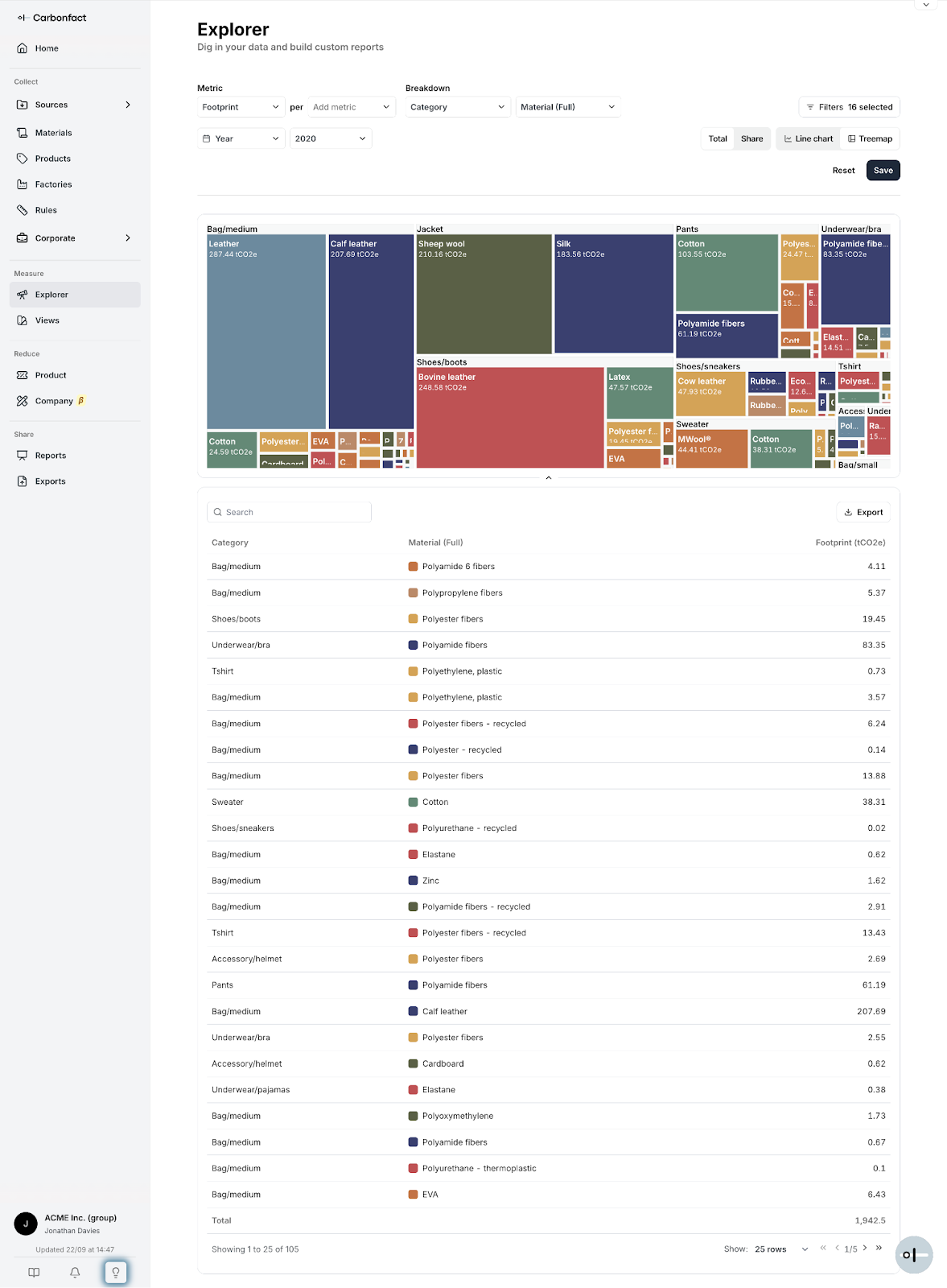
Source: Carbonfact
Primary focus: Company-wide sustainability reporting
Generalist ESG platforms are designed to help companies manage sustainability data across environmental, social, and governance topics. They centralize reporting and often provide complete dashboards for frameworks such as CSRD, GRI, and CDP.
These platforms are best suited for organizations looking to consolidate broad sustainability reporting at the corporate level.
Examples: Workiva, Worldfavor, Persefoni
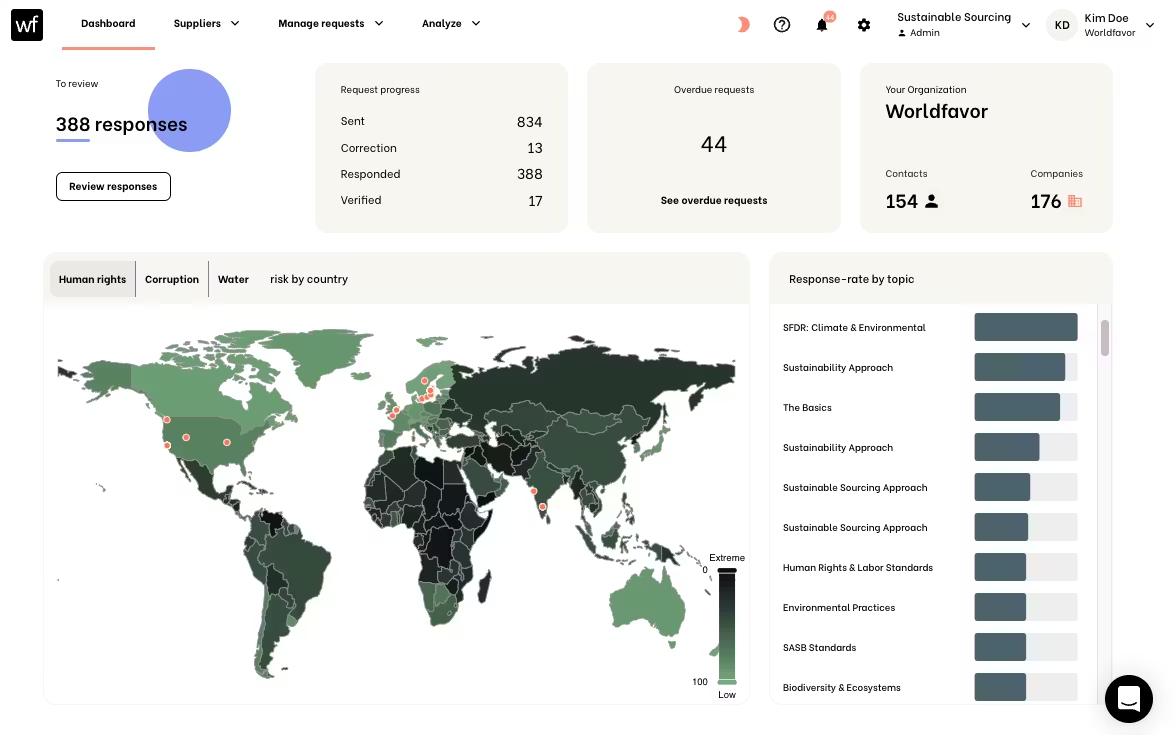
Source: softwareadvice.com’s Worldfavor page.
Primary focus: Measuring greenhouse gas emissions
Carbon accounting tools focus specifically on calculating emissions across Scopes 1, 2, and 3.
Many rely on spend-based data, estimating emissions based on financial data rather than physical activity. They also often rely on generic emission factors, foregoing processing steps and regional energy mixes. While this simplifies data collection and calculations, it often fails to reflect the reality of materials and production processes in fashion supply chains.
These tools are most useful for non-fashion brands focused on corporate carbon reporting.
Examples: Plan A, Greenly, Watershed
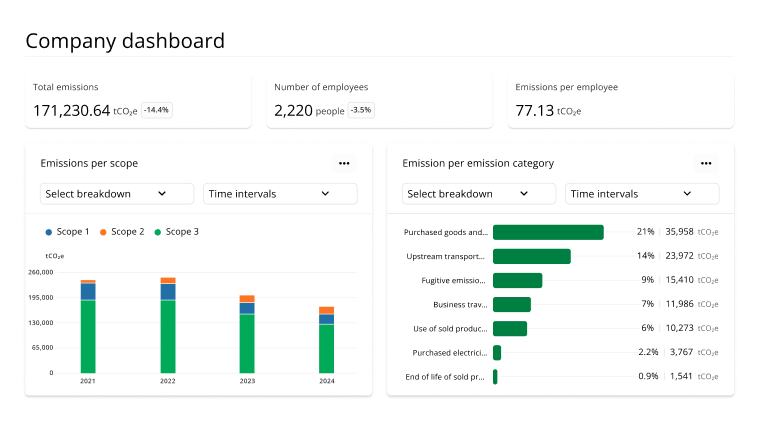
Source: Plan A website
Primary focus: Supply chain transparency and supplier tracking
Traceability platforms help brands map their supply chains, track materials, and monitor supplier relationships.
They are increasingly used to support due diligence requirements and provide visibility into sourcing practices.
Traceability tools are essential for understanding where products come from, but they typically do not explain what impact those products have.
Examples: Fairly Made, TrusTrace
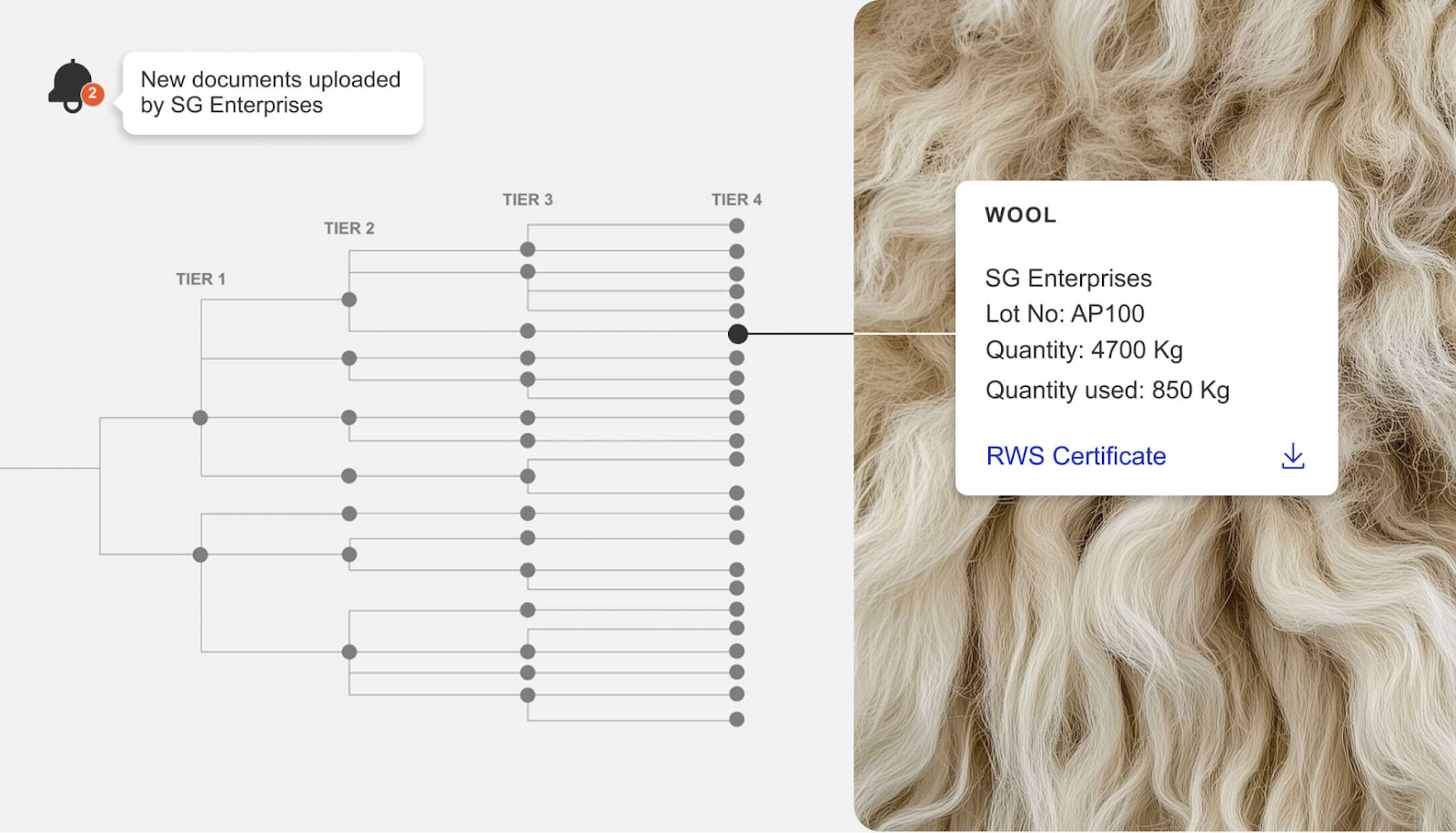
Source: TrusTrace website
These categories are not mutually exclusive.
In practice, many fashion brands combine multiple tools:
For fashion companies, generalist carbon accounting platforms aren’t recommended as they don’t provide enough accuracy and granularity on product-level impact (scope 3.1).
The key is understanding what each tool is responsible for and ensuring the underlying data is consistent across systems.
There is no single “best” sustainability software.
The right approach depends on your priorities:
What matters most is whether your setup allows you to connect sustainability data to real business decisions, not just reporting outputs.
As sustainability requirements evolve, a clear pattern is emerging:
Most tools make sustainability easier to report – but very few make it easier to measure accurately.
This distinction matters most in environmental impact, where:
Because of this, brands are increasingly shifting toward solutions that can handle product-level environmental data, rather than relying on aggregated or proxy-based approaches.
This shift is not just about accuracy – it’s about usability.
When environmental data is structured correctly, it can be reused across:
In contrast, when data is too high-level, it often remains locked in reports without influencing real decisions.
When evaluating sustainability software, the most important question is not which platform covers the most features, but:
How does this software handle environmental data – and how close is it to the reality of how your products are made?
In fashion, environmental impact is driven by materials, processes, and supply chains, not by high-level averages or financial proxies. Some tools simplify this complexity – others expose it.
The difference determines whether sustainability remains a reporting exercise, or becomes something your teams can act on.


Environmental intelligence platform - built for apparel and footwear brands, and their suppliers.