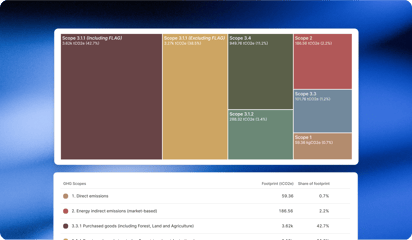
-1.jpg?width=412&height=244&name=Imagery%20template%20(2)-1.jpg)

Environmental intelligence platform - built for apparel and footwear brands, and their suppliers.


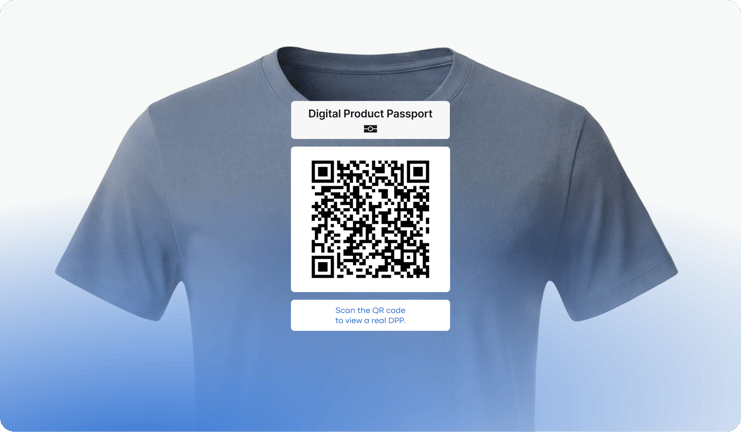
While the exact requirements are still evolving, the direction of travel is clear: The Digital Product Passport will become a core part of how apparel and textile products are assessed by consumers, similar to the already-existing NutriScore for food. For apparel (and later, footwear), DPP is expected to enter into force in mid-2027, with an (not definitive) 18-months grace period before compliance becomes mandatory.
As fashion brands prepare for upcoming obligations under the Ecodesign for Sustainable Products Regulation (ESPR), under which DPP falls, one question comes up repeatedly:
The challenge is that “DPP software” can mean very different things depending on how the solution was designed. Some tools focus on consumer storytelling, others on supply chain traceability, and others on environmental data and compliance.
This article breaks the market into four main types of Digital Product Passport software – helping brands understand which approach best fits their regulatory and operational needs.
P.S: Want to know more? Read our Deep dive on DPP here
Digital Product Passports (DPPs) are becoming a regulatory requirement for fashion and textile products under the EU’s Ecodesign for Sustainable Products Regulation (ESPR), with enforcement expected from 2027. As a result, brands are actively evaluating DPP software – but not all solutions are designed for the same purpose.
In practice, DPP software falls into four categories: marketing-led, traceability-led, LCA-led, and layered DPP systems. Each reflects a different starting point, from consumer storytelling to supply chain visibility, environmental measurement, or data consolidation.
The key differentiator is the type and quality of product data each approach relies on. While some tools focus on presentation or traceability, LCA-led DPP software builds on structured, product-level environmental data that can be reused across DPPs, reporting, eco-design, and sourcing decisions. For brands preparing for long-term compliance and scale, this distinction has a direct impact on risk, flexibility, and return on investment.
Before comparing solutions, it’s important to clarify what a DPP for fashion is expected to contain.
While final delegated acts are still evolving, DPPs for apparel and footwear are expected to draw from structured product data such as:
This means DPP software is not just a publishing layer – it sits on top of how product data is collected, structured, and maintained over time.
Most DPP solutions for fashion fall into one of three categories: marketing-led, traceability-led, or LCA-led.
Each solves a different problem, and each has clear trade-offs.
Primary focus: Consumer communication and brand storytelling
Marketing-led DPP tools are designed to create visually polished product pages that explain a product’s story, materials, or sustainability claims. They often excel at front-end presentations and are easy to deploy quickly.
Strengths
Limitations
For fashion brands treating DPPs primarily as a communication exercise, marketing-led solutions can be a starting point. However, they often struggle to scale as data requirements increase which can create a compliance risk.
Example: Tappr
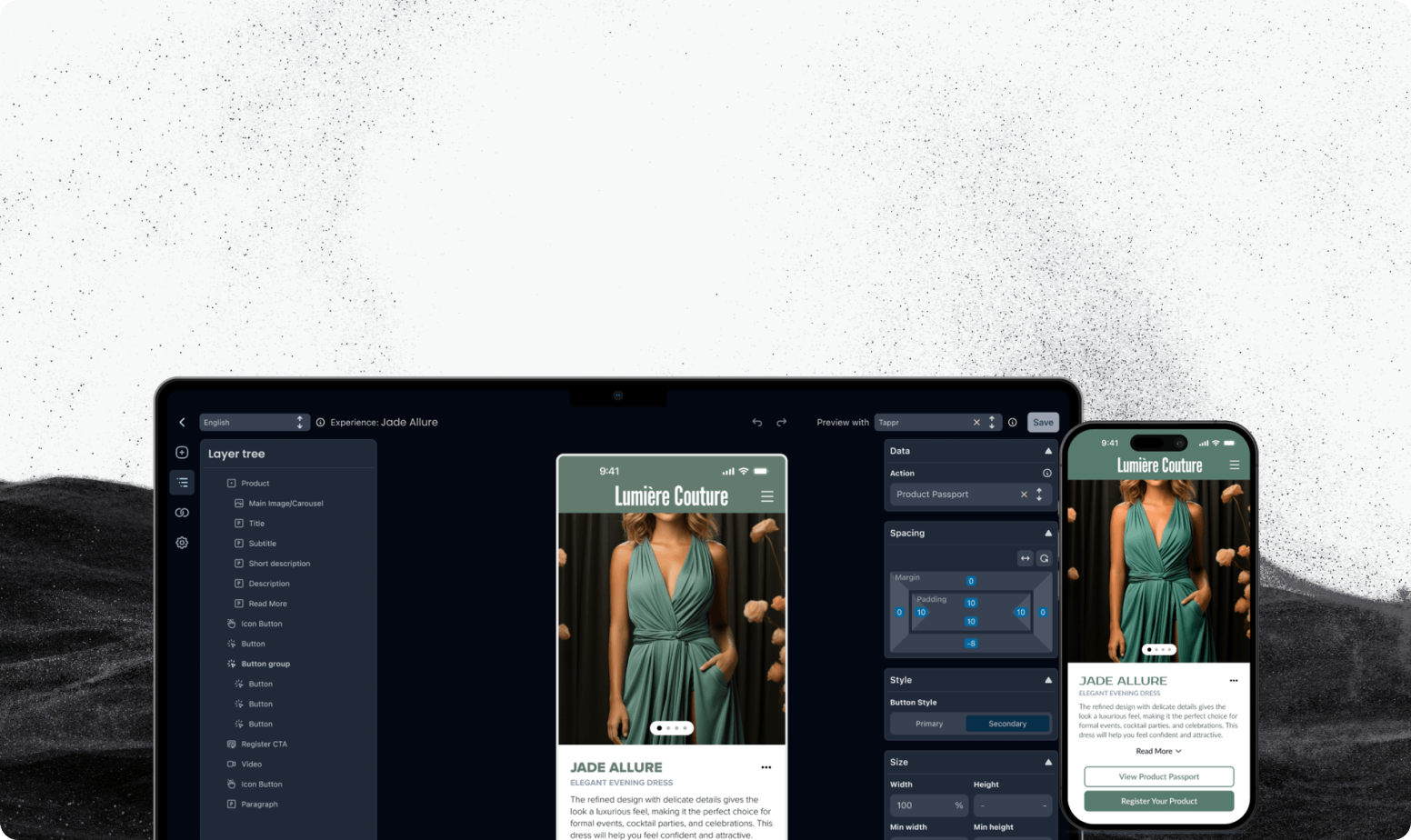
Source: Tappr website
Primary focus: Supply chain visibility and tracking
Traceability-led solutions originate from supply chain mapping and compliance use cases. They focus on tracking materials, suppliers, and production steps across tiers.
Strengths
Limitations
These platforms are well suited for brands prioritizing supply chain control, but they may require additional systems to meet environmental and reporting expectations tied to DPPs.
Example: Fairly Made

Image source: Fairly Made website
Primary focus: Product-level environmental data and compliance
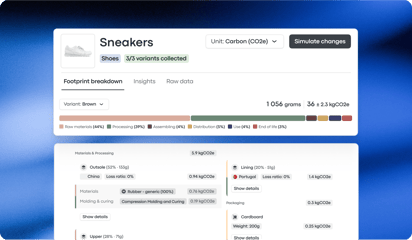
LCA-led DPP platforms are built around environmental measurement and structured product data – built on product Life Cycle Assessments (LCAs). They treat the DPP as an output of a deeper data foundation rather than a standalone artifact.
Strengths
Limitations
For apparel and footwear brands who want to be as transparent and compliant as possible, LCA-led approaches tend to offer the most long-term flexibility.
Example: Carbonfact
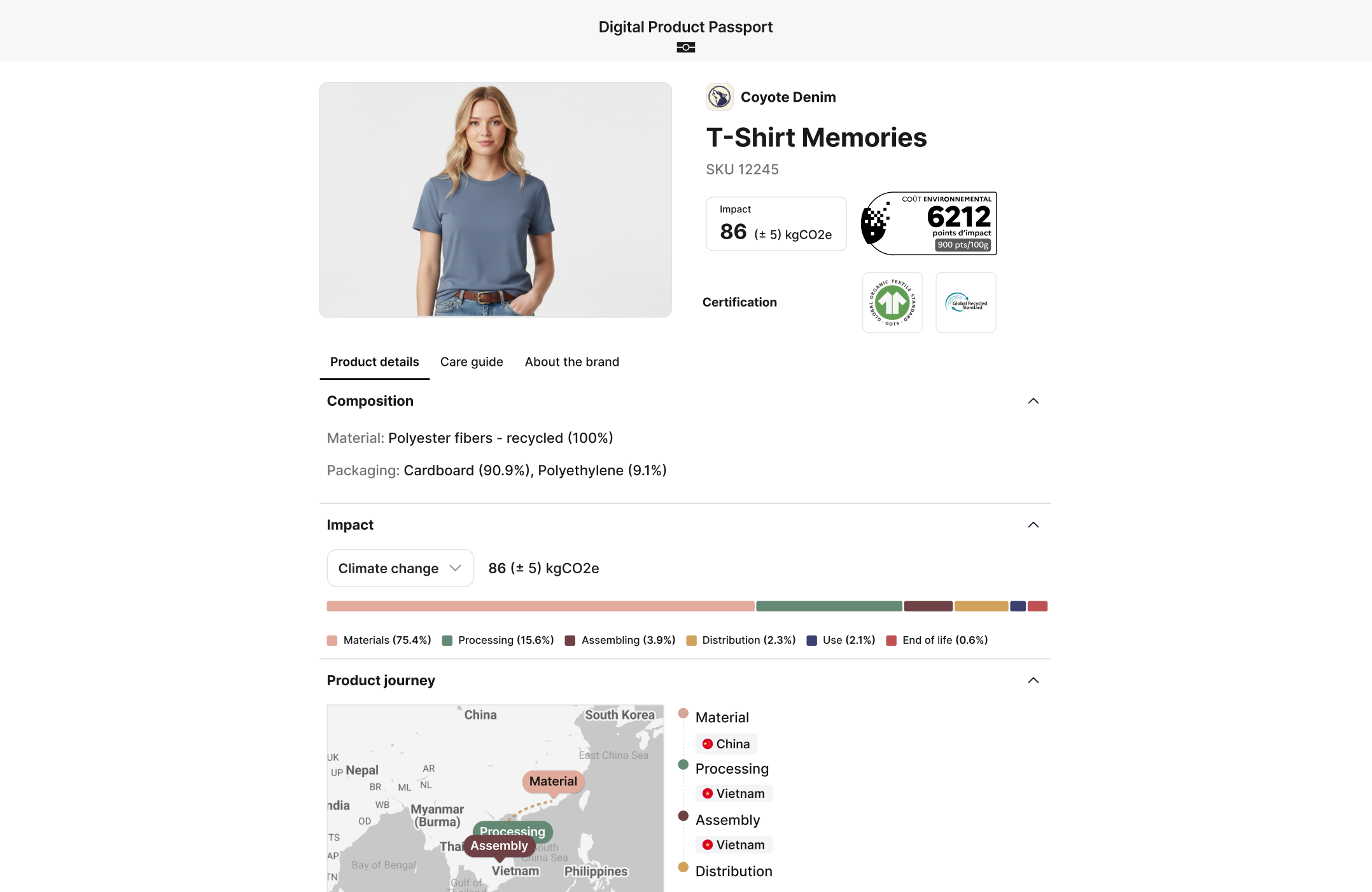
Source: Carbonfact website
Primary focus: Data orchestration and consolidation
Layered DPP systems act as a central aggregation and presentation layer for Digital Product Passports. Rather than generating all data themselves, they ingest data from multiple systems – such as Product Lifecycle Management (PLM) tools, traceability tools, and environmental data platforms like Carbonfact.
Strengths
Limitations
Layered DPP systems are most relevant for large, multi-brand organizations that already operate several specialized data platforms.
Example: EON
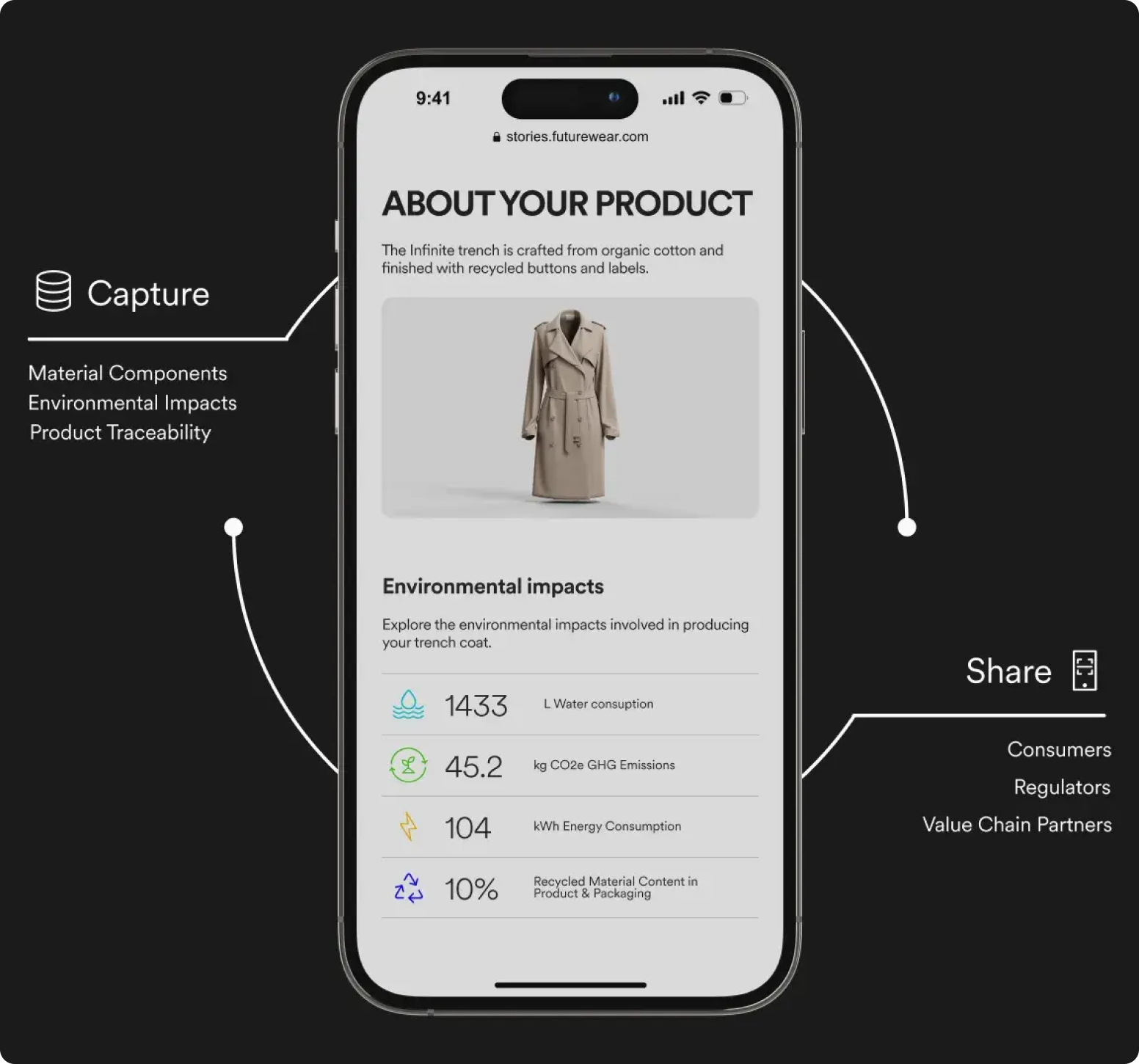
Source: EON website
There is no universally “best” DPP software – only the best fit for a brand’s maturity and objectives.
What matters most is whether the DPP software is built to evolve as requirements expand. For this, a strong data-backed foundation is a must.
Treating DPPs as a one-off project is a missed opportunity. The same product data used for DPPs increasingly feeds:
LCA-led platforms, such as Carbonfact, are designed around this reality. By structuring product-level environmental data first, DPPs become one of several outputs – rather than a parallel system to maintain. Regardless of whether you choose to integrate this data into an Layered DPP system, the foundational product footprint calculations and automatically-generated reports already create strong Return on Investment (ROI).
This reduces duplication and helps brands avoid rebuilding their DPP approach as regulations mature.
When evaluating the best DPP software for fashion, the most important question is not what the passport looks like today, but:
What data foundation does it rely on — and will that still work in three years?
Understanding whether a solution is marketing-led, traceability-led, or LCA-led, or a data consolidator for Enterprise-level companies, gives brands a clearer way to assess long-term fit, compliance readiness, and scalability. The main question to ask is this: do we treat DPPs as a standalone compliance cost, or as an exercise in product-level data we can use across reporting, design, and decision-making?
DPP software helps brands create, manage, and publish Digital Product Passports by structuring product data and making it accessible through a digital link, typically a QR code that leads to a web page. Depending on the solution, this can include product composition, supply chain information, environmental impact data, and care or end-of-life instructions.
DPPs are not yet mandatory, but they are expected to become a legal requirement for apparel and textile products under the EU’s ESPR, with application starting around 2027. Brands selling into the EU should already be preparing their data and systems.
Marketing-led DPP software focuses on consumer-facing presentation and storytelling, often using manually curated data. LCA-led DPP software is built on structured, product-level environmental data (often based on LCAs) and is designed to support compliance, reporting, and decision-making beyond the DPP itself.
Brands with complex IT landscapes and multiple ESG, traceability, and PLM tools often use a layered DPP system to consolidate data from different sources into a single passport. These systems typically depend on upstream tools, such as LCA-led platforms, to generate the underlying data. In short, the answer to this question depends greatly on the IT system landscape: enterprise brands with many tools already in place stand to benefit from a layered DPP system, provided all data can be integrated, while brands without a large selection of IT systems can start smaller and later consolidate into a layered DPP system.
Because LCA-led DPPs rely on reusable product-level environmental data, the same datasets can support CSRD and GHG Protocol reporting, eco-design and material-sourcing decisions. This reduces duplication and turns DPP preparation into a broader operational asset rather than a one-off compliance cost.



Environmental intelligence platform - built for apparel and footwear brands, and their suppliers.