

![[Guide] SBTi: How Fashion Brands and Suppliers Can Set Climate Targets](https://www.carbonfact.com/hs-fs/hubfs/Imagery.webp?width=412&height=244&name=Imagery.webp)

Environmental intelligence platform - built for apparel and footwear brands, and their suppliers.


Status: ✅ SB 253 reporting begins in 2026; SB 261 enforcement paused
For apparel and footwear brands doing business in California, new climate disclosure requirements are taking effect under SB 253 (the Climate Corporate Data Accountability Act) and SB 261 (the Climate-Related Financial Risk Act). Together, these laws set state-level rules for how large brands must report greenhouse gas emissions and climate-related financial risks.
While enforcement of SB 261 is currently paused, SB 253 remains in effect. In-scope brands will be required to begin reporting Scope 1 and Scope 2 emissions starting in 2026, with Scope 3 to follow from 2027. This means fashion companies should start preparing now: building data collection processes across operations and suppliers, as well as drafting initial disclosures in line with the GHG Protocol.
Looking for a Carbon Accounting solution? Find our complete, hands-on guide to Carbon Accounting and the GHG protocol for apparel and footwear brands here.
Now, let’s break down California’s climate laws!
Together, these laws are known as California’s Climate Accountability Package.

SB 253 (the Climate Corporate Data Accountability Act) introduces mandatory greenhouse gas (GHG) emissions reporting for large companies doing business in California. For apparel and footwear brands, this marks the start of regulated emissions disclosure at the state level.
SB 253 applies to emissions reporting only (not financial risk) and follows a phased approach, starting with Scope 1 and Scope 2 emissions and expanding to Scope 3 over time.
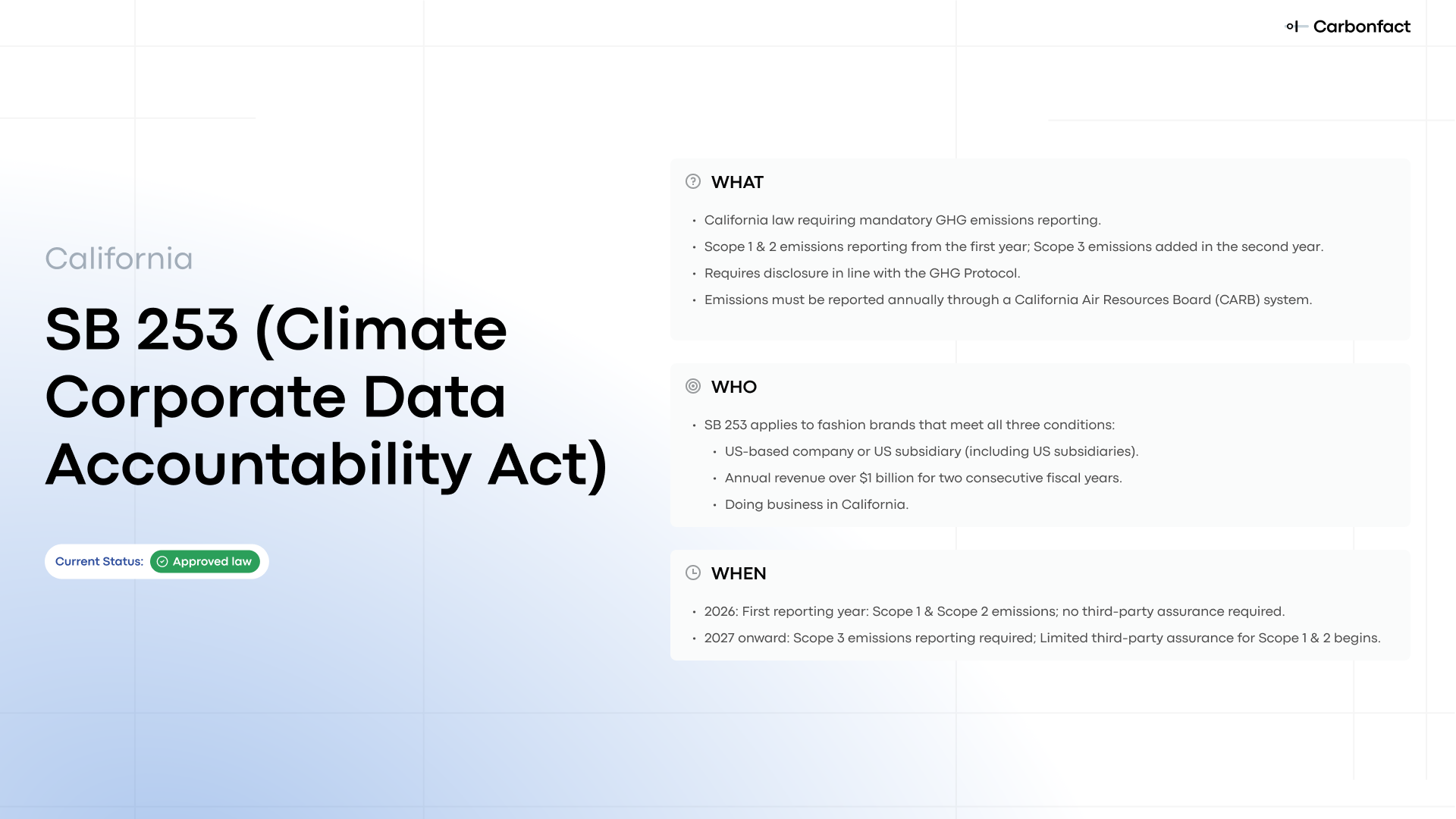
A fashion brand will be in scope of SB 253 if all three of the following conditions are met:
This means SB 253 does not apply to all fashion brands. It targets large companies that meet specific revenue and California business thresholds.
SB 253 requires in-scope brands to measure and disclose their greenhouse gas emissions in line with the GHG Protocol:
Emissions data will be submitted each year through a California Air Resources Board (CARB) managed online reporting system. While the final submission format has not yet been confirmed, brands may use CARB’s updated Scope 1 and 2 reporting template as a reference. Brands must retain records supporting their emissions calculations for at least five years.
For fashion brands with complex global supply chains, the Scope 3 requirement is particularly significant, as it will require data collection beyond direct operations, including raw material sourcing, supplier manufacturing, and logistics.
Carbonfact is a Carbon Accounting and Reporting platform built for apparel and footwear brands. Here is how our platform supports your brand:

In December 2025, the California Air Resources Board (CARB) released draft implementing rules for SB 253. This draft triggered a 45-day public consultation period, running through February 2026, after which CARB is expected to finalize the rules, potentially with revisions based on public feedback.
It is important to understand which requirements are mandatory in 2026 already and which ones start from 2027. Let’s break it down:
For apparel and footwear brands, 2026 is the first reporting year under SB 253 and is designed as a transition period.
2026: What Data Should Be Reported?
Brands must report their Scope 1 and Scope 2 greenhouse gas emissions. SB 253 follows a prior fiscal year reporting approach. For the first year of reporting, CARB’s proposed reporting periods are:
If a fashion brand develops its own annual report that includes information on Scope 1 and 2 emissions, that report can be submitted to CARB for 2026 reporting.
2026: What Is the Deadline for the First Report?
The first reporting deadline is August 10, 2026.
2026: What If a Brand Was Not Collecting Emissions Data?
California Air Resources Board (CARB) has clarified that:
CARB will make these statements available through a public portal.
2026: Is Third-Party Verification Required For Emissions Data?
For the 2026 reporting cycle, no third-party assurance is required, and CARB will not penalize companies that make a genuine, reasonable effort to comply, even if their first SB 253 submission is incomplete or imperfect.
Important: The 2026 submission will establish the baseline for all future SB 253 reporting. Decisions made in year one –such as greenhouse gas boundaries, calculation methodologies, and data documentation –will carry forward into future disclosures. If these foundations are weak, you may need to redo the work later when third-party verification applies.
From 2027 onward, reporting requirements are expected to tighten. Limited assurance on Scope 1 and Scope 2 emissions will begin to apply based on 2026 data. This means emissions data will need to be reviewed by an independent third party. Reporting obligations will also expand to include Scope 3 emissions, with further detail to be confirmed as CARB finalizes the regulatory framework.

Maximum penalty: Apparel and footwear brands that fail to file required reports or comply with SB 253 may face penalties of up to $500,000 per year.
Enforcement body: The California Air Resources Board (CARB) oversees compliance.
Factors considered: CARB looks at historical records, whether the brand made good-faith efforts to comply, and the severity and nature of any reporting failures or inaccuracies.
Exemption years for Scope 3: SB 253 includes a safe-harbor provision for Scope 3 emissions, meaning brands will not be penalized for Scope 3 misstatements made with a reasonable basis and in good faith through 2030. This protection does not apply to Scope 1 or Scope 2 emissions.
Now, let’s take a look at the SB 261!
SB 261 (the Climate-Related Financial Risk Act) requires large brands to assess and disclose how climate change could impact their financial performance and operations. Unlike SB 253, SB 261 does not focus on emissions data, but on climate-related risks and how companies manage them.
Fashion companies with over $500M in annual global revenue operating in California. “Doing business in California” follows the same definition used for SB 253.
SB 261 was adopted in 2023 with an initial reporting deadline of January 1, 2026; however, enforcement is currently paused following a court decision. CARB has confirmed it will not penalize companies for missing the initial deadline while legal challenges are ongoing, and a new reporting timeline will be announced once enforcement resumes.
SB 261 requires companies to publish a climate-related financial risk report every two years and make it publicly available.
The report should:
(Both of these bear similarity to the Corporate Sustainability Reporting Directive’s (CSRD) double materiality assessment.)
The reported risks fall into two main categories: physical and transition.
Reports should be aligned with the Task Force on Climate-related Financial Disclosures (TCFD) framework or equivalent standards such as ISSB. While TCFD was formally disbanded in 2023, its recommendations were incorporated into the ISSB standards. As a result, fashion brands already reporting under ISSB or International Financial Reporting Standards (IFRS) are largely aligned with SB 261 requirements.
The four key elements of the TCFD framework are:
Companies are allowed to publish parent-level reports as well as financial risk disclosures that have already been prepared in accordance with other reporting requirements like the Corporate Sustainability Reporting Directive (CSRD).
The issue we frequently hear from brands is that new reporting requirements are highly overwhelming, making it challenging to navigate regulatory hurdles without becoming trapped in endless administrative tasks. That’s where Carbonfact’s philosophy comes in: Measure once - report everywhere.
Carbonfact builds a single, GHG‑Protocol‑aligned Scope 1, 2, and 3 inventory for your brand. Then you can reuse that data everywhere – from SB 253 to CSRD, B Corp, to SBTi – instead of rebuilding new carbon accounts for every regulation.
SB 253 will require annual disclosure of Scope 1–3 emissions, with data submitted via a CARB online system and retained for at least five years. Carbonfact centralizes all Scopes in one platform and automatically produces an audit‑ready GHG inventory that can be used to populate SB 253 reports instead of manually stitching spreadsheets or consultant PDFs every year.


Environmental intelligence platform - built for apparel and footwear brands, and their suppliers.