

![[Guide] SBTi: How Fashion Brands and Suppliers Can Set Climate Targets](https://www.carbonfact.com/hs-fs/hubfs/Imagery.webp?width=412&height=244&name=Imagery.webp)

Environmental intelligence platform - built for apparel and footwear brands, and their suppliers.


Status: ✅ Approved EU law
From August 2026, the Packaging and Packaging Waste Regulation (PPWR) will start introducing European Union–wide requirements to reduce the environmental impacts of packaging across its lifecycle. The regulation sets the objective that all packaging placed on the EU market must be recyclable by 2030 and compatible with the EU collection and recycling systems.
For apparel and footwear brands, the PPWR applies to packaging formats such as shoe boxes, polybags, protective packaging, and e-commerce shipments. It establishes rules on recycled content in plastic packaging, limits on empty space, labeling requirements, and Extended Producer Responsibility.
Let’s dive into the new requirements!
The Packaging and Packaging Waste Regulation (PPWR) applies the life-cycle and the waste hierarchy thinking to packaging. The waste hierarchy is the EU principle that prioritizes preventing waste first, followed by reuse and recycling, with disposal as a last resort. Under the PPWR, this means reducing unnecessary packaging and increasing reuse where possible, before relying on recycling.
Meanwhile, the life-cycle thinking considers environmental impacts across the entire life of the packaging. For brands, this translates into compliance obligations and financial responsibility through Extended Producer Responsibility (EPR) schemes.
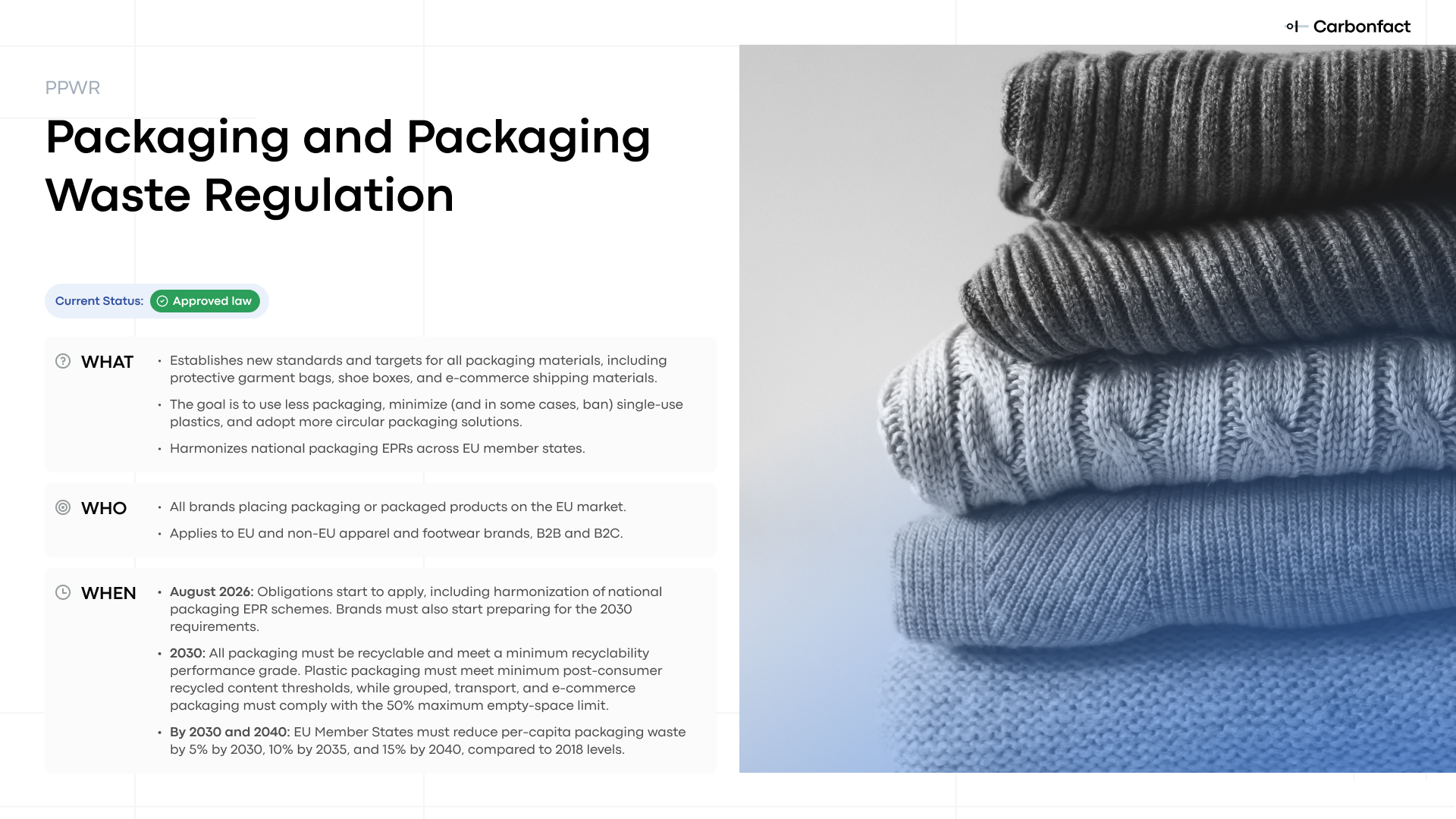
In practice, the regulation focuses on three core objectives:
The PPWR prioritizes waste prevention by limiting excessive packaging, reducing empty space in transport and e-commerce packaging, and restricting single-use packaging.
The Regulation requires packaging to be recyclable and introduces minimum recycled content thresholds for plastic packaging. Together with harmonized labeling rules, these measures aim to improve waste sorting and increase the quality and quantity of material recovered through recycling systems.
By setting EU-wide requirements on packaging design, labeling, and Extended Producer Responsibility (EPR), the PPWR harmonizes different national approaches with a single regulatory framework.
The PPWR applies to any brand that places packaging or packaged apparel and footwear products on the EU market, regardless of where the brand is headquartered.
This includes:
EU-based brands selling apparel or footwear in the EU.
Non-EU brands exporting packaged products to the EU.
B2C and B2B brands, including direct-to-consumer and wholesale.
E-commerce brands, where transport and shipping packaging are used.
Under the PPWR, responsibility for packaging lies with the economic operator that places packaging or packaged products on the EU market for the first time.
"Placing packaging on the market for the first time” means the moment a packaged product is first made available in the EU. For example, when an apparel brand sells a garment in a polybag to an EU retailer or consumer, the brand placing that packaged product on the EU market is responsible.
The PPWR defines “packaging” broadly as any material or product used for the containment, protection, handling, delivery, or presentation of goods. This includes packaging placed on the market regardless of its material, format, or sales channel.
For the apparel and footwear industry, packaging covers everything from protective garment bags to e-commerce shipping materials. Let’s take a look at some examples:
Primary (Sales) Packaging – Refers to the packaging that directly contains and protects the product, typically until it reaches the consumer. This includes garment bags, protective tissue paper, and hang tags or labels.
Secondary (Grouped) Packaging – Used to group together multiple products, either to protect them or to facilitate handling and transport. Think: multi-pack box cartons for socks and accessories.
Tertiary (Transport) Packaging – Used for bulk handling, transport, and shipping. This can refer to either B2B packaging, such as pallets and stretch wrap, or B2C cardboard boxes and envelopes.
Under the PPWR, an item is not considered packaging only if it is integral to the product and necessary for its function throughout its entire lifetime.
While all EU states already have Extended Producer Responsibility (EPR) systems for all packaging, PPWR will standardize requirements across the EU. From August 2026, these harmonized rules will replace national legislation to strengthen waste reduction and recycling efforts.
Every brand selling in the European Union will have to:
Step 1 – Register in every EU country where they sell into.
Non-EU brands placing packaging on the EU market must appoint an authorized representative for EPR in each Member State they sell into.
Step 2 – Report annually
Today, each Member State's PRO defines its own producer register, with its own data fields, ID formats, and onboarding flow. From August 2026, PPWR sets common minimum requirements for these national registers – same producer definition, same data points.
The Commission will publish an implementing act setting the harmonised producer register and reporting formats. That act is still pending. Until then, brands continue to use each PRO's existing format.
Step 3 – Pay the fee: weight × material base rate × eco-modulation coefficient
Weight – total kilograms of each packaging material placed on the market in that country per year
Base rate – a fee in €/tonne set by the national PRO, which varies significantly by country and material.
Eco-modulation – a multiplier applied based on recyclability.
Fee increase incoming: From August 2026, EPR fees apply but are based on each country's existing national rules. The Commission has until January 2028 to publish the criteria defining recyclability grades A, B, and C (more on that in the next chapter). Once published, member states have 18 months to update their national EPR fees accordingly, so packaging with the worst letter will pay more in EPR fees. France, Belgium, and Italy already apply this nationally.
The PPWR sets the EU-wide framework for packaging design, content, labeling, and end-of-life. But the regulation leaves much of the technical detail to delegated and implementing acts that the Commission is publishing through 2028. This means that the requirements will be phased in over time.
Here is the timeline of requirements apparel and footwear brands should keep in mind:
PPWR is an EU Regulation, so it applies directly in every Member State without national transposition. The implementation layer, by contrast, is national: each Member State runs its own EPR register, sets its own fees, operates its own collection and recycling infrastructure, and enforces its own penalties.
The regulation also sets binding EU-wide recycling targets that Member States must achieve through national infrastructure:
Material-specific sub-targets for 2030 include 55% for plastic and 85% for paper and cardboard – the two materials most relevant for apparel and footwear packaging. The table below shows what is decided by Member States vs the EU to achieve these targets:
Carbonfact is the Environmental platform, built specifically for apparel and footwear brands to measure the environmental impact of their products and take actionable steps to reduce their footprint.
PPWR is not only about disclosure but also about packaging environmental performance over time – recyclability, waste prevention, and recycled content – that will allow brands to avoid non-compliance fines.
Our Product Impact Simulation tool enables you to run what-if scenarios on a product level, where you can experiment with different packaging materials, suppliers, renewable electricity share, or transportation methods, and build concrete company-level decarbonization scenarios.


Environmental intelligence platform - built for apparel and footwear brands, and their suppliers.