

![[Guide] SBTi: How Fashion Brands and Suppliers Can Set Climate Targets](https://www.carbonfact.com/hs-fs/hubfs/Imagery.webp?width=412&height=244&name=Imagery.webp)

Environmental intelligence platform - built for apparel and footwear brands, and their suppliers.



Status: ✅ Approved EU law, has been delayed by Omnibus I Simplification Package
The Corporate Sustainability Reporting Directive (CSRD) – which entered into EU law in January 2023 – standardizes sustainability reporting across the European Union as part of the European Green Deal and the EU Textile Strategy. By requiring detailed disclosures on environmental, social, and governance matters, the CSRD helps investors, regulators, and consumers better understand and compare the environmental performance of fashion brands.
Recent updates under the EU’s Omnibus I Simplification Package have narrowed the scope of companies required to report and adjust certain CSRD requirements, making it essential for apparel and footwear brands to stay informed on how these changes affect their compliance obligations.
Let’s dive in!
.jpg?width=1920&height=1080&name=2053%20(1).jpg)
Approved in December 2025, the Omnibus I Simplification Package introduces key changes to the Corporate Sustainability Reporting Directive (CSRD) and the Corporate Social Due Diligence Directive (CSDDD), aiming to simplify compliance requirements.
Read all about Omnibus I in our deep dive for apparel and footwear brands here.
Narrowed Scope: Only textile brands with more than 1,000 employees and over €450 million in annual net turnover remain in scope for the Corporate Sustainability Reporting Directive
Transition Exemption: Apparel and footwear brands that started reporting for the financial year 2024 but fall out of scope under Omnibus I receive a transition exemption and are not required to report for FY 2025 and FY 2026.
Exclusion of SMEs: Listed SMEs are removed from mandatory CSRD reporting and may instead apply the VSME ESRS (Voluntary SME Standard).
Digital Reporting Portal: The Commission will develop a centralized digital portal offering reporting templates and guidance to support compliance.
Voluntary Sector Standards: Reporting becomes simplified, with sector-specific European Sustainability Reporting Standards (ESRS) made voluntary. The European Commission is currently revising the general ESRS.
As part of the EU’s Omnibus I Simplification Package, the Stop-the-Clock mechanism was adopted in April 2025, delaying the application of certain CSRD and CSDDD requirements. While the CSRD was initially introduced through a wave-based rollout, Omnibus I simplifies this by limiting CSRD to a smaller group of companies defined by clear employee and turnover thresholds – meaning brands with more than 1,000 employees AND over €450 million in net annual turnover remain in scope.
Here is the timeline:
Wave 1 – NFRD brands
Who: Listed EU public-interest entities with more than 500 employees, already subject to the former Non-Financial Reporting Directive (NFRD).*
When: No change, reporting started in 2025 for the 2024 financial year.
Large EU brands (previously wave 2)
Who: Fashion companies with more than 1,000 employees and over €450 million in net annual turnover.
When: First reporting in 2028, covering the 2027 financial year (two-year delay).
Listed SMEs (previously wave 3)
Who: EU-listed SMEs.
Status: Removed from CSRD scope under Omnibus I reporting will be voluntary under a simplified standard based on VSME ESRS (Voluntary SME Standard).
Non-EU brands (previously wave 4)
Who: Non-EU parent companies generating more than €450 million in net turnover within the EU, with activity through an EU subsidiary or branch.
When: No change, first reporting in 2029 for the 2028 financial year.
*You may already be aware of the Non-Financial Reporting Directive (NFRD), which introduced similar reporting requirements in the EU. These were deemed insufficient, and in 2021, the CSRD replaced and expanded the NFRD's reporting requirements.
Important to note: Brands with fewer than 1,000 employees or less than €450 million in net annual turnover fall outside of the CSRD scope and do not need to report. For example, a fashion brand with 900 employees and €600 million in net annual turnover is not in scope.
For many big fashion brands, the delayed deadline for CSRD reporting will enable them to implement carbon accounting and life cycle assessment tools and procedures in advance.

The Corporate Sustainability Reporting Directive requires textile companies to publish non-financial information in accordance with the European Sustainability Reporting Standards (ESRS) developed by EFRAG (European Financial Reporting Advisory Group).
The ESRS outlines how and what information and ESG metrics apparel and footwear brands need to report to European regulators to comply with the CSRD. Overall, there are 12 European Sustainability Reporting Standards (ESRS).
In addition to the Climate Standard (ESRS E1) and the publication of Scope 1, 2, and 3 emissions information, the CSRD requires the publication of information relating to water, pollution, biodiversity, and circularity, as well as social information concerning workers and consumers.
EFRAG is also developing sector-specific ESRS for high-impact industries, including textiles. Under the Omnibus I agreement, these sector-specific standards will become voluntary and will be published at a later date.
The 12 topical ESRS continue to be organized into four areas: the cross-cutting standards (ESRS 1–2), the environmental standards (E1–E5), the social standards (S1–S4), and the governance standard (G1).
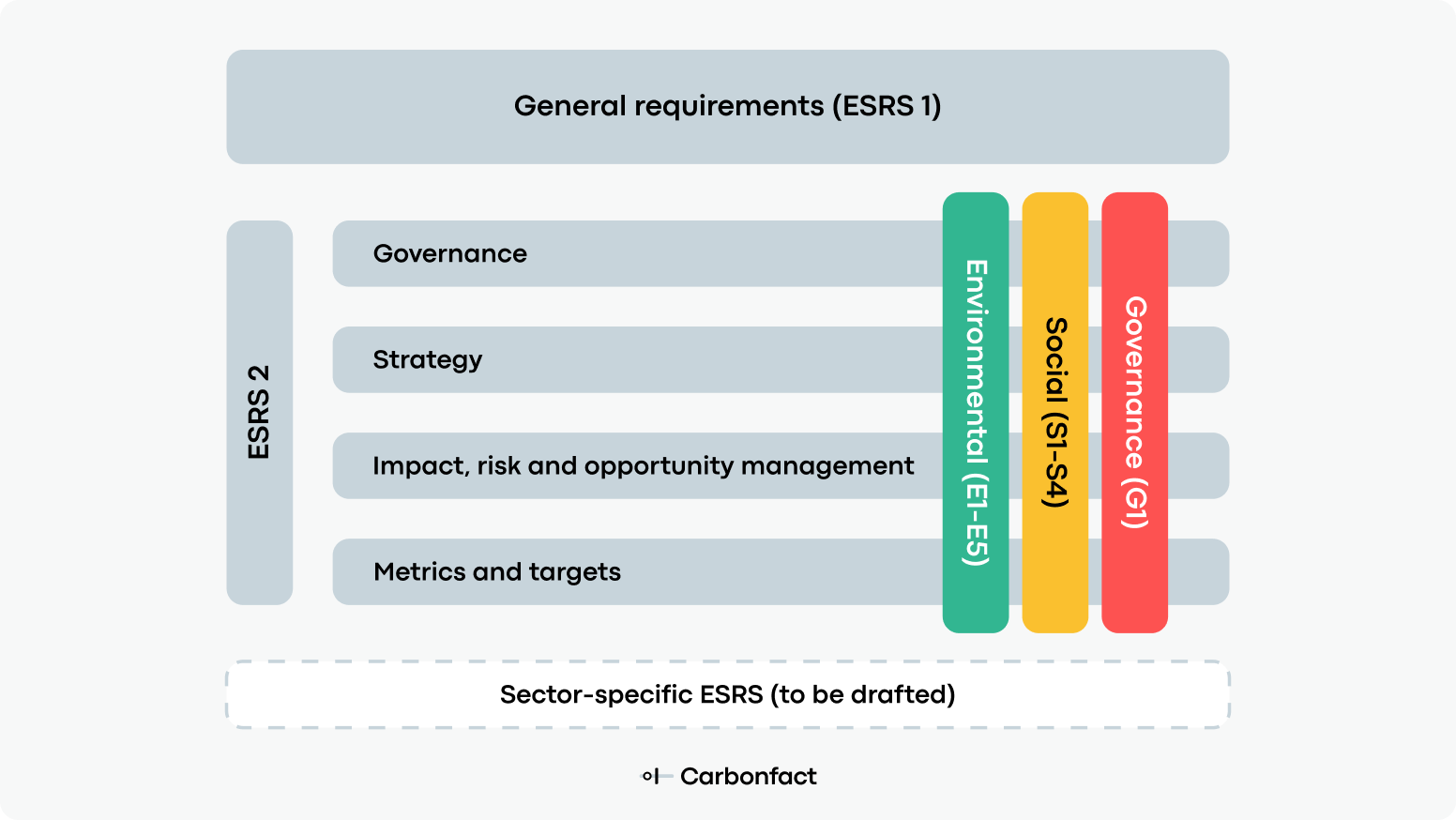
In December 2025, EFRAG submitted its technical advice on a revised, simplified set of general ESRS standards, reflecting lessons learned in 2024 by ‘wave 1’ reporters and the objectives of the Omnibus I Simplification Package.
Proposed simplification includes:
Usefulness of information as a general filter: ESRS disclosures must now be assessed through a “usefulness” lens. Textile companies should report information that genuinely helps users understand sustainability performance, rather than producing highly technical or excessive disclosures purely for compliance.
Simplified materiality assessment: The materiality assessment process now includes clearer step-by-step guidance, reduced documentation requirements, and better alignment with what auditors will expect. This lowers the workload for apparel and footwear brands and removes ambiguity around how to determine what is material.
Flexibility for value chain data collection: The previous expectation to obtain direct data from suppliers is removed. Textile brands may now rely more on estimates, proxies, or industry averages where direct data is not feasible
Phased-in requirements: The revised ESRS add practical reliefs – such as exemptions, simplified disclosures, and delayed timelines – for topics considered difficult or resource-intensive (e.g., biodiversity, financial effects, certain social metrics).
Principles-based narrative disclosures: Fashion brands now have more flexibility in how they explain their sustainability policies, actions, and targets. Instead of following strict templates, they can describe their approach in a way that reflects how sustainability is managed in practice.
Shorter and clearer ESRS: The standards have been rewritten to remove redundancies, reorganize content, and simplify language. This makes ESRS more accessible, easier to interpret, and faster to implement.
Reduction in mandatory data points: 61% reduction of data points that are required if material, deletion of all voluntary disclosures.
Enhanced interoperability with ISSB Standards: Overlaps with ISSB (International Sustainability Standards Board) have been strengthened, including alignment on GHG boundaries and treatment of anticipated financial effects. However, some ESRS reliefs go further than ISSB rules, meaning fashion brands aiming for ISSB compliance must review these differences carefully.
The European Commission will now prepare the Delegated Act revising the first set of ESRS based on EFRAG’s technical advice.
Although this will implement simplifications, the overall architecture of the ESRS remains unchanged. Fashion brands will continue reporting under the same four pillars – the cross-cutting, environmental, social, and governance standards – and the core disclosure topics such as climate, pollution, biodiversity, water, circularity, workers, and governance all remain in place.
What changes is not the structure, but the way apparel and footwear brands report: fewer data points, clearer guidance, a simpler materiality assessment, and greater flexibility for value-chain data.
Now, let’s see what’s inside the European Sustainability Reporting Standards (information is subject to change as ESRS are being revised).
These standards encompass General Requirements and General Disclosures, which “cross-cut” different sectors and industries. ESRS 1 establishes general requirements, such as important concepts and principles, that must be followed when reporting under the CSRD, while ESRS 2 outlines reporting requirements that must be followed under the three topical standards (Environment, Social, and Governance).
ESRS 1 also introduces the double materiality assessment, which emphasizes the consideration of both the external impacts of an organization’s activities on the environment and society, and the internal impacts of sustainability factors on the organization's financial performance. We’ll explore this in greater detail below.
These five standards require fashion companies to disclose information on greenhouse gas emissions, air and water pollution, and impacts to biodiversity. The ESRS environmental standards also dig into resource usage and circularity. These disclosures apply across the value chain, focusing on material and high-risk stages such as material sourcing, manufacturing, and end-of-life. Under the simplified ESRS, companies may rely on estimates and proxies where primary data is not reasonably available. Carbonfact’s CSRD software helps apparel and footwear brands to measure and disclose the environmental CSRD requirements.
ESRS S1 to S4 represent the social indicators within the European Sustainability Reporting Standards, offering a structured approach for textile brands to report on their social and human rights performance. These provide information on social matters, including employee-related aspects, human rights, and diversity policies. This includes fashion brand employees as well as workers across the value chain.
The governance standard emphasizes corporate governance, including structures, processes, and policies that influence decision-making within an organization. It encourages transparency and accountability in disclosing information related to governance structures, the composition of boards, and measures taken to ensure ethical and responsible business practices. Apparel and footwear brands will be asked to describe their business model and how sustainability considerations are integrated into their strategy. They are also required to report on how the brand identifies and manages sustainability-related risks.
Among the 12 ESRS reporting standards, the ESRS E1 standard on climate change is the most detailed and demanding. It includes nine disclosure requirements and is one of the most comprehensive standards.
There is in the ESRS E1 a clear reference to the GHG Protocol as one of the methods that can be used. Read our ESRS E1 Climate Reporting deep dive for apparel and footwear brands here.

Carbonfact is a CSRD reporting software built for the needs of the fashion industry. We help you:
This is a new reporting requirement presented by the CSRD. Simply explained, for each of the ten topical standards in the ESRS, textile companies will need to conduct a materiality assessment, determining what data points are relevant (i.e., material). If not relevant – or material – the brand will not be required to report on them.
It assesses how business actions affect or may affect both sustainability and financial aspects. Taking ESRS E1 Climate Change as an example, what is the impact of climate change on their business financially, and what is the business’s impact on climate change.
That said, for apparel and footwear brands, many of the standards, such as Climate Change, Labor Rights, etc, will definitely be material.
Targets: The Corporate Sustainability Reporting Directive mandates textile organizations to establish concrete targets, choose a baseline, and report their progress in achieving these specified objectives.
Audit requirement: The CSRD introduces an audit assurance requirement for its reporting.
Some apparel and footwear brands were already required to report in 2025 because they were previously subject to the EU’s Non-Financial Reporting Directive (NFRD). These brands formed the first group to transition into CSRD-style reporting, publishing sustainability disclosures for the 2024 financial year ahead of the broader CSRD rollout.
Here are some examples:
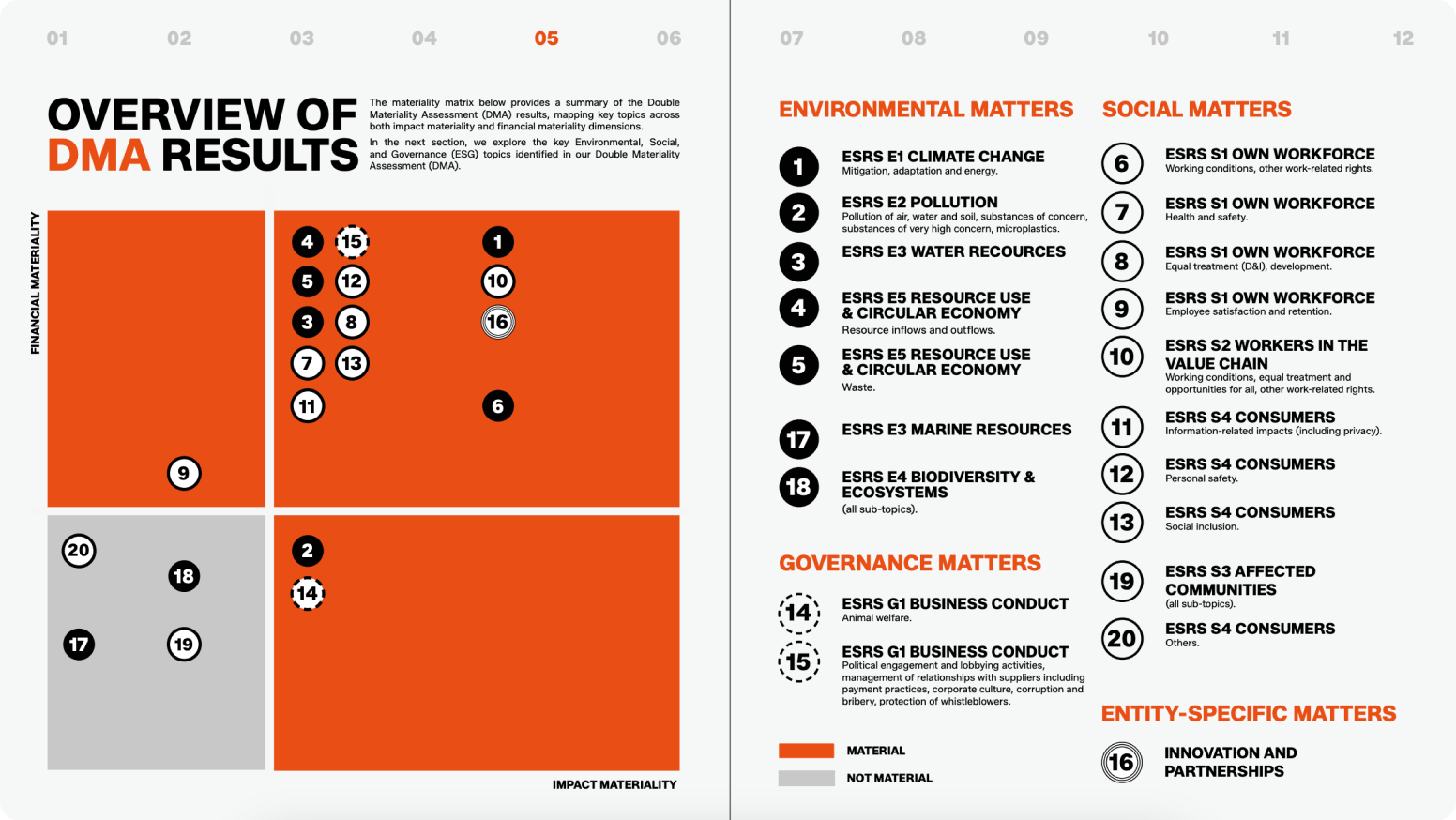
Source: Zalando 2024 Sustainability CSRD Digest
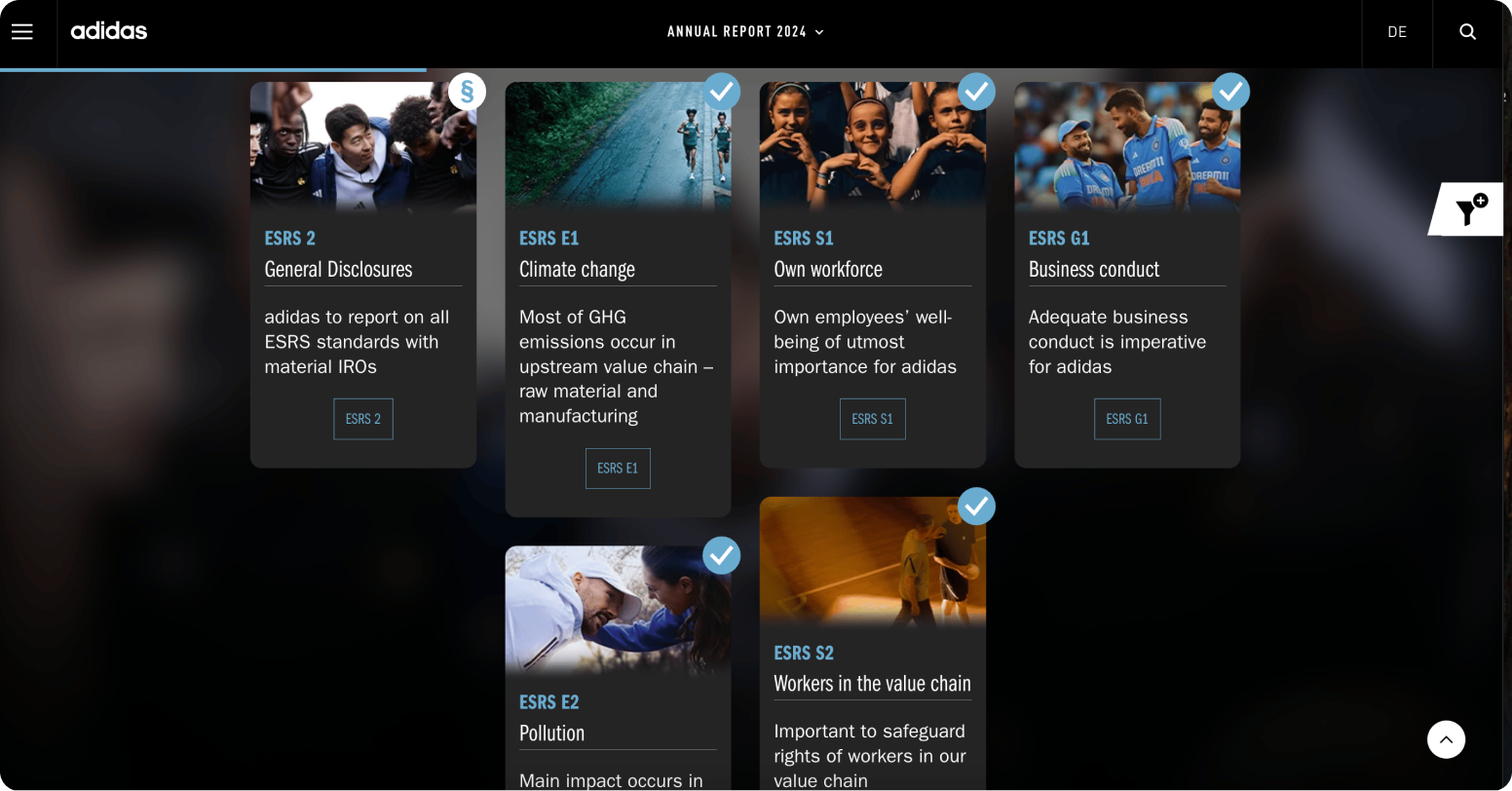
Source: Adidas Annual Report 2024
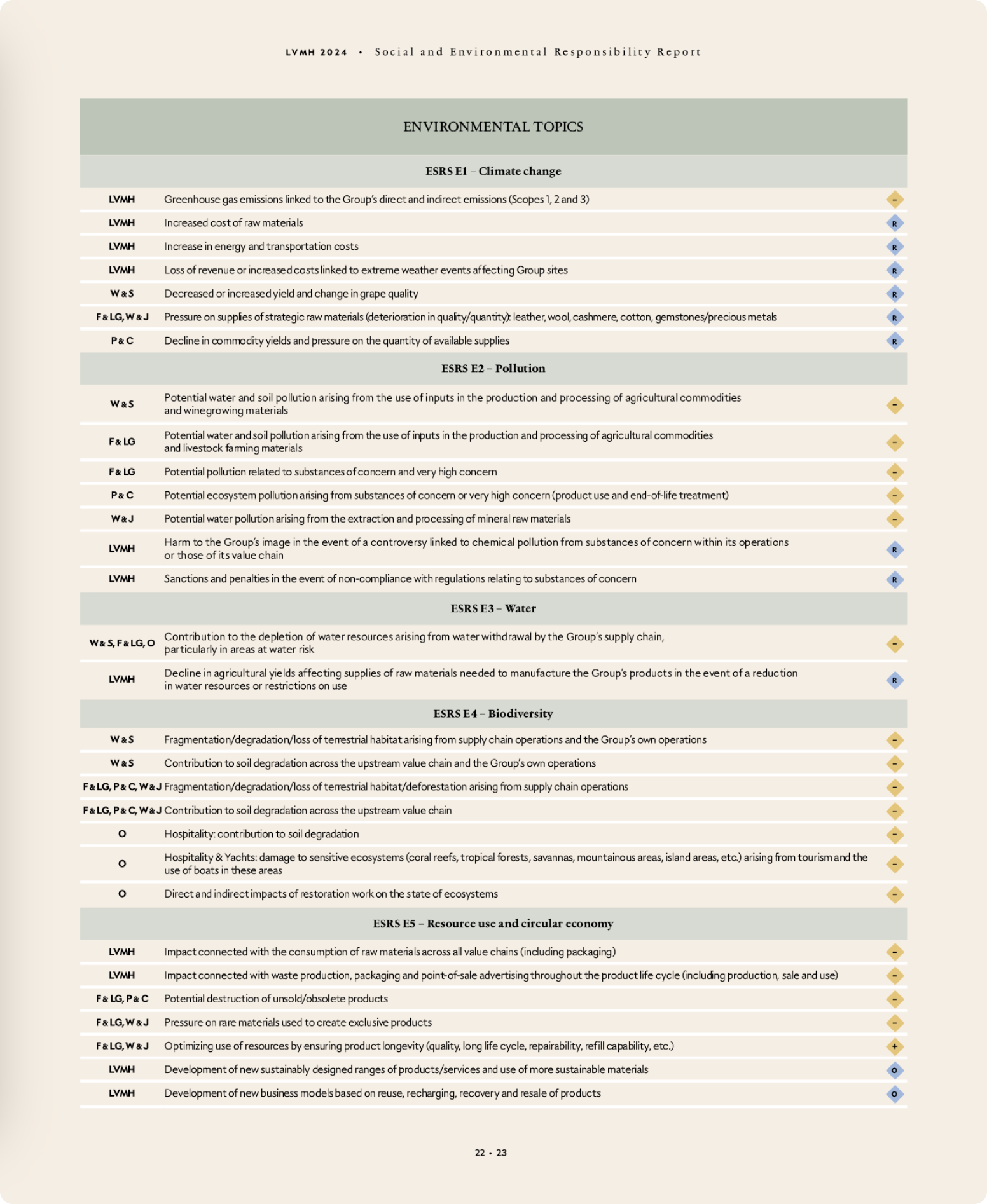
Source: LVMH 2024 Social and Environmental Responsibility Report
While brands technically have until 2027/2028 to fully comply with the CSRD, it’s essential that apparel and footwear brands start preparing now.
We recommend:
Conducting a double materiality assessment: As mentioned above, double materiality is a new reporting requirement. The first step in a materiality assessment is identifying what data points are considered “material” and will need to be reported on.
Conducting a data gaps analysis: Find out what primary data you already measure, where it is located, and what you haven’t yet measured.
Select the right CSRD reporting software: You will need to select the right tools that will help you centralize, provide, and analyze all the data points that you are required to report on. For the environmental standards, for example, you will need the following features:
As mentioned above, even if your brand’s reporting deadline isn’t until 2027 or 2028, you will need to begin tracking this data within the next two years.
Carbonfact is a CSRD Reporting Software tailored to the needs of apparel and footwear brands. Our solution helps fashion brands and suppliers track, measure, and report in accordance with the ESRS, ensuring they can accurately report on the CSRD. Because our team specializes in the fashion and textile industries, we are uniquely positioned to help brands navigate new EU and U.S. regulations around environmental sustainability.
Here is how:
The platform generates compliant reports that align with the European Sustainability Reporting Standards (ESRS), particularly:
ESRS E1 (Climate Change): Tracks GHG emissions, sets reduction targets, and supports transition planning.
ESRS E2-E5: Surfaces data for pollution, water, biodiversity, and resource use.
You can export your CSRD report directly from the Carbonfact platform with pre-filled templates
Key benefits:
Automated GHG Carbon Accounting: Automatically calculates Scope 1, 2, and 3 emissions at both company and product levels, aligned with GHG Protocol and ESRS E1 requirements.
Product-Level Life Cycle Assessment (16 PEFCR Indicators): Measures 16 environmental indicators (carbon, water consumption, pollution, etc.) for every SKU based on the PEFCR methodology, supporting multiple ESRS environmental standards (E1-E5).
Pre-Filled CSRD Report Export: Generates compliant reports with pre-filled templates that automatically transform your data into CSRD reporting format – you just need to hit export.
Data Consolidation & Smart Filling: Connects to multiple data sources (PLM, ERP, supplier portals) and uses intelligent "smart filling" to overcome data gaps, ensuring complete reporting without manual templates.
Version Control & Changelog: Tracks all calculations over time with full transparency and version control, creating an auditable trail essential for CSRD reporting requirements.
Bonus: The platform syncs your CSRD report with source data in real-time, so when data updates, your report automatically reflects changes without re-running manual analysis.



Environmental intelligence platform - built for apparel and footwear brands, and their suppliers.