

Environmental intelligence platform - built for apparel and footwear brands, and their suppliers.

-1.jpg?width=48&height=48&name=430471923_947159710328078_7998316763082046126_n%20(1)-1.jpg)
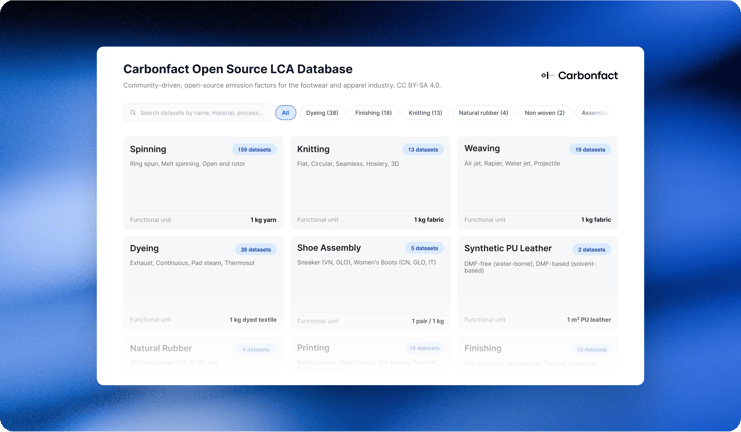
Carbonfact, the Environmental Intelligence platform for apparel and footwear, today released 300+ fully disaggregated LCA datasets for spinning, dyeing, weaving, and knitting, free to use for brands, suppliers, and researchers, available at carbonfact.com/database.
The release addresses a long-standing problem with LCA data for textiles. Most emission factor databases bundle different process technologies into a single, aggregated value. A dyeing process, for example, gets one emission factor regardless of whether it runs continuous or batch, which fiber it processes, or which chemicals it uses, with no visibility into the energy, water, or process inputs behind it.
Brands relying on these factors for product footprints and carbon accounting have had to take that number on faith, with no way to verify it, adapt it to their supply chain, or defend it in an audit.
Carbonfact's database solves this by disaggregating at the unit-process level, differentiating by fiber type, dye, and process technology, rather than bundling everything into a single category average. Every parameter is visible, auditable, and replaceable with a brand's own supplier data. For example, across dyeing, the difference ranges from –52% to +86% compared with the most widely used public dataset.
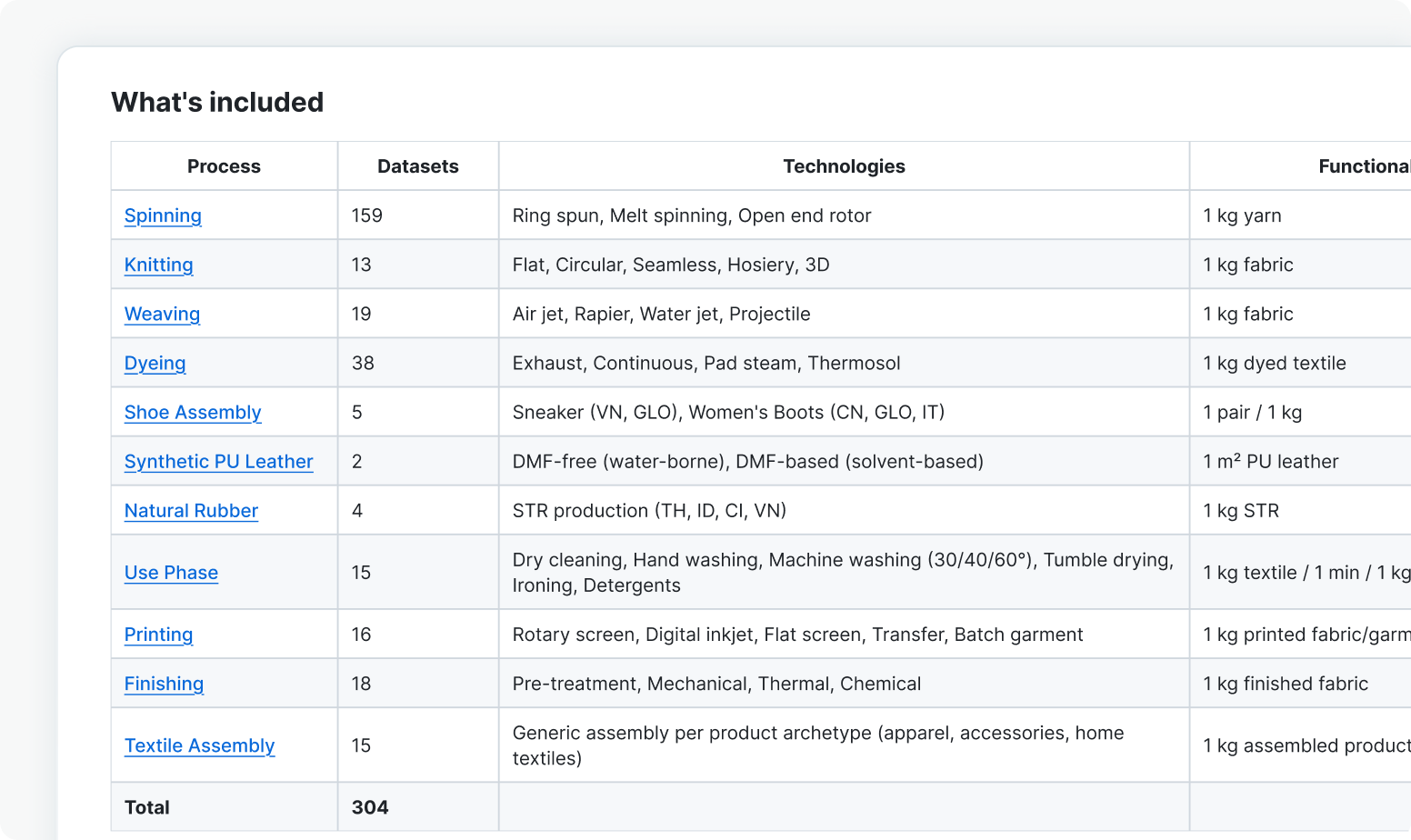
This first release contains 300+ LCI datasets across spinning (159), dyeing (38), weaving (19), finishing (18), printing (16), textile assembly (15), the textile use phase (15), knitting (13), shoe assembly (5), natural rubber (4), and synthetic PU leather (2).
Each dataset includes full methodological documentation and emission factors across all 16 PEFCR environmental indicators. Subsequent releases will add non-woven fabric formation, viscose, apparel assembly, bovine leather, and dyeing and printing chemicals.
The database was built entirely in-house by Carbonfact's science team, drawing on peer-reviewed literature, direct engagement with textile manufacturers, and primary factory data from Carbonfact for Suppliers, a free data exchange platform used by thousands of facilities. It uses ecoinvent as its background database, covering upstream impacts including energy, chemicals, transport, and waste treatment.
Every dataset has been validated against real production processes and is released under CC BY-SA 4.0, free to use, adapt, and build on, provided derivatives credit Carbonfact and share under the same terms.
"Decarbonizing fashion is not something one company does alone. You can only reduce what you can measure, and better measurement requires data that is open, transparent, and improvable by the people closest to the supply chain. That is why we are releasing this freely, so brands, suppliers, and researchers can use it, challenge it, and make it better.”

The database has drawn strong responses from practitioners at major apparel brands and the European Commission. Carbonfact is participating in the Data Working Group (DWG) of the Environmental Footprint Technical Advisory Board (EF TAB) at the European Commission, working on the next generation of EU methodology standards.
"Carbonfact's textile expertise is apparent in this data repository. We're happy to welcome Carbonfact as a data supplier, and look forward to integrating their data into future releases of our database.”

"We see a lack of robust, transparent data in the apparel and footwear industries. Carbonfact's database fills important gaps, which shows their expertise. We look forward to putting it to use in our own assessments and seeing the impact it has on data quality across the sector."


"Carbonfact's open database stands out for its disaggregation and transparency of textile manufacturing processes, filling an important gap left by the proxy-based, highly generic data most public datasets rely on. It's a positive initiative for the industry: such a public dataset can contribute to a common foundation that may eventually feed into mechanisms like the French environmental cost.”

-1.jpg?width=100&height=100&name=430471923_947159710328078_7998316763082046126_n%20(1)-1.jpg)

Environmental intelligence platform - built for apparel and footwear brands, and their suppliers.