


Environmental intelligence platform - built for apparel and footwear brands, and their suppliers.

-1.jpg?width=48&height=48&name=430471923_947159710328078_7998316763082046126_n%20(1)-1.jpg)
"You Ask, We Answer" – brought to you by Carbonfact's Head of Science. Each week Dr. Laurent Vandepaer, PhD together with Carbonfact's Science Associate Vincent Carrières answers one of your questions about sustainable materials, manufacturing impact, and energy transition in the apparel and footwear industry.
Before joining Carbonfact, Laurent led the integration of LCA into the sustainability and innovation efforts at On and performed LCA for other brands like Arc'teryx. Vincent joined Carbonfact after three years as a sustainability expert at Quantis, where he specialized in LCA and corporate footprinting.
What is the carbon footprint of TPU midsoles, and how does supercritical injection foaming affect it?
Asked by the Head of Sustainability from a footwear brand
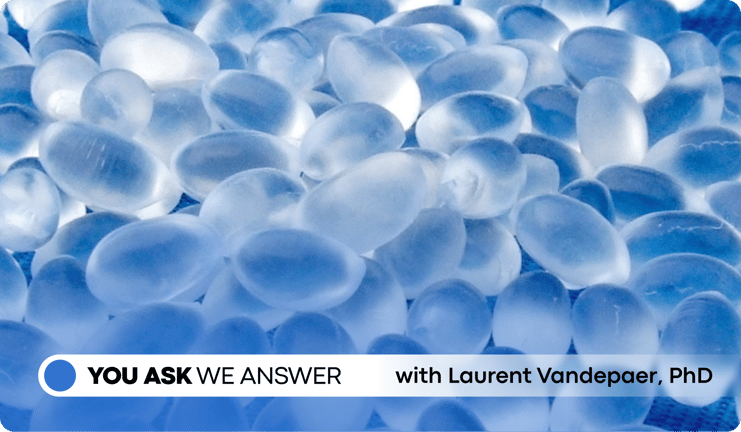
Thermoplastic polyurethane (TPU) is a versatile plastic material made from flexible and rigid building blocks linked together. This block structure gives TPU a distinctive balance of properties:
Elasticity – bounces back quickly after being compressed, giving good energy return when running or walking.
Durability – resists wear and tear.
Processability – can be heated, shaped, and reshaped into different forms.
Flexibility and transparency – can be soft or rigid, and in some cases clear, offering more design options than many traditional foams.
In footwear, TPU is increasingly used in midsoles, particularly in performance and lifestyle shoes where brands aim for lighter weight, higher responsiveness, and improved durability compared to conventional EVA foams (a flexible, cushioning foam made from petroleum-based chemicals).
Beyond midsoles, TPU is also used in outsoles, heel counters, and upper overlays, where durability, structural support, and impact resistance are required.
However, conventional TPU is produced from petrochemical feedstocks, derived from fossil resources. As a result, its carbon footprint begins upstream, at the oil and gas extraction and chemical production stage, before it is even processed into pellets or foamed into a midsole.
As TPU midsoles are primarily used in sports, the decision is rarely about material preference alone – it is about meeting strict performance requirements at scale. These include long-term mechanical stability under repeated high-impact use to prevent injury risk.
Because of this, replacing TPU with low-carbon alternatives is not a simple decarbonization lever. Alternative materials often struggle to match the same mechanical profile while remaining scalable and cost-efficient. Performance trade-offs can lead to higher return rates or shorter product lifespans – which may offset environmental gains.
As a result, many brands focus on optimizing the TPU they already use – reducing emissions through cleaner electricity, improved foaming efficiency, lower scrap rates, and partial recycled or bio-based inputs, rather than replacing the material entirely.
Industry example: Carbonfact customer On’s CleanCloud® shoe features an outsole made with 35% upcycled TPU sourced from landfill waste, developed in collaboration with Novoloop.
.png?width=1552&height=880&name=box%20(13).png)
Industry example: VAUDE uses Covestro’s Desmopan® CQ (Circular Quality) TPU, which contains up to 60% bio-based content in the midsoles of its hiking boots.
.png?width=1552&height=880&name=box%20(14).png)
(Bio-based midsole for VAUDE hiking shoes)
The carbon footprint of TPU primarily depends on:
Recently, Cirql, a next-gen supplier in the footwear industry, collaborated with Carbonfact’s science team to publish a Life Cycle Assessment (LCA) of Cirql® rTPU50™ – midsole made with 50% recycled TPU (rTPU50) via supercritical foaming process.
Cirql’s mission is to reduce landfill waste and eliminate harmful chemicals from footwear manufacturing by redesigning midsole materials and processes.
This LCA evaluates three scenarios for midsoles to understand the environmental impacts of different material formulations and energy sources:
100% virgin TPU, processed directly into midsoles via supercritical injection foaming (no compounding step required).
50% recycled TPU (rTPU50) with grid electricity, including a compounding step prior to foaming. Compounding is a process of blending virgin TPU pellets with recycled TPU.
50% recycled TPU (rTPU50) with partial renewable electricity, using a 20% solar / 80% grid electricity mix.
For one pair of midsoles (182 g total mass), the cradle-to-gate climate change impact is:
2.32 kg CO₂e per pair when made from 100% virgin TPU, using grid electricity.
1.72 kg CO₂e per pair when made from rTPU50 (50% recycled / 50% virgin TPU) under the same manufacturing and electricity conditions.
Switching from 100% virgin TPU to a 50% recycled formulation reduces the product-level footprint by approximately 26%.
When the electricity mix is further adjusted to include 20% solar power (80% grid electricity), the impact decreases to approximately 1.58 kg CO₂e per pair.
All values represent cradle-to-gate impacts, including raw materials, compounding, foaming, and packaging.
The climate change impacts of each scenario are broken down by life cycle stage to identify the main contributors and understand where environmental improvements can have the greatest effect.
The results show:
Virgin material drives the baseline impact: In the 100% virgin scenario, raw materials are the largest contributor. Replacing half of the virgin TPU with recycled content significantly lowers this share.
Manufacturing becomes the main hotspot with recycled content: In the rTPU50 scenarios, electricity used during compounding and supercritical foaming represents the largest share of emissions.
Electricity mix determines further reductions: Adding 20% solar power reduces total impact without changing the material formulation, showing that energy sourcing becomes the next key lever.
Compounding adds a small additional burden: This step appears only in the recycled-content scenarios and contributes a limited share of total emissions.
.png?width=1552&height=880&name=box%20(16).png)
All impact values in kg CO₂e per pair of midsoles. Percentages indicate the contribution of each life cycle stage to the total impact. Manufacturing includes both compounding and foaming processes.
Supercritical injection foaming is the process used for Cirql® rTPU50™ midsoles. During injection molding, nitrogen or CO₂ is injected into molten TPU. When pressure drops inside the mold, the gas expands and forms a fine, uniform microcell structure.
Performance
This microcell structure is one of the main reasons brands use the technology. It enables lighter midsoles while maintaining high energy return and cushioning performance — which is why it has gained traction in performance running footwear.
No Chemical Additives
Foaming is driven by nitrogen or CO₂, avoiding chemical additives and their by-products.
Autoclave vs Supercritical Injection Foaming
While autoclave foaming currently offers higher performance, supercritical injection foaming, a more recent technology, is rapidly catching up and may soon achieve comparable results. A key advantage of supercritical injection is its 1:1 molding process, which enables co-molding with the outsole or direct sole attachment to the upper without the need for glue.
In contrast, autoclave foaming relies on energy-intensive, multi-step molding processes using primarily high-pressure, high-heat chambers. Supercritical injection foaming is therefore less energy-intensive and can also reduce the number of manufacturing steps.
From a technical standpoint, supercritical injection foaming produces a mix of open- and closed-cell structures. Autoclave foaming, by comparison, creates a closed-cell foam with very fine and uniform cell sizes, which influences both the mechanical properties and the appearance of shoe midsoles.
EVA injection molding vs Supercritical Injection Foaming
Unlike traditional EVA injection molding, which relies on chemical blowing agents and cross-linking reactions that permanently change the material, supercritical injection foaming does not chemically lock the polymer. The material remains thermoplastic, meaning manufacturing scrap can be remelted and reused, and the material stays compatible with recycling systems.
A full LCA comparison with conventional EVA midsole production is a current LCA gap that Carbonfact is working on – we will share the results in the upcoming editions.
Industry example: The Salomon Index.02 features a midsole made from BASF’s Elastollan® TPU, which is manufactured using Supercritical Fluid (SCF) direct injection foaming technology.
.png?width=1552&height=880&name=box%20(17).png)
Industry example: Brooks uses nitrogen-infused supercritical foaming in its DNA LOFT v3 and DNA Flash midsole technologies, where nitrogen is injected into the foam during processing to create a lighter, more responsive cushioning system.
.png?width=1552&height=880&name=box%20(18).png)
(Brooks' Nitrogen-Injected DNA Loft V3 Foam)
Carbonfact for Suppliers is the industry’s first public environmental-data exchange platform connecting brands and suppliers through verified, comparable impact data.
Suppliers can host LCAs with full control over who sees what, while brands can browse materials and request access instantly.
Cirql has joined the Carbonfact for Suppliers network to make its midsole LCA data accessible to footwear brands working to reduce product-level emissions. Brands can now explore Cirql’s materials and manufacturing processes and request environmental data in just a few clicks.
Carbonfact’s science team reviews all LCAs on the platform to ensure methodological consistency and comparability. This allows brands to assess materials using aligned metrics and make more informed sourcing decisions.

Curious to learn more about the environmental impact of other key materials? Deep dive into our previous series:
-1.jpg?width=100&height=100&name=430471923_947159710328078_7998316763082046126_n%20(1)-1.jpg)

Environmental intelligence platform - built for apparel and footwear brands, and their suppliers.