Environmental intelligence platform - built for apparel and footwear brands, and their suppliers.
What’s are the CO2e emissions of Polyethylene?
The carbon footprint of polyethylene ranges from 4.1 kg CO2e per kg (median) to 4.1 kg CO2e per kg (average), with CO2 emissions from polyethylene production primarily driven by energy-intensive cracking of petroleum feedstocks. Greenhouse gas emissions from polyethylene manufacturing stem largely from fossil fuel extraction, refining processes, and polymerization reactions.
- Average footprint per kg: 4.1 kgCO2e
- Median footprint per kg: 4.1 kgCO2e
Emissions by Process Step in Polyethylene Production
The footprint of Polyethylene includes emissions from multiple processing stages. The following process steps were identified as carbon hotspots for Polyethylene production:
- Raw Materials: 66.7%
- Molding And Curing: 18.5%
- Mixing And Preparation: 14.8%

How Does Polyethylene Compare to Alternatives?
Recycled polyethylene production generates 2.6 kg CO2e per kg, representing a 37% reduction in greenhouse gas emissions compared to virgin production at 4.1 kg CO2e per kg.
- Virgin Polyethylene per kg: 4.1 kgCO2e
- Recycled Polyethylene per kg: 2.6 kgCO2e
Polyethylene Water Consumption
Water usage Polyethylene shows recycled material requires 0.9 m3 per kg, while the water footprint Polyethylene per kg for virgin production is negative, indicating Polyethylene water consumption varies significantly by production method.
- Average water use per kg: -1.2 m3
- Median water use per kg: -1.2 m3
Carbonfact for Suppliers
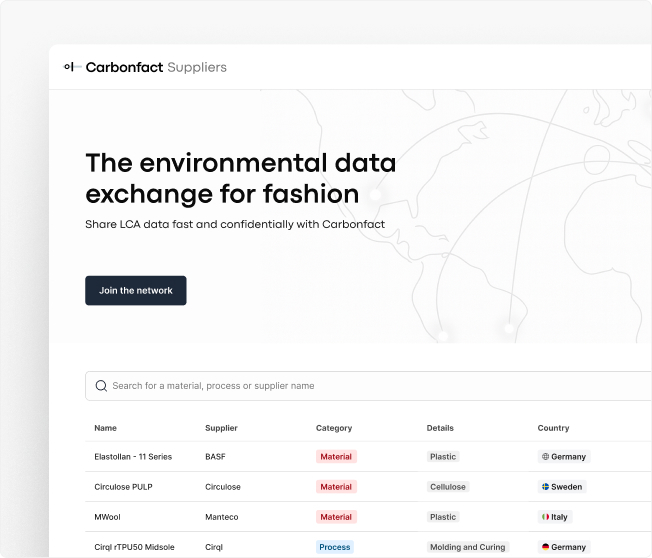
Free directory where 300+ brands discover innovative materials, and suppliers share LCA data confidentially.
CHOSEN by 300+ BRANDS AND SUPPLIERS
 Case study

"Shoes can consist of up to 1500 components. Before Carbonfact, we asked our developers to weigh every single piece but such a manual approach is not scalable. Carbonfact helped us in deriving rules to overcome data gaps by creating accurate assumptions."
Product Sustainability Lead at On

%201.svg)
.svg)
 Case study
"With Carbonfact we can do full product LCAs on all of our products. Thanks to measuring things early on, we can simulate how a new product is going to have a different impact compared to the current version. For example, one of our new products is expected to decrease its footprint by a fourth just by designing it differently."
Strategy & Sustainability at La Sportiva


 Case study

"We needed a solution that could handle the complexities of the apparel supply chain, provide year-to-date insights, and support with detailed scenario analyses for our supply chain. For us Carbonfact is not just a Carbon Management Software, but an extension of our sustainability team."
Secrétaire Générale at A.P.C.




 Case study

"What's really special about Carbonfact is the way that it can work alongside the VF brands to help identify where there are gaps in our product impact data. But also helping us bridge towards improving that data. So it's much more of a partner to solve the challenges we have."
Senior Sustainability Manager, The Northface


 Case study

"The Explorer is, for sure, my favorite feature. I love the ability to look at the breakdown of the carbon footprint per product line, for processes or on a material basis. That's so dynamic that we're able to leverage it in different ways depending on the projects that we're working on or the teams that we're engaging with."
Director of Planet & People Impact at Burton

 Case study
.svg)
"Carbonfact's offerings, particularly its product-level focus for footwear and apparel, ensures we can both measure our carbon footprint and actively find ways to reduce it. Carbonfact has been instrumental in helping us model different scenarios and make informed decisions that align with our sustainability goals."
Sustainability at Allbirds



 Case study
"We have moved from spend-based carbon accounting into Carbonfact to prioritize primary data and get more accurate calculations. The main reason for us to choose Carbonfact is that we now not only get our company's total carbon footprint but also break it down for each of our products."
Global Sustainability Manager at Happy Socks

References
Data sourced from Carbonfact’s proprietary database, powered by over 50 million LCAs run on textile, fashion, and footwear products. The methodology is aligned with the EU Product Environmental Footprint (PEF) and adapted for product category specificity.