-1.jpg?width=412&height=244&name=Imagery%20template%20(2)-1.jpg)

Environmental intelligence platform - built for apparel and footwear brands, and their suppliers.





The Higg Facility Environmental Module (Higg FEM) is a sustainability assessment tool used by manufacturers and brands in the apparel, footwear, and textile supply chain to measure environmental performance at the facility level.
Developed by Cascale (formerly the Sustainable Apparel Coalition), the tool standardizes how factories measure and report environmental impacts across the industry.
The goal is to create a common framework that allows facilities and brands to:
Facilities complete the assessment annually and share results with brand partners through the Worldly platform.
The Higg Index was created to standardize sustainability measurement across the apparel and footwear supply chain. It was developed by the Sustainable Apparel Coalition (now Cascale), a group of brands, manufacturers, retailers, NGOs, and academics working to improve transparency around environmental and social impacts.
Before the Higg Index existed, factories were often required to complete multiple sustainability audits and questionnaires from different brands, many of which asked similar questions but used different methodologies. This created significant duplication of work and inconsistent data across supply chains.
The Higg Index was designed to replace these fragmented assessments with a shared industry framework. Instead of completing numerous audits each year, facilities can complete a single standardized assessment and share the results with multiple brand partners.
Over time, adoption has grown significantly. What began with a few thousand participating facilities has expanded to more than 14,000 manufacturing sites globally, making the Higg Index one of the most widely used sustainability measurement frameworks in the apparel industry.
Factories complete the assessment on the Worldly platform.
The questionnaire asks facilities to report:
Facilities must support answers with documentation such as:
The assessment is not pass/fail. It is designed to identify areas for improvement rather than determine compliance alone.
Completing the full module typically takes 3-6 weeks, depending on how much environmental data the facility has already collected.
Facilities are encouraged to review all questions in advance to understand what information must be gathered.
Higg FEM measures environmental performance at the factory level, not at the level of individual products.
This means the assessment evaluates how a facility operates overall, across all production, rather than calculating the environmental impact of a specific product.
The questionnaire covers key environmental areas such as energy use and emissions, water, wastewater, waste, air emissions, chemicals, and environmental management systems. Together, these provide a standardized view of how well a facility manages its environmental impacts.
Product-level emissions measurement calculates the carbon footprint of a specific product, typically across its lifecycle. Instead of looking at total factory emissions, it allocates impact to individual products or product categories.
Higg FEM is useful for understanding how well a supplier manages environmental impacts and for comparing facilities. But because it operates at the factory level, it does not show how emissions are distributed across products or which products drive the most impact.
As a result, Higg FEM data alone is often not sufficient for carbon accounting, regulatory reporting, or detailed decarbonization strategies.
Product-level measurement provides a more granular view, allowing brands to link emissions directly to products and make more targeted decisions on materials, design, and reduction efforts.
In practice, the two approaches are complementary.
Higg FEM helps assess how a factory operates, while product-level measurement helps understand what drives emissions at the product level.
Both are useful – but for brands focused on carbon accounting and decarbonization, product-level data is often necessary to turn supplier data into actionable insights.
The assessment applies to a single facility entity. The Higg FEM must include:
Facilities cannot exclude parts of the operation when completing the assessment.This ensures the results reflect the full environmental impact of the manufacturing site.
One of the most important aspects of Higg FEM is the three-level maturity model used in each section.
Each environmental category contains:
Basic environmental management and compliance requirements.
Examples include:
Facilities demonstrate more advanced monitoring and management.
Examples include:
Facilities implement advanced environmental performance strategies such as:
If a facility fails to meet Level 1 requirements in a section, the score for that section cannot exceed Level 1 even if Level 2 or 3 questions are answered. This structure encourages facilities to build progressively stronger environmental management systems.
New facilities can start with FEM Foundations, a simplified version of the module.
Key characteristics:
FEM Foundations helps new facilities understand environmental reporting before completing the full assessment.
The module is completed once per year.
Typical reporting cycle:
This allows the industry to benchmark facility performance across supply chains.
Facilities complete the Higg FEM self-assessment. Many brands require suppliers to have the assessment verified by an approved third-party auditor, although facilities can also choose to pursue verification independently.
Verification improves:
Verification bodies must follow Cascale protocols and use standardized verification procedures.
Recent changes to the verification process introduced core verification.
Instead of verifying every question:
Facilities still complete the full questionnaire, but only the core questions are verified. As a result, verified scores are now partially verified scores. As a result of the changes to the verification mechanism:
Manufacturers do not simply complete the Higg FEM questionnaire – they must typically purchase a Worldly platform subscription in order to access the assessment and share results with brand partners.
Facilities can choose between several subscription tiers depending on the tools they need.
Typical plans include options such as:
Indicative pricing for facility subscriptions ranges from approximately:
Facilities may also receive discounts for multi-year subscriptions.
In addition to the platform subscription, facilities that undergo verification must also pay a verification access fee and the verifier’s audit costs. Because many global brands require Higg FEM participation from their suppliers, these costs are often viewed by manufacturers as part of the cost of working with major apparel brands.
The Higg FEM verification process includes a $300 verification access fee.
The fee is collected by the verification body and passed to Cascale to support program development. Verification bodies also charge their own audit fees.
Brands use Higg FEM scores to understand how well a facility has implemented environmental management practices and performance tracking systems, rather than to measure absolute environmental impact.
The Higg FEM scoring system is designed to drive behavior change. Facilities earn points for “positive” responses to questions that reflect actions such as tracking data, setting targets, and implementing improvement programs.
Each facility receives:
Scores are built progressively:
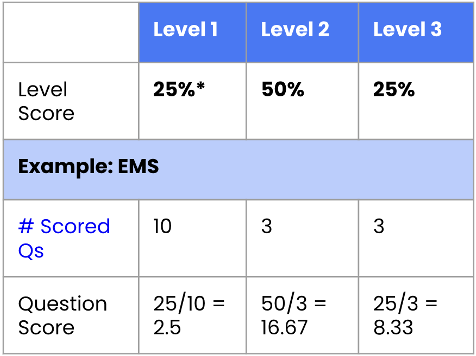
Example of a Higg Score. Source: Cascale Higg FEM 4.0 Scoring Methodology
Facilities must meet Level 1 requirements before they can meaningfully score in higher levels, which reinforces a step-by-step improvement model.
Importantly, the score reflects:
It does not directly measure:
Because of this, two facilities with similar Higg FEM scores may have very different environmental footprints.
Brands should therefore use Higg FEM scores primarily for:
Rather than as a standalone indicator of environmental impact.
For factories, the Higg FEM score increasingly influences relationships with global brands. As mentioned before, it is no longer allowed to publicly share a Higg FEM score. Private sharing is still allowed, providing a means for brands to benchmark performance (e.g. through the Insights Hub, see further down in this article).
Higher scores can support:
Lower scores often reflect gaps such as:
However, the tool is designed primarily for continuous improvement, not compliance enforcement.
There are two types of Higg FEM results:
Self-Assessment
Completed by the facility internally.
Verified Assessment
Reviewed by an approved third-party verification body.
However, under the current verification approach, facilities complete the entire Higg FEM questionnaire, but verifiers review only a subset of key questions rather than checking every response. These verified questions primarily focus on foundational environmental practices and quantitative environmental data, such as energy use and emissions.
Facility profile
Scoring
Environmental performance sections
Management practices
Verification status
Benchmarking
You can find visuals of the Higg FEM assessment here
Although Higg FEM is often discussed as a yearly questionnaire, it is part of a broader ecosystem of tools designed to support environmental data collection and analysis across the supply chain. We mentioned some above, but we’ll focus further on supplier-relevant systems here.
Two important complementary tools are Higg Facility Data Manager (FDM) and the Insights Hub. Together, these tools help companies move from annual reporting toward continuous environmental performance tracking and analysis. Images of how Higg FDM and Higg FEM can be found here.
The Facility Data Manager (FDM) is a tool that allows facilities to track environmental performance data throughout the year.
Instead of collecting all data once per year for the FEM assessment, facilities can enter operational data monthly, including:
This improves data accuracy and makes it easier to monitor environmental performance over time.
FDM integrates directly with the Higg FEM assessment. Data entered throughout the year can automatically populate parts of the annual FEM questionnaire, significantly reducing the amount of manual data entry required.
In fact, the Facility Data Manager can capture up to 100% of the Level 1 quantitative data required in Higg FEM, allowing facilities to streamline the reporting process.
The Insights Hub is a data analytics platform built on top of Higg assessment data.
It allows brands and suppliers to analyze environmental performance across facilities and identify opportunities for improvement.
Typical capabilities include:
The platform aggregates environmental metrics collected through Higg FEM and allows organizations to compare results against global or regional industry averages.
For brands managing large supplier networks, these analytics tools help translate the large volume of Higg data into actionable insights. Click here for a video on the Insights Hub
The Higg FEM generates a very large dataset.
Each question in the assessment corresponds to a specific reference ID and data point. When the full dataset is exported, it contains approximately 10,000 variables, covering environmental metrics, management practices, and facility characteristics.
Facilities and brands can export this data from the platform in CSV format for further analysis.
However, because of the large number of variables introduced in newer FEM versions, the entire dataset can no longer be exported into a single spreadsheet due to Excel’s column limits. Instead, the data must be exported across multiple files or analyzed using dashboards within the Higg platform.
For brands working with hundreds or thousands of suppliers, this dataset forms an important part of their supply chain environmental reporting and analytics infrastructure.
Despite its widespread use, the system has several limitations.
Common challenges include:
The upcoming move toward core verification reflects an effort to improve data quality across the system.
*It’s important to note that Higg has other modules, such as Higg Materials Sustainability Index (MSI) and Higg PM (Product Module).
Despite its challenges, Higg FEM has become one of the most widely adopted environmental assessment frameworks for apparel manufacturing.
The system helps the industry:
Verification adoption has grown rapidly, with assessments now conducted across more than 80 countries worldwide.


Environmental intelligence platform - built for apparel and footwear brands, and their suppliers.